Speakers are, of course, the most difficult of all components to evaluate, even in the best of circumstances. This is because they are the least perfected of all the components and that doesn’t even take into account room requirements and sonic priorities.
In my case, I also have the added burden that two of my main contributors are (or were) speaker manufacturers, some of whose products you will see as References below. Other associates are distributors of speaker lines. Accordingly, I made the only decision I could:
What I say to those who question my objectivity is; please closely read the rest of the References first to see my consistency and sensitivities, before making judgments on the few choices you may be understandingly skeptical about. Any final and true judgment concerning these (or any) specific components requires a personal listening session with them. If this list inspires such an event, it has been a success, no matter what the ultimate result.
This is the component category in which I believe that I am most behind the curve. While I am very confident that all the speakers that are included deserve to be there, I am just as confident that there are at least an equal number of others that are missing. I have heard some of the missing, but I haven't yet made the in-depth evaluations and comparisons that are a requirement for their inclusion.
Important Distinction: In my "Priorities and Distinctions" section within the main Reference file, I emphasized the primary importance of musical "low-level information", which must be reproduced if a component is to be included in this list. I also used the word "accurate" before that expression. I feel this component category requires a further distinction and an exception, because of its unique nature.
All components, except speakers and cartridges, are generally accurate; at least when focusing on timbres and phasing etc. They have other problems; like losing information, dynamic compression etc. That's the reason for my choice of priorities. However, speakers have much more serious problems than the other components, which means you can't even assume that their basic timbre and phasing are natural and accurate.
Accordingly, for many audiophiles, getting the timbres correct (accuracy) will be their first priority within this category, while "completeness" will be secondary, though still very important. I generally agree with them.
There are a growing number of loudspeakers, usually large and extremely expensive, that require the use of large, costly, complex and inferior amplifiers to help overcome their problems of design. These models are either downgraded or not References at all. Almost every speaker I have ever heard that has low sensitivity, and a difficult impedance, has the same problems; they sound dry, mechanical and compressed.
Playing these speakers unnaturally loud, with the use of (usually very expensive ) high-power amplifiers, which usually have the same sonic problems, is a solution that actually compounds the problems. The only beneficiaries of this strategy are those who build, market and sell these expensive and usually (grossly) overpriced components.
If all that wasn't enough, they also have a serious problem with retaining the desirable sonic quality of cohesiveness, which one reader described as the characteristic of the entire frequency range "being cut from the sameAcapellaThis is very difficult to achieve with multiple drivers, crossover points etc. In reality, these products are actually designed for people looking for "prestige", rather than the accurate reproduction of music.
TopThe Sadurni Staccato Max is a large 4-way horn system (including its self-powered subwoofer). It is, simultaneously, both a new direction in speakers for me, while also the culmination of a personal trend going back for more than 3 decades (increasing speaker sensitivity).
The Sadurni Staccato Max review is currently being posted in sections (see the link below). The review will be quite lengthy and exhaustive, as befitting such a serious component/system change, with my usual commitment that all of the important events, experiments and details will be completely revealed within the review.
The Acapella TW 1S was added to the Class A Reference Speakers back in January 2004. This action was somewhat unusual since I had not heard the tweeters in my own audio system, or even in a friend's system that I was familiar with. Instead, four straight days of concentrated auditions, at the 2004 CES, compelled me to give them the recognition I felt they deserved. An associate, who was with me for the entire duration of the CES, fully agreed with my sonic assessment. We were both simply far too impressed with the Acapella to do anything else.
At the time, I wrote a short description of the TW 1S (now removed) which couldn't have been more positive and, even after more than 13 years, I think it still held up for the most part, though with some reflection, as well as some recent events, I felt forced to qualify my most extreme statement. Now in 2017, I am actually living with these super tweeters. Further, I have extensively experimented with them, and two other highly critical listeners have also heard the results in my system as well. One of these two extra listeners assisted me in the experiments.
Below are the results of the experiments and our numerous listening sessions. Finally, I felt a general discussion of super tweeters is also appropriate, if not a requirement, at this time.
However, first we must start at the beginning, a few decades ago now, for the necessary perspective.
Back in the early 1980s, at one of the Chicago CES (late spring) shows (long gone and sorely missed), I was able to extensively audition the Hill Plasmatronic speakers. It was a truly unique design, with its plasma driver going down to (a still unprecedented) 1,000 Hz! The sound was unsurprisingly amazing in certain ways, but it also had the easily predictable problem of cohesion (try successfully matching a massless plasma driver to any dynamic driver, at 1,000 Hz no less). Unfortunately, the Hill was also expensive and impractical for even the most serious audiophiles, and only a few were sold (though enthusiasts of this unique design are still around, see Links below). However, plasma driver fans would have another choice, the Magnat MP-02, which was manufactured in Germany. Even better, I was able to audition the Magnat in my own system, with two audiophile friends (one of them was the owner of the Magnats, the other an employee).
Unlike the full-range Plasmatronics, the Magnat plasma driver was strictly a super tweeter, designed to replace, or add to, an existing tweeter. I can't remember the specific crossover frequency, or whether it was even adjustable, but I do very well remember the sonic results and one other critically important factor. My best recollection of the system we used (around 1989) is this: Versa Dynamics II turntable/tonearm, Jadis JP-80/Jadis JA-80, Wilson WATT II and Entec subwoofers. The Magnat was placed on the top of the WATT II. My listening room was around 24' X 20', with a 9.5' ceiling.
To put it simply, the sound of the system was transformed. It was one of the largest and most significant improvements I had ever heard with just a single component change. The Details?...The soundstage was not only much larger, but better focused, with a separation of instruments I had only experienced before with the Morrison omni-directional speakers. Not surprisingly, the speed and the extension in the highs was in a class of its own. The sound was also incredibly natural, pure and clean. Overall, it was an audio revelation, something audiophiles live for and dream about, but rarely experience in actual life. I would have obviously purchased a pair of the Magnats immediately (for myself and my store), but there was one very serious problem with them...
The Magnat released ozone into the room, and in large quantities (unlike the Acapella or the Hill Plasmatronics tweeters). My listening room was pretty large, but not nearly large enough to absorb the ozone that was released. There wasn't an unpleasant smell, but the air felt so "heavy" that it was now actually difficult to simply breathe. I also started feeling light-headed. So I would spend a few minutes listening, leave the room, and then return around 5 minutes later. This was repeated all evening.
Meanwhile, my two friends, who were apparently completely unaffected by the ozone, stayed in the room during the entire evening, never once complaining about the air in the room, even though they told me it was easy to notice the change. Fortunately, they accommodated my wishes when it came to playing my personal LP References, so I was confident of my evaluation of the Magnats, despite the fact I heard them for a relatively short period of time. (For the record, my two friends completely agreed with my highly positive assessment of the Magnats' performance.)
Accordingly, I permanently ruled out the Magnats after that evening, though the dream of owning a pair of ion super tweeters, without the health drawbacks, would remain with me. In the end, it took more than 25 years to realize this dream. This brings us to the present and my experiments with the Acapella TW 1S Ion Super Tweeters being used with (a double pair of) the Coincident Pure Reference Extreme speakers.
I purchased and received the Acapella tweeters in June 2015. I could only afford them because I received a once-in-a-lifetime "sweetheart deal" from a distributor (who I've known for 40+ years now), basically the OEM price. I could provide a number of common "excuses" for the unusually lengthy delay in auditioning the tweeters, but the main reason was that I strongly felt I required some assistance, not only for positioning and basic set-up, but also to ensure a thorough and competent evaluation, which I could then post with confidence. Unfortunately, one by one, my associates cancelled their plans to visit me for various reasons until, finally, Jean Nantais (of Lenco fame) visited me as planned in April, 2017, and eagerly agreed to help me with the experiments.
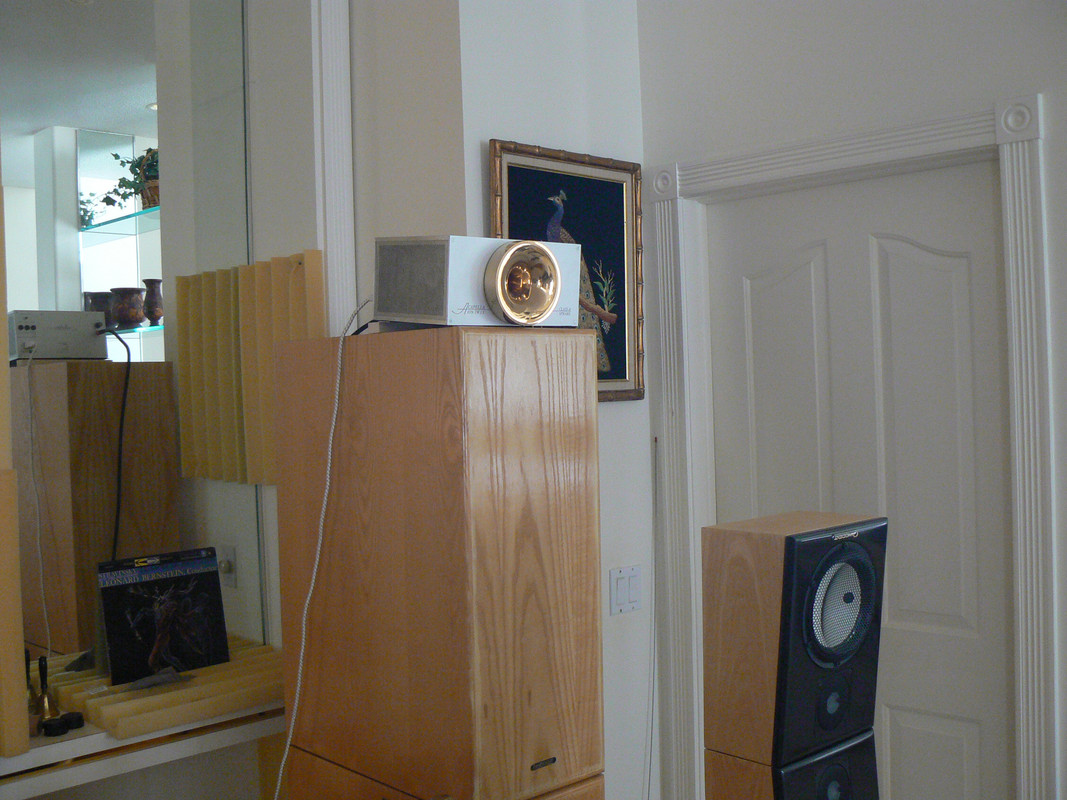
The reason why I felt I required assistance with the Acapella TW 1S was simple; The tweeter was much heavier and bulkier than I imagined, even though I had seen pictures of it and had read the relevant specifications (it includes a built-in amplifier and crossover). However, once I actually handled it, I knew immediately it was impossible for it to safely fit on top of the Pure Reference Monitors (my obvious first choice, which proved to be a fantasy). Considering my "options" at length, I soon realized there weren't any. In fact, there was only one real option...
Short of building custom stands for them (which would take up space I didn't have, even while ignoring the extra cost), all I could do was place the tweeters on the tops of the Pure Reference Subwoofers!? Yes, the resulting issues and questions with this "solution" are both obvious and inevitable: 1. Will the vibrations from the subwoofers compromise the tweeters? 2. Will the extra height of the subwoofers, and their backward position in relation to the monitors, compromise the cohesiveness of the signal and music? Only actual auditioning would answer these important questions, as you will find out below.
Meanwhile, I had the first basic logistical question to answer: Would I risk placing the tweeters, all by myself, on top of the subwoofers? For me, it required a ladder and extremely steady arms and hands. One serious slip had multiple consequences: A broken super tweeter for certain, plus most likely either a broken amplifier (Frankenstein 300B) or a broken speaker (Pure Reference Monitor), since both of them are directly below the subwoofers. In the worse case scenario, maybe all three components broken at the same time. Further, even a slight slip meant the top of the subwoofer would be seriously scratched. I felt that while such a catastrophe had maybe only a 5% chance at most of actually occurring, that 5% was still too much of a chance for me to take. Thus 22 frustrating months went by.
Jean Nantais (JN) and I spent 4 days and (late) nights experimenting with these tweeters. We positioned, removed and re-positioned the tweeters multiple times, taking turns lifting them into position. I did all the crossover work, including the important calculations, along with the capacitor choices and soldering (see pictures below). Jean, in turn, helped me to acoustically isolate the tweeters from the subwoofers, properly angle them for optimum cohesion and also make certain that they would never slide off the subs.
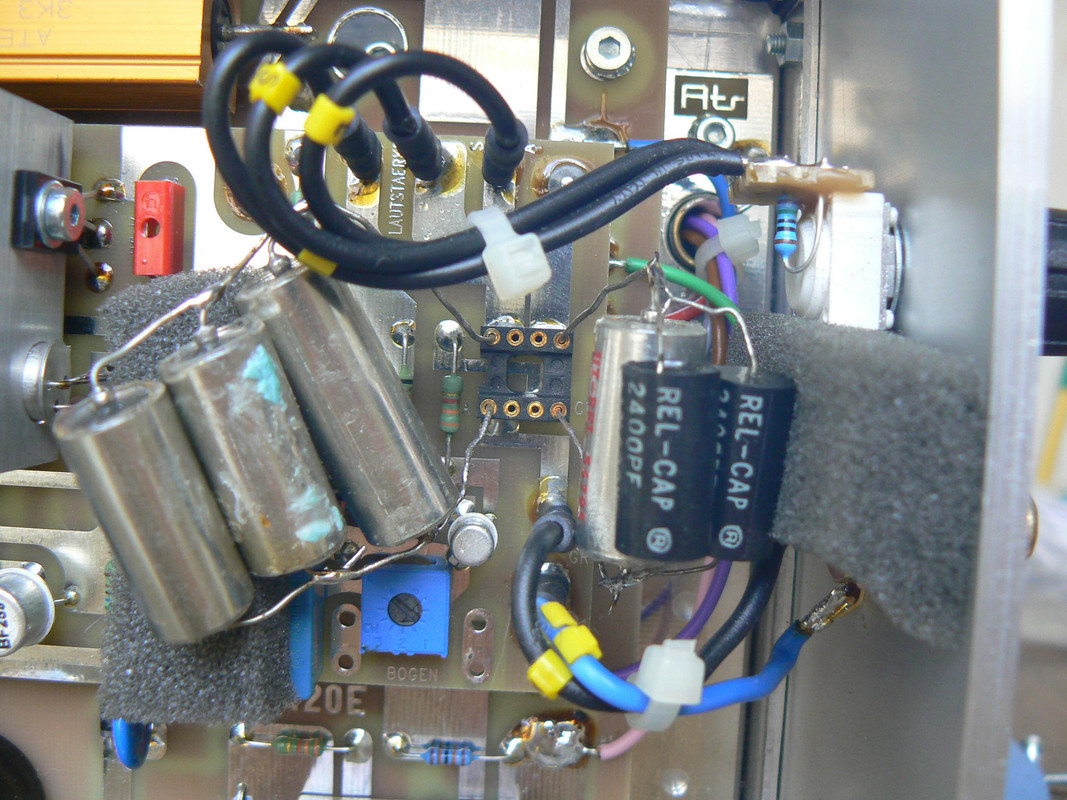
Further, some basic information: The tweeters have an RCA input, since they have their own dedicated tube amplifier. The volume control is external (in the rear), but the crossover is inside the unit, requiring a side panel to be removed. Changing the crossover frequency requires inserting specific capacitors into tiny slots (see picture below). The Acapella crossover is 12 db/octave (second order). The stock crossover frequency is 8500 Hz. The tweeters turn on automatically, in stages, when they sense a moderate level signal (like many contemporary subwoofers), and they also shut off automatically when they sense no signal for around 15 minutes.
Finally, the actual results...
Nantais and I didn't get to the Acapella super tweeters for a few days. His last visit was three years ago (2014), so we decided to first re-optimize the (Reference Lenco) turntable and the phono system. By the time we finished the phono optimization, we had improved sonics along with the added bonus that JN had re-familiarized himself with my system and could now easily notice slight differences.
As it turned out, our first experiment, conducted initially in the afternoon and then later in the evening, actually consisted of two separate and independent "stages". The most important experiences and insights, specifically about the Acapella (positive and negative), as well as about super tweeters in general, were acquired during these two first stages. The two remaining experiments, discussed below, were also illuminating, but they are more accurately described as refinements in comparison to the "big picture" results of the first experiment.
First Stage- After the tweeters "snapped on" and the system warmed up, the first stage commenced with JN and I listening intensively. Frankly, neither of us was impressed, initially or even after an extended period of time. In fact, we both soon began to wonder, eventually out loud to each other, whether the system had actually gone backwards with the addition of the super tweeters. Yes, we could easily hear the extra high frequency extension and speed, but everything else was somewhat "confused" and imprecise. Overall, this was a major disappointment. So we obviously asked ourselves, what could be the cause of the problems?
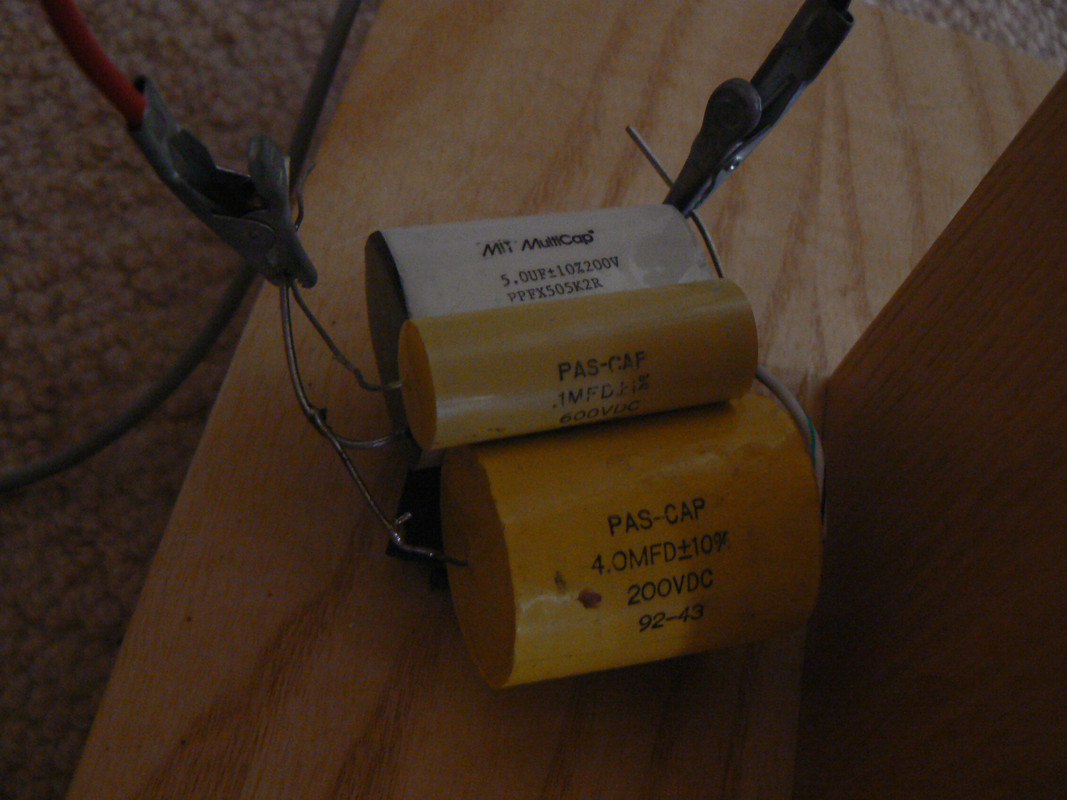
It could not be subwoofer related, because they weren't even turned on at this point (it was still in the afternoon and I rarely turn the subs on during the day). Further, the music we played wasn't even that challenging. Fortunately, I had anticipated exactly this kind of result and had planned for it. I asked Nantais to leave the room, to remove any bias on his part, and made a single change to the system: I now rolled-off the PRE monitors above 8,500 Hz (the exact same Xover frequency as the Acapellas), using a capacitor network going from hot to negative (see picture).
The Details- Prior to JN's visit, I had opened up the Acapella cabinet to learn the stock Xover frequency. I then researched the PRE monitor's impedance (two of them in parallel), used the standard crossover frequency formula, and built a high quality (all film and foil) capacitor network to roll-off the monitor at the same frequency as the Acapella. I used wires with alligator clips, allowing me to use the caps, or remove them, in seconds. (I asked JN to come back after an appropriate period of time, which wouldn't tip him off, and we began the "second stage" of our listening session.)
Second Stage- We both noticed a dramatic improvement almost immediately. While the sound still had the extension and speed we heard before, it was now also highly precise and intelligible, instead of being diffuse and congested. The sound was also cleaner, with greater instrumental separation, as well as improved focus. The soundstage was better defined, with a much clearer sense of the recording space, and the decays lasted longer and in a realistic manner. It was like hearing one natural voice again, instead of two artificial voices arguing and interfering with each other.
So we had found "the critical key" for a successful implementation of the super tweeters, and through direct experience; The monitors had to be rolled-off as well, at the same frequency, or they would noticeably interfere with the super tweeters in a disastrous fashion. In short, the high-pass super tweeter crossover frequency had to match the crossover frequency of the low-pass (monitor's) tweeter. If this was not done, there would be "sonic chaos" in the entire frequency range in which the two tweeters simultaneously played. In this case, between 8.5K and 20K+ Hz.
We next experimented with the volume of the super tweeters, matching them with the monitors' tweeters and, after being satisfied with the results, we shut the system down for the afternoon. Later that same evening, we turned the system back on, this time including the subwoofers. We first went through the afternoon play list, but eventually played some highly demanding music as well. We listened closely for any sonic problems that we may have missed in the afternoon session, expected and unexpected, especially now that the subwoofers were engaged and the potential problems they brought along.
Here is what we also discovered through these initial day and evening experiments:
1. The subwoofer vibrations did not cause any noticeable problems, and we listened specifically for them. This was verified many times by playing the same recordings with the subs off and on, and was verified again when my second friend visited me a few weeks later. This result was not surprising when you think about it. The Coincident subwoofer has outstanding cabinet structural integrity (150 lbs each). Better, its top plate is extremely thick, and the tweeter is located at its deadest part, the front joint. The Acapella is even further acoustically isolated with some damping material which we installed.
2. There was also no noticeable problems caused by the location of the super tweeters, with its extra height and distance from the monitor's tweeters. The focus and separation were outstanding, even better than before. There was absolutely no "fun house mirror" effect, that can be noticed with out-of-phase reproduction. However, it did take careful positioning and the angling down of the super tweeters to achieve the optimum level of performance. We first used paperback books, though we eventually used Nantais' much more elegant and functional "little isolation platform".
3. JN and I also listened to the monitors rolled-off above 8.5k, and with the super tweeters turned off as well. The end result was now a "mellow and sweet" speaker, but surprisingly satisfying, mainly because most of the high frequencies were still present. I can understand why someone would prefer this type of sound, especially with poor recordings (digital and analogue), even though it is not true "hi-fi". Actually, I once had plenty of customers who preferred speakers with a "forgiving" sound. JN had the last word, he said "it sounds just like a vintage speaker".
4. We even listened to the Acapella super tweeters on their own (to break them in without having to turn on the entire system). We were surprised yet again. This time we couldn't get over how much of a positive effect the super tweeters were making considering how little actual sound we observed coming directly from them on their own. In fact, at certain times it almost sounded like virtually nothing was turned on and playing.
5. Finally, we also heard another benefit from rolling-off the monitors' tweeters: The listening "sweet spot" had expanded from just one seat in the middle, to all three seats. While this obviously wasn't important to me when listening by myself, which is 90+% of the time, it is important when I have guests. Since I had lost the two side seats when going to double monitors per side (which meant two tweeters per side), I can only surmise that the roll-off decreased the interference caused by the two Coincident tweeters operating simultaneously in the highest frequencies.
Our first night's listening sessions lasted until very late in the evening. I was exhausted, but still excited, especially considering how we had overcame the disappointing initial results. I also had another reason for my excitement. I was acutely aware that the stock crossover capacitors in the Acapella were basically "junk" (and that is being kind), which meant that there was plenty of room for improvement (the double-edge sword), so I was really looking forward to our next day's experiments.
The next morning I did an inventory of my small value (.02 uf or smaller) capacitors, new or used. All of them were either Teflon or polystyrene (2nd best to Teflon in my experience). Most of them were in the picofarad range. I soon discovered that I was not able to exactly match the 8.5K crossover frequency of the internal stock capacitors, but I came pretty close, 8K. I didn't believe such a small (Hz) difference, by itself, would be noticeable. I also discovered that the capacitor insertion openings were too small for the V-Cap Teflons, so I used the REL cap Teflon caps instead. I also, of course, lowered the roll-off crossover frequency of the monitors to 8K as well, so there would be no overlap in the system frequency range.
The system was powered up and we listened once more to the same (now by default) reference recordings from the previous day. Once again, we almost immediately heard an easily noticeable improvement. However, we also agreed that it was definitely smaller, in both scale and importance, compared to the critical improvement we experienced the previous day. The sound was even purer than before and there was also a greater sense of the original recording space, which is an important element if the goal is to "take down your guard" and help you believe what you are hearing is "alive" and "real".
I was quite happy with our efforts at this point. I also wondered whether anyone else had ever changed the Acapella's internal crossover caps to the best available, or was I the first? There was no previously written/posted record of any capacitor upgrade that I could find anywhere, and, to put it simply, if you don't use the best capacitors, then you will never hear the full capabilities of the Acapella ion tweeters. Meanwhile, we now had to make another decision, this time concerning the crossover frequency.
The only option I ever considered was attempting to lower it, but how low? I knew we should try 5K eventually, which is the lowest frequency limit of the Acapella (without any sonic compromises). My first inclination was to change the frequency in two separate stages: first from the current 8K to 6.5K, and then go from 6.5K down to 5K. However, after first discussing this scenario with Jean, and contemplating all the extra work that was required to build four crossover networks and installing/uninstalling them, plus the added changes necessary to roll-off the monitors, also at different frequencies as well, we decided to go to 5K immediately, and skip the 6.5K interim step (which became "Plan B").
It was a long and tedious job to change the crossovers of both the Acapella tweeters, plus the Coincident monitors (see picture). We had no idea what to expect, since it could be incredible, or a disaster in a worst case scenario (a cohesive, a spectral and/or a phase total mismatch). As it turned out, it was a complete success. There was another improvement, definitely larger than the second experiment, though still not quite as important as the first (Second Stage). Overall, this was a very satisfying change. In fact, when I considered the overall cumulative improvement in performance, starting from no Acapella tweeters, I had reached the (crossing the Rubicon) point where I could now genuinely state, with conviction, that "I couldn't live without them". This was no longer simply a nice refinement, what we were listening to now was effectively a new speaker, which was also literally true. The details...
The mid and extreme highs were still the same, meaning the added extension and purity didn't change. However, the lower highs and upper midrange did change, and all for the better, which had a large impact in many areas. There was first a greater overall feeling of immediacy and presence. Most instruments were now faster, cleaner and more precise. This was especially noticeable with the percussion family, but it was also true with any instrument operating in the higher frequency ranges. These improvements included all voices, and especially sopranos. The sense of space and natural decays were also once more enhanced. Further, the musicians playing at the back of the soundstage were now better clarified.
Overall, this improvement was major in scale. It was only less important than the "Experiment One-Second Stage" because that one change critically removed the monitor's tweeters' interference, thus enabling all the benefits of the ion super tweeter to be heard in the first place.
While both Jean and I were excited with the results of the new Teflon 5K crossover point, we decided that after all these different changes, we should go back to the very beginning, and once again audition my audio system without the Acapella tweeters playing. We did this for two reasons; first to allow us to hear, and appreciate, the entire extent of the sonic improvements and, as a bonus, it would also make it easier for us to make any adjustment, if required, to the volume level of the super tweeters in relation to the monitors.
This was a difficult task, and required a second person for verification (another reason why the audition delay was necessary). Changing the volume level of these super tweeters is similar to a VTA change (or even using "tone controls" in many decades past). We ended up using only a few discs, all of them CDs. CD was our best option in this instance because we needed a source that could be played multiple times quickly and without any sonic change (potentially caused by vinyl deformation and/or volume). We ended up choosing high quality recordings using jazz horns and woodwinds, plus piano and some ancient music as well. In the end, the jazz instruments were the most revealing and important, and in particular one CD: Blue Sun - Mark Isham - Columbia CK 67227.
Our Methodology- As discussed above, to first establish a reference we could trust, we went back to the Coincident Pure Reference Extreme playing strictly on its own. To our surprise, it sounded much better than we expected, which could only mean that the Coincident tweeters are truly superb. (They are still the finest dynamic dome tweeters I've ever heard overall.) We played the reference CDs until we were ultra-familiar with them, and then we went back to the Acapella ion super tweeters and played the same CDs all over again.
The ultimate goal was for the sound to be both as accurate and realistic as possible (yes, they are closely related). We quickly discovered that with improper settings the system could sound either "forgiving" or "aggressive". (Both are equally wrong, but the former is popular and desirable to many pseudo-audiophiles, while the latter is almost universally avoided.) In general, the "most accurate and realistic sound" offers; the greatest diversity, the least predictability and the smallest noticeable (and least describable) character. From a purely practical perspective, the end result should sound as if the original tweeters have simply been improved, and with no sense that there are two different tweeters with two different characters. The good news- after a couple of intense hours of back-and-forth, with increasingly smaller incremental volume changes, we achieved all of our goals.
A few days after Jean Nantais left, another audiophile friend visited me for a couple of days (he would also visit me a second time around a month later, which was also important and described below). I'm glad he did, because his opinion of the ion super tweeters was more critical than either Jean's or mine. It's not that he heard something that we did not, but rather the weight he placed on what he heard. This requires a detailed explanation:
Unlike Jean and I, my friend had mixed feelings when first auditioning my system with the new tweeters. He observed and enjoyed all the sonic benefits of the tweeters operating at 5K as described above, as we had. He was also quite surprised, as again we were earlier, that the unusual positioning of the super tweeters didn't cause any noticeable problems, even when he was directly listening for them (in fact, he had even warned me earlier about them). However, he still felt that a different sonic downside came along with all the benefits.
My friend argued that the ion tweeters had enhanced the perceived speed of the system in the midrange. This enhancement, in turn, increased the already existing speed differential between the midrange and the bass, which is, of course, inevitable when using different bass and midrange drivers. In other words, the inherent midrange/bass driver dichotomy had crossed his personal threshold, meaning it was now an active problem that he could no longer ignore. He described it as "disjointed".
His specific example was the contrasting left and right hands performing on a solo piano. He felt that while the two hands will always sound somewhat different, as they had in the past, this difference was now more noticeable with the new tweeters. Worse, it had reached that critical point where it now bothered him. My friend also emphasized that this particular problem was only audible with "simple music", where a single instrument was individually exposed. By contrast, he felt it was completely inaudible if the music was "complex", with continually changing volume levels, frequencies and instruments. I generally agreed with him concerning the simple/complex music issue, but I had a different subjective response to the midrange/bass issue on simple music. I felt the change was relatively subtle, and ultimately a trifle compared to all the benefits of using the Acapella super tweeter.
My Friend's Second Visit- This was a month or so later, and my audio system had changed again during this short period (details forthcoming), and this particular change had improved the bass reproduction. In fact, the improvement was significant enough, in my friend's estimation, to change his perspective. In short, he now felt that the midrange/bass problem, while still noticeable, was once again small enough to be easily ignored, and so he left a happy man.
The Acapella Ion Super Tweeters have proven to be as outstanding and unprecedented in a real system as they were at the 2004 CES, where and when I first heard them. So, I reiterate; The Acapella is the finest tweeter I have ever heard. However, in my original article I also wrote that "This may be the most perfect component ever manufactured in audio history". This statement now has to be qualified, as "The Truth" line stage has replaced the Acapella for that highest distinction, at least in my opinion.
Consolation Prize - The Acapella is still the most perfect tranducer I've ever heard. As far as I'm concerned, from my perspective, I now have a new, and significantly superior, speaker system. You can't ask for more than that.
The Acapella also epitomizes the inevitable and critical distinction between a "Reference" and a "Recommendation". While it's my ultimate speaker reference, I would still only advise a small amount of audiophiles to ever consider purchasing them. Why? Their price is the obvious issue. At $ 18,000/pair, the Acapella is simply not cost effective in 99% of audio systems, despite all its sonic strengths. Also, and almost as important, the Acapella tweeters require skill and patience to be heard at their very best, as I have described in detail above. In short, it's a serious project to optimize them, especially if the owner wants to closely replicate what I have now accomplished in my own system.
However, the Acapella, unquestionably, still has a legitimate place in the audio marketplace, mainly because of its unique sonic capabilities. As for its price, this is, in the end, relative, because we should not forget that there are now even cables which cost much more than the Acapella, and they all have far less positive impact on the final sound.
Further, to hopefully assist potential purchasers, I've listed below some experienced-based reasons (or arguments) to seriously consider purchasing the Acapella tweeters, assuming they are affordable in the first place, and that they can also be successfully utilized in an existing audio system. These "reasons" are in addition to the pleasure gained from simply hearing its unprecedented performance:
1. The knowledge that it is not only the best of its type, but also that it can't be improved upon, so it is effectively a final purchase. This is not just pride and "ego". It is also a practical purchase and even anxiety reducing in the long run (which many audiophiles can appreciate).
2. Once it is properly optimized in a system, you gain the practical knowledge, and confidence, of knowing that if there is now an audible sonic problem in the highest frequencies, it's not the tweeter's fault, thus saving time, and reducing anxiety, looking for the actual source.
3. The Acapella will reveal and expose the strengths and weaknesses of any audio system, and any component or musical software that is utilized within that system, existing and in the future. In short, it's also a "tool" for experimenters, both pros and amateurs.
Finally, and at the risk of repeating myself, I believe the Acapella Ion Super Tweeters should be heard by all serious audiophiles (which, because of Acapella's extensive speaker line, will be a lot easier than ever hearing the Magnat). This is because it is vitally important, if your personal audio growth is a priority, to always know what the best components actually sound like in real life, and this concept is especially applicable to the Acapella TW 1S.
Long before I had any experiences with massless super tweeters, I owned the RTR Electrostatic tweeters for years (both the ESR-6 & ESR-15), plus a few ribbons as well. All my experiences with these tweeters were positive overall, even though I realize now that none of them were fully optimized to my much more critical standards of today.
Accordingly, the purpose of this article was not just to report on the Acapella, but rather to hopefully encourage the readers of this website to at least once audition a good quality super tweeter in their own system. It doesn't have to be "the Acapella or nothing". I realize the cost of the Acapella is prohibitive, even if you get a deal like I did, or find one used at a big discount, but that's still no excuse to completely avoid all super tweeters.
A few full-range speakers already include super tweeters, arbitrarily defined by me as going to 40K minimum flat, but that is rare, so almost all speakers are candidates. (Speakers with extended, but poor and distorted, highs are also candidates.) The fact that even the superb Coincident Pure Reference Extreme was able to be improved is dead proof that virtually any speaker can be improved.
Fortunately, there are other high quality super tweeters available on the market, new and used, and I believe that even if they are not quite as good as the Acapella, they should still provide an important sonic improvement. Before the Acapella arrived, I was seriously looking at several other models myself, for years now actually (such as the Townshend Maximum, even though I realized that its low sensitivity would most likely be an unsolvable problem). These super tweeters can be an incredibly cost effective investment, with far greater long-term sonic benefits than another over-priced cable or even an amplifier change.
All the non-massless super tweeters I've seen, or read about, have two important advantages over the Acapella; they are affordable for most audiophiles, plus they are a lot smaller and less bulky, making them much easier to position and optimize. However, they don't have built in amplifiers, as does the Acapella, which is one of the reasons why they are less expensive, and also why they may be less flexible when matching sensitivities, which is critical.
Finally, I'm concerned with the reviews of various super tweeters I've read on-line. None of the reviewers went to the lengths I did to remove and optimize the overlap of the super tweeter with the original tweeter. Sometimes it isn't necessary, though only if and when the crossover point is extremely high (and the original tweeter attenuated in the highs). However, in most instances, it is an absolutely critical requirement.
A super tweeter is a component that must always be taken seriously, even if it appears physically small and inconsequential, because the set-up is critical (see above). It should never be simply thrown into a system while hoping for the best. Think of it almost like a phono cartridge, with all of the care and precision that component requires to sound its best. If that is your perspective, and you have patience (plus a few good friends), the implementation should be successful.
Below are links to information concerning the Acapella, Townshend and any other super tweeter that appears to have serious potential. There will also be links to reviews and threads that I feel may also prove helpful.
Relevant Links:
Further information on the Acapella
Townshend Maximum Super Tweeter
Engima Acoustics Sopranino Electrostatic Super Tweeter
Hill Plasmatronics Dedicated Website
Audiogon Townshend Super Tweeter Threads
Murata ES103a - No direct link available. Google name for information.
Note- The foam is being used to dampen the capacitors' micro-movements, which could be the cause an audible distortion.
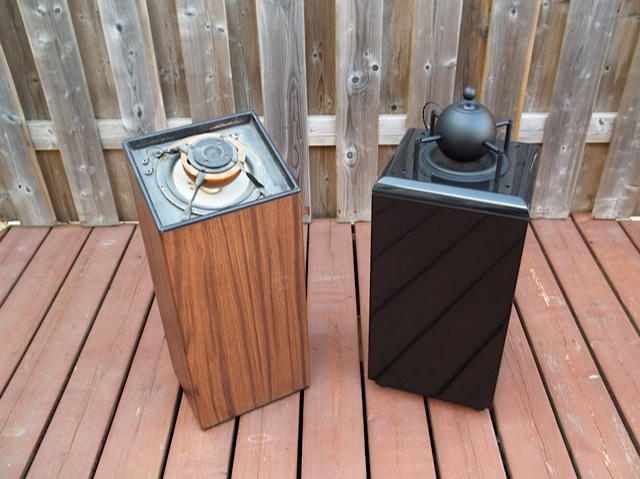
For a 16 year period, the Pure Reference Extreme (PRE) was the finest speaker I had ever heard overall, and my top "Reference". It replaced my former 10+ year "Reference", the Ars Acoustica System Max. These two speakers are very similar in their basic design philosophy, though their execution is quite different, mainly due to a decade's worth of improvements in (dynamic) driver technology. The PRE is also unusually practical: It is flexible in the choice of both amplifiers and listening rooms.
Since I obviously don't change my speaker references very often, I felt it was necessary, in 2008, to discuss my basic philosophy on speakers. This discussion included the long-term history, and evolution, of my personal speaker references, plus the specific and detailed reasons why the Coincident Pure Reference Extreme had achieved its current status at the time. Further, the scope and length of this essay eventually required the creation of a dedicated file.
Accordingly, the lengthy review/essay on this speaker can be found in the dedicated Coincident Pure Reference Extreme File.
Until 2024, the Avantgarde Duo was the finest horn loudspeaker I had ever heard, and I've heard plenty of them over the years. Amazingly, it isn't even their top-of-the-line model. Their best model, according to the manufacturer and distributor, is the Trio. Sadly, the Trio wasn't at the 2004 CES, which is where and when I heard the Duo.
The Duo is the first horn loudspeaker I've heard that doesn't have obvious horn colorations. It also disappears as well as any horn speaker in my experience. The dynamic gradations are state of the art, just like other well executed horns, but that's not a surprise. Its sense of immediacy and transparency are amazing. It's simply "alive" sounding. We tried to find its fatal flaw, but we failed. It passed a number of tough tests: massed violins, various voices, piano, woodwinds. Most impressively, it did this with digital sources, transistor amplification and ($1/ft) generic interconnect and speaker cable. If that wasn't enough, the listening room was mediocre. Despite all this, it provided the best sound at the show. I've only heard one other speaker in my life sound so good with so many obstacles to overcome. My associate agreed with my assessment, and, if anything, he was even more enthusiastic. The retail price is in the $ 17,000 range, which is expensive, but it obliterated most of the speakers that cost more.
There are two serious caveats:
1. The sound that impressed us so much came from the manufacturer's room, and not the distributor, which had various problems. It's obvious that setup is critical and there was only one listening seat that was optimum in both rooms.
2. Neither of us was even close to being happy with the bass integration, which is the major weak point in the design. It wasn't really bad, but it was still noticeably UN-seamless. This could be a serious (disqualifying) problem for some listeners. The Trio's lower horn goes 70 Hz (170 Hz Vs. 100 Hz) deeper into the bass, which should seriously reduce this problem. (On the other hand, a 3-way horn is inherently less cohesive than a 2-way horn.) The Duo (and the Trio) has its own built-in bass amp and crossover, so that avenue can't be changed for the better. They also make a powered, horn subwoofer called the "Basshorn". They are supposed to be incredible, but they cost around $ 27,000 a pair. The extra (stock) bass modules, used in the distributor's room, did NOT help to alleviate this problem area in our opinion.
I received this letter, in September 2005, from a reader with important information. There is only slight editing:
"...I have read your Reference components list... I was willing to give it a try with the Avantgarde Duo, and went to a showroom of Avantgarde close to my home in Germany. Surprisingly, they managed to give a demonstration of the "classical" Duo with 8 Ohm drivers, and after that I was able to listen to their new Duo Omega. The newer drivers are something to listen to; they are a lot faster, more detailed ... more of everything... After the Duo Omega we heard a Trio, and we liked the Duo´s more coherent soundstage and presentation better."
Personal Note-This is great news! I then asked the reader for further information and clarification. This was his reply, and once again with only slight editing:
"You can find the description for the new Duo Omega here:
http://www.avantgarde-acoustic.de/download/files/
1124898721430c97a175d87.pdf
The dealer was Avantgarde themselves. They have a showroom near Duisburg/Germany. Mr. Krauss was demonstrating the Duo Omega and it was breathtaking compared to the regular Duo. The drivers are much faster. They show more detail, and not in the sense of beeing overly analytical, but in the sense of musicality... The Duos will arrive in December and I will report and send pictures."
Personal Note- I'm disappointed, but definitely not surprised, that it "was Avantgarde themselves" that had the successful demonstration. My associates and I have heard the (regular) Duo on several occasions now, but only the manufacturer was able to impress us to the point of being "blown away" (a popular and overused audio expression from the 1970/80s). Readers should be acutely aware that while these speakers have great potential, it is also quite difficult to realize in real life, at least so far.
Finally, I didn't overlook the reader's remark about liking the new Duo more than the more expensive Trio. There's going to be trade-offs between these two speakers, despite what the manufacturer claims. In fact, I wonder who "we" consisted of? (This helpful reader soon realized even further clarification was required, so this 3rd letter just arrived:)
"The wondering "we" needs obviously clarification. I went to the Avantgarde showroom with a friend of mine with the so called "super-ears", and besides that he is using a self-build speaker that is, in my opinion, the best speaker of my life. It uses compression drivers in conjunction with sherical horns. You see we are horny guys. Unfortunately, it does not fit into my music room. So the Duos are the closest thing possible."
It's no secret that this speaker (which is otherwise outstanding) has problems with the bass frequencies. The integration, in particular, is troublesome to me. They have their own "Basshorns", but they cost a fortune, and are huge. Fortunately, a European reader, who owns a pair of Avantgarde's upscale Trios, may have come to the rescue. He was still bothered by the bass, and had a custom-made pair of subwoofers made. Here's his communication, with some slight editing (English is not his first language):
"Just wanted to share with you my new Trio bass units. As I found the overly eq´d, ctrl 225 pro Avantgarde subs lacking in integration and speed, I managed to get Bert Doppenberg (ORIS horns), in Nunspeet NL, to design 2 custom bass towers for my Avantgarde Trios. Their enclosures are made in a matrix manner, with 82 separate internal chambers. The drivers are Bert's own 15 inchers (2 in each box), tuned to max efficiency (103dB), uneq´d minus 3 dB @ 38hZ.
Since it was easier for Bert to build the enclosures himself, and actually do the tuning in his studio, rather than making a drawing to have them made in Norway, I went down to NL in January and picked them up. After having played around with the passive line filter, to feed the LM3875 based BD30 amp, for a little over 10 months, I now feel I´m close to my target;
They sound like a true extension of the midbass horns of the Trio. The bass lines are actually much better differentiated. The midbass, with two 15 inchers a channel, is fantastic. They have, in my room, a useful output of uneq´d response down to 25hZ, which is more than adequate."
The contact information for Bert Doppenberg is: sales@bd-design.nl
Personal Note- This is really good news for European Duo/Trio owners, who can have the speaker made there and directly shipped to them. Owners in the rest of the world, including North America, will have to purchase the plans, and woofers, and have them made and assembled locally. Still, alternatives are always welcome. Hopefully, someone in North America will also make a suitable Duo/Trio subwoofer.
A reader, with the latest (new Omega drivers) version of this speaker, just sent me a letter with his recent experiments and observations. They may be helpful to current and prospective Duo owners. He is European, so I have done a little editing:
"The Duos are burned in by now, and I used bi-wiring for the midrange and high driver. The bass is connected directly to the preamp, by using the hot lead of the XLR connector.
In this configuatiuon, the sound has changed considerably. The bass has more definition, even though it is still the weak heel of the speaker, but by biwiring, and omitting a few stations in the signal path, the Duos sound somehow cleaner and also faster. Maybe this is all worthwhile for those who are not happy with their Duos."
TopThese were the very first speakers made by Apogee in the early 1980s. They were never reviewed in my memory (which is another disgrace of the audio 'press') and were quickly forgotten when they were discontinued and replaced with inferior models.
These speakers were "classics", a true breakthrough, both in sound and basic design. They weighed something like 300 lbs each and needed a huge amount of current to drive them.
At their best, they were extremely fast, clean, neutral and dynamic, and with a mid-bass I've never heard before, or since for that matter. Their biggest problem was that they required ultra high-current amplifiers, which still all sound relatively dry and mechanical. Without that problem, they would be a Class A speaker. They are (probably) the best dipole speaker of all-time* and can still sound almost "awesome" (a very over, and mis, used word) with proper setup and amplification.
Subsequent Apogee models were almost "like toys" compared to these "Originals" (including the look-a-like Diva), both in sound and build quality, though they were much easier to drive. (The only exceptions were the very early Scintillas and the very late Grands. The Stages were also "good value".) The best amplifiers for these speakers (that I was aware of) were the original, pure Class A, Mark Levinson ML-2. They were only 25 watts into 8 ohms, but 400 watts in a .5 ohm load! They were just what these speakers require for optimum dynamic performance. They must be biamped.
* Their only competition for that title, that I am aware of, are the Sound Labs A-1 and A-3, which I will also be adding to this list.
Finally, to read an extensive essay, originally posted in February 2007, on our many experiences with this speaker, both positive and negative, click here: The Apogee Speaker, Levinson and Krell Amplifiers.
Addendum- An Australian company now builds an updated and improved version of the Apogee Full-Range. I haven't heard it, but a number of audiophiles have been "blown away" by it. In fact, based on every thing that I know, and I've heard from others, I wrote a short article why I believe it may just be "The World's Best Speaker?!"
TopI was a Wilson Audio dealer in the late 1980’s and personally owned a pair of Watt IIs, that I later extensively modified. I am also familiar with many of their subsequent models. The basic WATT design is David Wilson's greatest audio achievement, because it demonstrated, for the first time, the potential of dynamic loudspeaker designs. When it first came out, it may have been one of the finest speakers available, at any price. Further...
I believe the Wilson WATT to be one of the most important and influential audio components of all time. Despite its obvious faults, the design noticeably proved the critical importance of reducing cabinet resonances to the bare minimum, no matter what the effort and cost. This unique achievement has since permanently changed the course of loudspeaker design, to the amazing degree that almost every serious dynamic speaker made today has been influenced by the WATT. It's difficult to imagine a greater audio legacy than that. In short, almost every audiophile, who uses and enjoys dynamic speakers, owes David Wilson some gratitude, even if they are not fans of Wilson's own models. In fact, somewhat sadly...
It must also be said that the WATT (and every other Wilson Audio speaker) has almost always been overpriced, to even absurd levels in recent years. It is also true that all of Wilson's speakers (except the earlier WATTS) have been grossly overrated by a groveling (see TAS #125) and incompetent audio press. However, the WATTS can still be an excellent choice if purchased used and then modified.
Only their cabinets will be utilized, so it’s best to find the cheapest model available. Updated drivers, crossovers etc. can then be installed for a reasonable (not by Wilson!) cost. The end result will be a superb speaker, definitely competitive to Wilson's latest models, purchased at a fraction of their cost, and which even low-powered (SET/OTL) amplifiers can drive (a major advantage).
Avoid all their other speakers. The best woofers that I've heard for the modified WATTS are the better models from Entec (see below). In larger rooms, the Tympani IV Bass Panels (see below) are an excellent choice. There are probably other choices equally as good. Wilson's Puppies (to #V) are "good", but they lack truly deep bass and are VERY overpriced.
Further- A reader, who lives in Hong Kong, recently sent me this (slightly edited) information, which may prove very useful.
"The price for used Watt/Puppies, any models, are fairly "cheap" here in Hong Kong. It's about 50%-60% of what you have to pay for in North America. So, next time when people are travelling to the neighborhood and would like to pick up a pair, this is the place to shop. This also applies to other big name gear, new or used, because the economy here is real bad." (4/04)
One of the all-time "classics", this speaker should have been somewhere within this list from the beginning. The reason for the "oversight" was that I wanted to hear it again with a more "modern" perspective. I was able to audition the most recent version (post 1990), which according to a reader, has improved drivers, horn and crossover.
This speaker has state-of-the-art dynamic range, tremendous detail, a very good sense of "immediacy" and a "huge sound". The efficiency is an incredible 104dB at 1 watt. It is at its best with ultra-low powered amplifiers, including 2A3's etc. This also allows it to capture low-level information. Ordinary tube amplifiers may sound noisy because of its efficiency, while virtually all transistor amplifiers will exaggerate the obvious "horn" colorations that already exist.
It must be placed in a corner to get the specified 35 Hz bass, otherwise it will lose at least 10 Hz. Both of the frequency extremes are missing, which to me is a minor problem, but there is one major problem; some easily noticeable frequency aberrations, which will seriously irritate many, if not most, contemporary listeners. This problem has been significantly reduced by the improvements made in the 1980s, but it is still there.
The speaker weighs almost 170 lbs, and the retail price, for a pair, is $ 5,800. (Compare that to the Wilson Grand Slam etc. for value.) There are many updates and modifications that you can make to this speaker. In fact, I would love, just once, to hear the Klipschorn (fully modified) in an all-out system.
This is a component that is the epitome of the "loving it or hating it" concept. If the listener is amazed on their first listen, there is a good chance it could become "the speaker of their dreams". On the other hand, if the listener is immediately put off by its problems, it is highly unlikely that anything can ever be done to change that first impression.
Klipsch's other models, the La Scala and Belle Klipsch, have the exact same drivers, but they also have smaller cabinets that are not designed for corner placement. Their tonal balance problems are even more pronounced, harder to mask, and they are also more difficult to work with during speaker placement.
This speaker, along with its less expensive siblings, is probably still the most satisfying and safest way "to get into" serious horns, though it will never again be "the best" horn loudspeaker. (see above-for Class A Horns)
Because of its inherent problems, the most accurate classification of this speaker is (Upper) Class C. I did put it in Class B for a while, because of its unprecedented longevity and its reputation as a "Classic", but recent technological improvements have finally caught up with it.
CAVEATS- There is occasionally a "honeymoon" type of experience with this speaker. Some listeners go "crazy" about them on their first listen, but then become tired of them after just a few days or a month. That is the reason why more than one "long listening session" is in order with them before the purchase.
Room Size- The room size must be relatively large, so that the distance from the listener to the speaker is far enough for the speaker to sound "whole" and "cohesive", rather than as three separate drivers. I suspect a 15' to 20' minimum distance should be adequate.
This Reference designation is somewhat in the manner of a "swan song", because the Victory II has recently been discontinued. That's a shame, but according to the manufacturer, the price had already gone from $ 6,000 to $ 7,000 (a pair), and would have risen to $ 8,000 on a new run, due to escalating parts costs. However, since the Victory II will still exist in the used speaker market, and the additional fact that I previously asked Coincident, privately and in public, to specifically manufacture this speaker (something I never did before or after), I feel I have a responsibility to discuss its performance*.
*The description and discussion below applies only to the Victory II, and not the "original" Victory. The original Victory can be upgraded to the VII for $ 1,000. I highly advise getting this upgrade. As of now, late October 2007, there are only 18 pairs of VIIs in existence, and I have one of them.
The Victory II (VII) sounds almost exactly the same as the Total Victory II (TVII). This isn't surprising, since they look exactly the same from the front, and are using the same speaker drivers. The only serious differences are the deeper and more powerful bass of the TVII, because of its 4 extra side-firing woofers, and the increased height of the TVII, which usually provides a larger sound. As I placed the VII on top of a (7" tall) sandbox, and also installed the "Extender Feet", I virtually eliminated the height difference. Further, I am also using (the Ars Acoustica) subwoofers, as I previously discussed (in theory) on this website. Thus, I'm hearing the VII at its highest potential. (Though I have also heard them without subwoofers.)
In general, as with the TVII, the VII, especially with a subwoofer, is superb in virtually every area of performance. It is highly neutral, immediate, transparent, fast, detailed, delicate, clean and dynamic. If anything, its sound-floor is even lower than I expected (based on my memory of the TVII). In fact, with the one possible exception of the Ars Acoustica System Max, it may be as low as (or lower than) any other speaker I've ever heard in my own system. Accordingly, its retrieval of harmonics, decays and ambience is outstanding.
In the same vein, when making comparisons to the best speakers I've ever heard;
-Short of an ion tweeter, such as the Acapella, the VII's high frequencies are as good as I've ever heard.
-Short of the new Pure Reference, it's as neutral as any speaker I've heard.
-Short of the finest horns, it's as dynamic and "alive" (in the mids and highs) as any speaker I've heard.
-It also has that "effortless" quality that only horns can improve on.
-Its sense of immediacy reminds me of the Martin-Logan CLS, though with a natural richness and body missing in that electrostatic.
I have only one serious point of concern with the VII (along with the lack of deep bass, which can be alleviated with a proper subwoofer), and that is its ultimate imaging capabilities.
The VII has a large image, both wide and deep. The precise placement and separation of the instruments/performers are also excellent (even when the music becomes loud and complicated). Where it noticeably falls short of the finest imaging speakers, such as the first-place Morrison (an omnidirectional) and even the next-best Ars Acoustica (a 2-way similar to the Wilson WATT), is in their unique focusing ability. With these speakers, both of them 2-ways, you almost feel that you can literally outline the exact shape of the instrument, or body, of the performers. The VII does not share this ability. This isn't surprising, since I've never heard any 3-way do so. In fact, it may be technically impossible for any speaker, other than a 1-way or 2-way, to have this ability. So, at this point then, we must discuss "trade-offs", and how they apply to this speaker's design and performance*.
The VII has extra drivers between the woofers and the tweeter; two midrange domes (actually giant dome tweeters, which are amazingly fast and pure) in a D'Apollito configuration. The extra drivers give the VII several sonic advantages; increased speed, linearity and purity, plus greater dynamic capability. They also relieve the other drivers, allowing them to be heard at their best, but the unavoidable downside is a third radiation pattern and a second crossover point. While the VII's five drivers are all fast, accurate and complete, making it surprisingly cohesive, the extra radiation pattern can't be finessed. Thus the focus is noticeably deficient compared to the best performers. This is important because, so far, this is the only noticeable** problem I've heard with this speaker (along with the deep bass rolloff of course). In fact, with an excellent subwoofer, the VII actually outperforms, overall, every single speaker I heard at the 2004 CES, and at all price points.
*The new TV IV, which I haven't heard, addresses this extra driver issue. It uses a "deluxe" version of the ribbon tweeter used in the TVII and VII, extending a full octave lower, thus eliminating the need for the extra midrange domes.
**Meaning it's audible without a direct comparison, or a serious use of your memory.
In summary, the Victory II is for those serious audiophiles looking for a speaker truly faithful to the musical signal, being both accurate and complete sounding, and also easy to drive with SET amplifiers. However, because the VII is highly revealing, readers should be warned right now that it will also enable you to hear the "ugly" along with the "beautiful". That means not only will you hear how bad the worst recordings really are, but it will also reveal basically all the weaknesses of the other components in your system.
Don't let the relatively low price fool you, the VII will pass on more musical information (other than deep bass) than 90+% of the speakers selling for 5 to 10 times its (former) retail price. Unless you are prepared to take the time and expense to find and assemble a truly excellent system around it, the VII will be an exercize in frustration. If you do make that commitment though, you will be well rewarded, and don't worry about the "expense". There are many excellent components available at reasonable prices, especially when purchased "used".
I predicted on this website, more than two years ago now, that the VII, with a "suitable subwoofer", would be "world class" in performance, and competitive with anything out there, despite its relatively modest price. I feel my "prediction" has been proven accurate, but I'm not a psychic (or I would have also predicted its cancellation). I just heard the TVII, and the rest was easy. While it's unfortunate that the VII can no longer be purchased new, they will eventually become available on the used market. Considering the discounts I've seen for used components, even for the best of their type, I now predict there will be a lucky audiophile whenever a pair of these speakers becomes available.
Notes:
1. I can not confirm the specified sensitivity of the VII to be 97/db at 1 watt. In my system, it is only slightly louder than the Ars Acoustica, which is around 92db. I would estimate the VII to be in the 93db range. However, the VII is still very easy to drive, because its impedance curve and crossover are also highly benign.
2. My reference system is exactly the same except for the speaker change. I've been using records from The Supreme Recordings and some (highly familiar) personal favorites as my source material.
3. With my analog source, I must use a subwoofer in my system, due to my amplifier impedance matching problems. I can play the VII full-range with my digital source, but in my 500+ sq.ft. room, I still need a subwoofer on some source material.
4. The Victory II is still (subtlety) breaking in, despite the 300 hours play time with my receiver, on a local classical music station. I assume the limited dynamic range of the station couldn't finish the job.
5. The nightly warm-up routine of my system is now more easily heard than at any time in the past. I assume that this is also because of the ultra revealing nature of the VII. It takes around 2 hours of play time for me to get to 95% optimum. The first half-hour is awful.
6. The Victory II's reproduction of "space" is excellent, but it's not "outstanding". The front and back sense of space is not as well synchronized (or as cohesive) as the Ars Acoustica satellite, which sounds better "organized", but after warm-up, this is subtle.
7. The Victory II will be best heard in near total darkness for those listeners (such as myself) who are easily distracted by the sight of 5 drivers, and thus expecting the worst. It's all in the mind of course, because the speaker doesn't sound disjointed, but why have one sense conflict with another when it's unnecessary?
8. Subwoofer Advice- For those audiophiles with small rooms, the VII's bass, which goes down to around a solid 40Hz, will do the job on its own. For those with larger rooms (300 sq.ft. or greater), I would seriously consider subwoofers, which take the speakers' performance to another level (Class B). The quality of the subwoofer will be critical. A cheap and/or low quality subwoofer will sabotage the VII's inherently outstanding performance. Even if only one quality subwoofer can be purchased at a time, that is infinitely preferable to a pair of mediocre subs. (I would especially consider all-out DIY subs, using high quality woofers.) I estimate the crossover frequency to be optimum at around 50 to 60 Hz, and a steep slope, 24 to 48 db/octave, will be preferable.
Personal Disclosure- I checked out my "Changes and Updates". Since September 1999, this website's birth 8+ years ago, I've added exactly two Coincident speakers, the TVII in 2004 and now the VII, to my References. Further, both of these speakers are now discontinued. So, not even one currently manufactured Coincident speaker is now a Reference on this website. That status will change next month, but it is obvious that I have never been "obsessed", or had a "love affair", with Coincident speakers. However, that's the charge made by the paranoid, the ignorant, the cynical and/or those with (usually monetary) agendas. Readers of this website can make up their own minds on whether my (always disclosed) personal relationship with Israel Blume, the owner/designer of Coincident, has effected my judgment.
It took a letter from a reader (see his letters below) to remind me that I have overlooked (and underestimated) these speakers. This reader could not have been more correct, because these speakers should have been References from the beginning. I have no excuses, because I have a lot of experience with various Acoustat models, and so have some of my closest associates.
I plan to give specific model Reference designations after some further research and communication (not all the Acoustat models are equal). However, I can state at this time that none of their "hybrid" models (which had dynamic woofers) will be on this Reference list. Until then, I would first carefully read the letters below, since they derive from the contemporary experiences and observations of the writer. Of particular importance, and relevance, is his use of modern amplifiers.
Another suggestion is to go to: www.audiocircuit.com
Once there, check out their "Acoustat" file for information and the history of the company.
This classic speaker design has a midrange neutrality and cohesiveness that still puts almost all other speakers to shame. It is also very transparent and has excellent low-level retrieval. Unfortunately, it is insensitive, difficult to drive and can’t handle very much power or else the panels will "arc", causing permanent (and audible) damage.
The Quad’s must be auditioned carefully to ensure they are matched sonically and that there are no problems with the panels, which are now very expensive to repair. Even when there is no outright damage, the aged panels will still sound different than when they were new, due to the inevitable stiffening and stretching of their diaphragms and membranes. (See below for possible repair information.)
Some of their sonic problems are uncorrectable...
Their midbass is bumpy and they don’t image very well; the sound tends to come "off the panels". They are at their best in a small or medium-sized room, and with music that doesn’t require high volumes for emotional effect.
The ESL-63, which eventually replaced the original, was more focused, superior in the frequency extremes and played louder, but its midrange wasn't as natural or as immediate. Many listeners might still prefer it over the "Original", especially those who listen to a wide variety of music.
I haven't heard Quad's current electrostatic models.
I have read that the ESL can be rebuilt to their original condition (along with their original sonics) with minimal work and expense. There is even now a website that describes these procedures and parts (quadesl.cc). There is a direct link within this site's Links section.
For European readers- One reader has informed me that there was a German equivalent of this (ESL-57) speaker manufactured around 40 years ago. It was called the Braun LE-1. Only around 500 pairs were ever made. It was the same speaker inside, "but built with a more rigid and beautiful frame". He also claims it is now a "collector's item".
This same reader also informed me that this same speaker went back into production in 2000. According to another reader; "the replica is made by Quad Musikwiedergabe, the German Quad distributor. In fact they bought the original production line of the ESL from the new owners of Quad."
The New Old Quad now sells for $ 3,300 a pair. It has the same model number as the original. I have also provided a link to this German Quad manufacturing company within the Links section. This site is in both English and German.
Further- Quad (of England) can still supply replacement bass and tweeter panels for the original (57) Quad ESL. They are 140 and 120 GBP respectively, plus shipping.
A reader recently informed me about a new Quad 57 (and 63) tweeter panel from a company in England with the name: One Thing Audio. In the reader's words;
For those seriously interested, and I would be if I still owned the Quads, the link to this company is in the Links File.
This speaker was originally designed, manufactured and marketed by the late audio legend Stewart Hegeman. That was now a long time ago and it has now been continuously improved for more than 45 years by the current designer/builder/owner, Don Morrison. My (now former) store was even a dealer for this line for a period in the 1980s.
The primary and unique sonic strength of this speaker can be heard by anyone: It has the finest overall imaging I’ve ever heard. The soundstage is both huge and focused, with the speakers totally disappearing. The sound is also quite neutral and cohesive, and the speaker has very deep and detailed bass, especially for its size. This all assumes, of course, that the speakers are properly setup, which may be difficult in some rooms.
On the downside, it cannot play really loud; it compresses dynamics both loud and soft; and it has a rather dry, analytical quality. In my experience, this is one of those "love it or hate it" designs that must be auditioned thoroughly before purchase.
I have not heard the more recent (and more expensive) models* which may have addressed these problems and thus move it to a higher class. I do have strong confidence that the newer models will be noticeably better than the earlier versions. This is due to my positive experiences with all the prior updates Morrison made to the speakers, and to his electronics, while I was in Toronto.
This speaker is an unique and excellent design that should be in many more stores. This won't happen because the speakers are (literally) hand-built, and Don Morrison, for all of his talents and dedication, will never be mistaken as a disciple of Dale Carnegie.
*The most recent model I've heard myself was an early version of the 1.5, now more than 25 years ago. The most recent models, that I'm aware of, are:
2006- Model 17 (new drivers)
2011- Model 19 (new baffle board and tweeter bowl)
2013- Model 19.1 (new drivers)
2013- Model 41 subwoofer (same woofer as 19.1)
FURTHER: Audiophiles who have a serious interest in the omni-directional MBL speakers should look at the Morrison as a serious alternative. Its imaging qualities are at least as good; it is much more sensitive and practical to amplify; it has much more cohesive bass than the MBL; and it's far less expensive. The MBL scores some serious points too, but at a real high cost.
Relevant Link:
These speakers (along with the recent Audiostatics) are both the fastest and the cleanest, overall, I have ever heard, especially in the midrange. While all the CLS generations have the basically the same performance, only the earliest version was generally reliable, but even those models may have problems now.
These speakers define precision and immediacy. They sound just like they look; a totally transparent window into the performance. They also have excellent macro dynamic qualities; the finest I’ve ever heard with electrostatics (along with the large Sound Labs), and they can even play very loud if they are rolled off in the bass.
Their problems are equally obvious; they have phase irregularities, so the sound can be heard to come "off the panels", and they also have an analytical quality, which can only mean that they are losing some low-level detail.
They also require a powerful (and natural sounding) amplifier because of their inefficiency and difficult load. (The Counterpoint SA-20, SA-220 and all the Natural Progression models are excellent matches. So are the ASL Hurricane and the Altec 1570.) A (very high-quality) subwoofer is needed in a large room, in which case the CLS should then be modified to roll off their bass below 100 Hz. (The Tympani IV bass panels, below, are a superb match with the CLS.)
Ironically, their reputation for sounding bright is unwarranted and is almost always caused by using inferior solid-state amplifiers, and/or mediocre digital sources, poor setup and incompatible cables. The one absolute rule I have found concerning these speakers is that they can never be used with both a transistor preamplifier and a transistor power amplifier at the same time.
With care, the CLS should sound very neutral, but with a bit of a lean quality caused by their thinning of harmonic timbres (which is partially caused by their phase/timing problems).
Important CLS Trick- An associate has informed me that he uses the internal (5") input wire within the CLS to hook up directly to his (Altec 1570) mono amplifier's speaker binding posts. This totally eliminates the speaker cables. A very desirable procedure; both sonically and financially. Other suitable mono amplifiers may also use this technique. (1/04)
Of course, the vast majority of Martin-Logan speakers are Hybrids; using dynamic woofers along with their electrostatic panels. Unfortunately, none of these numerous other speakers are in the class, or have the same sonic potential, of the CLS (unless you are lucky and can find the over-priced Statement electrostatic panels on their own or at a bargain price). Their common (and unavoidable) problem is that the transition between the two (very different) drivers is always easily noticeable, which then draws attention from the music. For those listeners who either can't hear this sonic discontinuity, and/or are not bothered by it, then many of these hybrid speakers can offer outstanding performance for the money. However, all of these hybrid speakers require amplification that is both full-bodied and highly controlled in the bass, as well as stable with good power (100 watts or more). There are not that many amplifiers meeting those requirements.
Finally: This company provides excellent service.
These electrostatics are from Holland, and are far different (and superior) to their earlier, sonically veiled models that this company made in the early 1980s.
They have the same incredible speed and purity of the CLS, but with even superior imaging and a richer sound. They can't play quite as loud, but that is not a problem in most small or medium sized rooms. Their appearance, tall and thin, is both stunning and practical. They require very high quality amplifiers, but need less power than the CLS's. They can be doubled up for better bass.
CAVEAT: These speakers can be damaged if played at very loud volumes.
Further- I have no experience with their current models, which have built-in transistor amplifiers, along with room correction circuitry. I would avoid them for now, since I feel Audiostatics, being ultra-revealing, sound their best with high quality tube amplifiers.
These are not technically "subwoofers" since they have virtually no response below around 30 Hz. They are an excellent match for extending the bass of other dipoles, like the CLS and the Quads, or even small high-quality monitors, like the Wilson Watts (all versions), though only in large rooms.
The blend is superb, and they have incredible midbass impact. They are large, both tall and wide, and require very powerful (500 watt minimum!) amplifiers to sound "alive". Their only other downside is that their huge size may compromise the image focus. They also require a steep, minimum 24 dB/octave (preferably 36 dB/octave) low pass, electronic crossover (DB makes a crossover that is superb for this application). The crossover point should be around 125 Hz*. The (now discontinued) Parasound HCA-1200 or 2200 amplifiers were excellent choices.
*It's possible to still get good results up to 180 Hz or so, and even with a good first order slope, but there will be a trade off with power/weight/body versus speed/immediacy/purity. Ultimately, it's the listener's call of course.
Further- They can also be noticeably improved by building a heavy-duty frame around (and under) their existing frame. My associates and I used Granite (around 100 lbs. of it per channel). This included a 1.5" thick granite base of around 48" by 18".
These are the finest self-powered subwoofers I have ever heard. They are clean, go very low and have excellent control; in fact they can sound over-damped at times. They go deeper and have more weight than the Tympan above, but they don’t have the Tympani's amazing midbass impact, definition and superb cohesive blend.
The best models, for the money, are their older versions with 3 woofers in a box (SW-1), and especially the models with the deeper cabinets (SW-2). None of their models with just 2 woofers per cabinet (SW-5), and even the most recent (L2-F20), has sufficient weight and impact on their own. This means another pair must be purchased so that they can be stacked. This is an expensive, though potentially superior, method of achieving optimum results with this particular design.
CAVEAT- All of their models can be overloaded with powerful and sustained low bass notes (i.e. Respighi-Pines of Rome-Catacombs-Mobile Fidelity-UHQR). This happened in every instance, even when I had a stacked pair of SW-2 models (that's 6 woofers per channel!), and it's important to note that I never listen at extremely high (HP/TAS) volume levels.
TopCOINCIDENT SPEAKER TECHNOLOGY TOTAL VICTORY II- I've heard the original version of these speakers for three years now, in a number of extensive and thorough auditions, using equipment, software and listening rooms I am intimately familiar with, and with varying degree of break-in; from very little up to being fully broken-in. I've been very impressed with them from the beginning, and in every subsequent instance, but I've held back from making a Reference designation for two reasons:
1. I wasn't certain of the full extent of their most obvious, to me, sonic problem, and
2. I wasn't as impressed with them as much as I thought I would be after I went back to my own system. (This is equally true of almost all the other speakers and components I've heard since then, but with the Total Victory I didn't know why.)
As of June, 2004, this is no longer the case, since both of the above reasons are now history.
There is a new (II) version of these speakers, which not only takes care of my primary sonic reservation, but also improves on their sonic strengths and, very importantly, even allows the use of a greater choice of low-powered amplifiers. Here are the details:
The Total Victory II looks exactly the same as the original version, meaning the cabinet and drivers are exactly the same. The changes are in the crossover, the tuning of the ports, the internal cabling (with their latest Extreme speaker cable) and better floor coupling (with larger, heavy-duty spikes and "Extender Feet"). Unfortunately, I didn't hear the speakers with either the new spikes or the extender feet. Improved coupling should provide superior focus, bass definition and more precise transients. So I still haven't heard these speakers at their absolute best. (They weren't totally broken-in either, but they were reasonably close.)
I actually didn't expect much of a difference, and I was not given a "heads-up" of what to listen for by the person performing the audition, so I went into the listening session both skeptical and "blind". That perspective didn't last too long, because the improvements, while not "day and night" or "fundamental", were definitely easily noticeable and "significant", meaning the type of improvements that raise a component to a new level of performance.
The first improvement I noticed was in the area that bothered me the most in the past; overall cohesiveness and blend, or as many have described it; "sonics like a seamless piece of cloth". The improvement was obvious; the speaker was now as "seamless" as any four-way I've heard. This quality enhanced other strengths of the speaker; it was more natural; especially noticeable with male voices, which had less overhang and slurring, or body without fat.
Then I started hearing other improvements; there was greater phase coherence, allowing more musical textures to be heard and greater separation and intellegibility of the musicians. The sound-floor was also lower; conveying more subtle details, decays, harmonics, micro-dynamics etc. The sound was cleaner, more precise and more immediate too. While one other change was made in the system (a cartridge), I still know some of these improvements emanated from the speaker, because of another comparison we made, but I just don't know how much.
Also important was the enhanced ability of low-powered tube amps to control the lower bass of the II. I heard this distinctly with the Coincident MP 300B, which has only 17 watts or so. The amp had good bass detail and even impact with this new model. This means amps with minimum midrange and high frequency compromises can now be used to drive this speaker.
So overall, from my perspective, the Total Victory II goes from being "excellent", though maybe a "near miss", to something that is now outstanding and a Reference. I feel this way because it passed my ultimate personal test; by comparison, my own system, custom made for my preferences, was not much more satisfying. In fact, taking into consideration the differences in listening rooms, the two systems were competitive. This might not appear like much of a distinction, but in the last 8 years, only two speakers I've heard have been able to make that claim; the Total Victory II and the Avantgarde Duo. So what does this all mean?
At this point in time, the two finest speakers currently available, at least that I am aware of, without any considerations of price, are the Total Victory II and the Avantgarde Duo (and most likely the Avantgarde Trio). To make that statement clear; none of the mega-buck speakers I heard at the CES 2004 were as satifying overall*.
*Though it must be kept in mind that I only heard those speakers in "show conditions" while I heard the Total Victory II in an all-out, optimized home set-up. I'm pretty certain that a few of those speakers, all much more expensive than the Total Victory, can equal, or even surpass, its performance in an equivalent optimized set-up.
Now a comparison between the Total Victory II and the Duo:
Rules- Price is irrelevant for now and the reader must remember that I heard the Avantegarde Duo at the CES 2004, in a mediocre room and not close to its best, while I heard the Total Victory II had its near best. The results...
I believe that the Duo has greater ultimate potential than the Victory II. The Duo has a greater sense of immediacy, "aliveness" and is slightly cleaner and more seamless in the mids and highs, while also being a little more dynamic, at soft and loud volumes. They're both very neutral, with good separation and a satisfying soundstage. But while the Victory II falls noticeably behind in a number of areas, it also has two noticeable advantages, both more easily heard, and both involving the bass frequencies;
1. The Total Victory II's bass, below 160 Hz, is far superior to the bass module that comes with the Duo, in virtually every way.
2. Maybe even more important, the bass of the Total Victory II is very cohesive with the rest of its frequency range, while the Duo's bass sounds different enough that it will probably constitute a serious problem to a listen critical in that area. (I'm not sure at this point whether I could live with the Duo's stock bass myself.) By contrast, the Total Victory II does not have any "serious problems".
So why do I put the Avantgarde Duo in "Class A", and not the Total Victory II? Because the Duo (and I also assume the Trio), with the addition of an "all-out" custom-made woofer system or, from what I've been told by many people, Avantgarde's own BASSHORNS, can reach the highest level of speaker performance in the world today. Of course, you're talking serious money for the custom made woofers or the BASSHORNS, but money is irrelevant at this point of the discussion. When money does matter, a different perspective is in order...
The Total Victory II costs $ 13,000 a pair. That is an increase of $ 1,500 over the original version, which is still available at $ 11,500 a pair. After hearing the Series II, I wouldn't consider the earlier version which, by the way, can be updated for $ 1,820 plus shipping. I advise everyone who has the original to get the update, even if you have to sacrifice something else you've been planning to purchase. The improvements are too serious to ignore, especially at that price. They're a "refinement" yes, but they're a major refinement, and noticeable enough that I couldn't live without them after hearing them.
The Duos are $ 17,000 to $ 19,000 a pair, which isn't that much more, but they still may require expensive woofers to finish the project. The BASSHORNS are $ 27,000 a pair, and sometimes more than one pair is needed in a large room. That is a lot of money, many times the cost of the Victory, and is an accurate indicator of the comparative value of the Victory, which is still second best.
To summarize; if you are in the $ 10,000 to $ 15,000 range, and have no intention of ever spending more, I would look at the Total Victory II, even if you have to make a sacrifice to get there. If your budget is above that, and assuming you have a good sized room and horn speakers don't bother you, I would look for a used pair of Duos first, and then save up more for BASSHORNS, unless the bass problems don't bother you. If you have enough money to purchase everything new, I would take a trip to New York City and hear the entire Avantgarde line for yourself. You'll either buy them on the spot, or go back a more experienced and knowledgeable listener, with the realization that horn speakers aren't for you. At that point, I'd take a real close look at the Total Victory II, regardless of its much lower price.
Important Note- This speaker was removed as a "Reference" as of April 2013 due to higher standards.
KLH MODEL NINE ELECTROSTATICS- This was considered (by Stereophile's J. Gordon Holt) to be "the finest speaker", overall, in its day, which was back in the 1960s and 1970s. I owned a double pair of them myself for a few years in the mid 1970s.
It was very fast, detailed, clean and transparent. It had to be "doubled up" to play reasonably loud and provide decent bass extension. The "imaging" wasn't very good and while it was neutral, it was not quite as "natural" sounding as the Original Quad. The outer, wood frame could "buzz" in a highly irritating fashion with certain bass frequencies and it also had some reliability problems with its step-up transformers. It required a very stable, powerful and clean amplifier to drive them.
It would be interesting to hear how a (double) pair of these speakers, with modern amplifiers, would compare with modern speaker designs.
VARIOUS MAGNEPAN MODELS- All the speakers from Magnepan that I have ever heard (to 2004), including the Reference Tympani bass panels above, require above average power, and louder-than-life sound pressure, to sound "alive". This is because they very noticeably subtract low-level information; particularly dynamic shifts and harmonic decays.
They are excellent in many other sonic areas, but this one serious weakness, especially within this list's set of priorities, disqualifies them from being a Reference at this time. They also lack "cohesiveness", which is the ability to sound as of "one sonic cloth". However, they may still be an excellent choice for audiophiles looking for an Entry Level speaker, if purchased used at a good discount.
If a reader wants their best model for the money, I would advise buying the 3.5, used only, which should be easy to find. It's worth the effort and patience to save up the extra money to purchase the 3.5 instead of living with their less expensive models. It has all of their many strengths, and less of their obvious weaknesses. Newer (still used) versions of the 3.5 are also desirable.
ARS ACOUSTICA LA DIVA- This model doesn’t have the purity, immediacy or speed of their top-of-the-line System Max, or most of the other Class B speakers for that matter, but it is still neutral, cohesive and retrieves more low-level information than almost any other speaker. "Ultra liquid" best describes it. It is also of "one sonic cloth", which is an important priority for many listeners. The main sonic problem deals with the precision and the purity of the tweeter used, which is otherwise excellent.
It is easy to drive and its bass is excellent for such a small enclosure. Think of a Wilson Watt that is more full-bodied and with a richer, more complex sound and deeper bass, though with less "speed". Depending on your sonic priorities, this speaker will either be something you love, or something you have no interest in. This speaker was in Class C, and still would be if it was generally available.
ARS ACOUSTICA SYSTEM MAX- This is still the second finest speaker system I have ever heard overall. (It was replaced by the Coincident Pure Reference.) Its flaws are far fewer than most, and generally subtle. It is extremely neutral and it is supreme in retaining low-level musical information, including subtle dynamic inflections. It also disappears very well and it is relatively easy to drive. It was in Class A for the longest time, but I have removed it since it is almost impossible to find, new or used.
Its main problems are first a noticeable lack of power and weight in the mid and lower bass range, which is otherwise superb in quality. The only other serious problems deal with the limitations in ultimate speed, precision, immediacy and cohesiveness inherent in even the highest quality dynamic-driver systems.
The SYSTEM MAX is still excellent in all these areas, but it's not the equal of the finest crossover-less electrostatics, nor even the dynamic Coincident Super Eclipse (and Victory series) in the areas of speed and precision. The highly modified (Focal) tweeter has resonance's that may become audible when certain frequencies are excited at high volumes. Further, the "imaging" does not match the Morrison models.
Finally, the dynamics gradations, while outstanding at low to medium levels, still do not equal the best of the horn speakers, like the Klipschorns, or Avantgarde Duos etc., at higher volumes. The existence, and the accumulation, of all these flaws, is the reason why it is not possible for there to be one "best" speaker with today's technology.
The tonal balance and phase can be changed slightly with dip switches to compensate for both rooms, listening positions and amplifiers. The subwoofers can be stacked which may help in its most obvious problem area. All the cabinets are made out of a special meta-polymer, including the subwoofers, and are the deadest I am aware of. They may be thought of as expensive at $ 16,000 U.S., but are actually an excellent value compared to the competition, considering both their sonics and their build quality.
CAVEAT: I have yet to find one amplifier that optimizes both the satellite and the subwoofer. The satellite requires extreme purity, which means low-power (SET/OTL) amplifiers, but the subwoofer requires some current, which means more power and circuit complexity. In short: this speaker still has room to evolve, even within its current design structure, because it is too pure for today's high-power amplifiers, and not quite sensitive enough for low-power amplifiers.
NOTE- This speaker manufacturer, Ars Acoustica, doesn't have a website, or even a dealer in North America at this time (that may change). They do have an e-mail address. It can be found in The Links.
CELESTION SL6/SL600 LOUDSPEAKERS- I received a letter from a veteran reader that I felt should be shared with everyone. It's only slightly edited;
"...It occured to me that there is no mention of Celestion's original SL6 and SL600 speakers. They should be on your (Reference Component) list as Entry Level (SL6) and Class C (SL600). I know that the SL600 with its funky aerolam cabinet was way overpriced when new, but now (more than 22 years later) it's one of the truly excellent bargains USED.
I have a pair and it continues to amaze me (It's currently driven by a pair of VTL Tiny Triodes fed by a Luminous Audio passive preamp and a Well Tempered Classic/Denon DL-103R...Throwing out my existing $$$$ active preamp and replacing it with the little passive Luminous thing was the most important upgrade of the last year.)
To get back to the Celestions: These loudspeakers...possess all the strengths (and a lot more) of the original (BBC/Rogers) LS 3/5a design, but without the weaknesses. I have always found them to be the next best thing to an electrostatic speaker (although I do not agree with Stereophile's John Atkinson who claimed them to "land safely" in the Martin Logan CLS's performance area. They simply don't.). Nevertheless, they do provide outstanding imaging capabilities with an incredibly smooth and detailed midrange and a fast, low fundament which is enough for all but the biggest orchestral works. I know you've heard people talk like this before, but there is one thing that gets me the most: One of the biggest advantages over other seemingly similar two-way designs is that the soundstage doesn't fold in when the going gets tough (a problem with most Linn speakers, BTW). And, it is among the few metal-dome tweeter loudspeakers that don't provoke listening fatigue in any way... They truly deserve a mention in the "Reference Components" files."
Personal Note- I had a few pairs of the SL6s in my store in the 1980s, as trade-ins. They were certainly good, and well built, with a number of sonic strengths, but while I no longer remember all the details, I do remember preferring other speakers in their price point at the time. As for the SL600, try as I could, I was never able to get a pair of them in my store (or home), even for a short loan. I only heard them at audio shows. It was obvious they were better than the SL6, but it was impossible to judge the degree of the improvement in an alien environment. It would be interesting to hear these (once) famous and successful designs on modern equipment, especially compared to the speakers of today. My Advice- Readers should NOT overlook or dismiss them if they become available for audition and sale.
Further- A reader also reminded me of the Celestion 700, which I don't have any experience with, but which he described as follows:
"A bit on the dark side, but the speakers can totally disappear and, as your reader said, they don't collapse under demanding music (provided you give it sufficient power)."
MERLIN VSM LOUDSPEAKERS- I've been regularly asked about about these speakers over the years, so I decided to share my perspective and observations with everyone.
I had the Merlin VSM (and the smaller TSM) in my (former Toronto) store for around a year, in 1998-1999. I auditioned them in different rooms and with different electronics, sources, cables etc. The results were all basically the same; I did NOT like them. They were noticeably cleaner and smoother than average, and also had excellent outer detail, but they were harmonically lean, dry and analytical, lacked both weight and impact in the bass and they were also compressed in dynamics. In other words, they sounded "dead" to me.
Like many other speakers I've heard with the same basic flaw, they only became (partially) "alive" when they were played "louder than life". I've heard them since then, though not in controlled circumstances, and they still appear to have the same problems.
I may be the only person who has criticized them in public (in print or on the web), but this is what I've heard, repeatedly. For some reason(s), other audio "journalists", or regular audiophile posters, haven't heard and/or reported these problems. (The now late designer/owner was a "nice guy", but that is irrelevant.)
I have a working theory of the primary reason why they sound the way they do; They use a Dynaudio tweeter. To be blunt- Virtually every speaker I've ever heard that uses Dynaudio drivers has the same problems, more or less, as described above. This has been my experience no matter how the designer utilized them, and no matter how much the particular Dynaudio drivers cost, and the VSM (Esotar) tweeters are extremely expensive.
The VSM, and Dynaudio drivers in general, remind me of transistor electronics, for better and worse. For the many audiophiles who enjoy and prefer the strengths of solid-state, digital sources etc., and feel tubes and analog are inferior, the Merlins may be a superb performer. Ironically, I still strongly feel that tube amplification would be a requirement in an effort to minimize the problems I hear with the Merlins, and, in fact, Merlin uses the superb CAT amplifiers at their public demonstrations. I agree with this choice.
I knew the late owner/designer of Merlin, Bobby Palkovic, for almost 35 years. I much prefered his models from the early 1990s. They were even at one time, in my opinion, the best sounding speakers at the CES show, and I told that to him. There was no question of his experience and talent, but I didn't like the designs of his last two decades.
Postscript- After writing this short "review", I realized it reminded me a lot of my VPI HR-X posting back in February 2005. That's another component which received a "pass" from both the audio "reviewers" and audiophiles in general. It can also be impressive to listen to for the first hour or so. Both components even have similar sonic strengths, and also the same musical weaknesses that turn me off. If these popular and acclaimed components turn out to be the sonic trend of the future ("Detail" above all, and without substance), count me out. I hope I'm not alone.
Further- A reader's question reminded me of a speaker similar to the Merlin VSM, which I used to own in the late 1990s. It was the Coincident Visionary Reference. It had an asymmetrical cabinet and used an even more costly version of the Dynaudio "Esotar" driver, instead of the "standard" version the VSM uses. The Visionary was both more sensitive and neutral than the VSM, with deeper, more powerful bass and it also had superior low-level detail. I compared them side-by-side on several occasions, and always preferred the Visionary. Still, in the long run, and despite all its strengths, I didn't care that much for the Visionary either. While not as noticeable, it still had the same basic problems as its Merlin competitor.
The Visionary Reference is rare, but if anyone really likes the VSM's strengths, and thinks I'm wrong about its weaknesses, then the Visionary is worth searching for. It can also be modified, by adding an extra woofer, for even deeper bass. While I never heard it modified myself, one of my former customers had this done, by the manufacturer, and was very happy with the results. (4/05)
EMINENT TECHNOLOGY MODEL 17 SUBWOOFER- This is one of the most amazing components I've ever heard of. I even wondered whether this was an audiophile prank, but Bruce Thigpen, the owner/designer, is not the joking type. I know, because I was a dealer of his for years. (The ET Tonearm and then their speakers.) I'm reacting this way because the subwoofer looks like a (heavy duty-commercial) FAN! That's right, just like an electric table fan, blades and all, though without the normal protective cover. It sounds crazy at first, but subwoofers are supposed to move a lot of air, and what moves air better than a fan? (Think of the various Hollywood Hurricane movies.) For the record; ET calls it a "Rotary Woofer".
The specifications for this "Rotary Woofer" are absolutely amazing, to the point of being almost unbelievable. How about "flat" to BELOW 1 HZ! At least that's what their own graph displays. And it can play above 110 dB. It goes up to around 30 Hz, and then dies out itself. It changes the pitch, as far as I can understand, by altering the rotary speed and shifting the relative position, or angle, of the blades as they continually turn. It has to be mounted in a wall. Here's the information from their own Eminent Technology website:
"Note, the model 17 must be professionally installed in an attic or basement which becomes an infinite baffle. The price includes the driver, enclosure, baffling, filters, motor, motor speed controller, motor mounting bracket and installation instructions. The amplifier should be capable of operating near its rated power at between 1 and 3 Hz."
I haven't seen, let alone heard, the ET Model 17 yet, but I still have a few reservations:
First; Fans usually make a lot of peripheral noise. If the tiny fans in some amps are irritating, what will this be like? (My associate was NOT aware of any noise after Thigpen used a muffling device-good news!)
Second; The Model 17 only goes up to 30 Hz, which means it will only mate with speakers that already reproduce relatively low bass (I wish it could go up to 60 Hz or so).
Finally; There's the price; $ 12,900 each! ($ 25,800 a pair). That price does NOT include the crossover or the amplifier, and that amplifier better be flat, and have real power, down to 1 Hz, or the rotary woofer itself will be frequency limited!
My Hope and Fantasy- That Bruce Thigpen comes out with another ("budget") version, that goes "only" down to 10 (or even 15) Hz, goes up much higher (to 80 Hz), and costs far less, so people can afford to buy a pair of them. This will make this design much more practical for Music, since it is obviously designed now for Home Theater. (10/05)
AUDIO PHYSICS VARIOUS MODELS (USED ONLY)- This line was in Class C, but we'be been told that their chief designer left the company, so caution is now in order. There are many models, constantly changing, so research before auditioning is advised. They have two inherent disadvantages; their prices are higher because they are imported from Europe, and they’re not as sensitive as a number of new designs coming on the market. The build quality/value is average. Some of their older models may have had Class B performance. Look for them used only, to bring their costs in line with North American models.
I haven't heard this revolutionary subwoofer myself, but one of my associates was extremely impressed when he heard it at the 2005 Rocky Mountain Audio Fest. Recently, Peter Moncrieff, the man behind International Audio Review (IAR), posted a very lengthy explanation and discussion of the TRW-17. Moncrieff makes a good case that the E.T. is not only "the best subwoofer" you can buy, but the only true subwoofer ever made. Here's the URL for his essay:
These two models are exactly the same except that the Millennium has separate cabinets for the subwoofers. Both models are extremely fast, clean, revealing, neutral and dynamic, and with a large soundstage. In fact, they were the fastest and most precise dynamic speakers I have ever heard, and even superior to the Ars Acoustica System Max within the midrange and highs in these parameters.
These speakers are a very easy load for amplifiers, with a 10 to 14 ohm impedance and 92db sensitivity. This means that they can be driven to high volumes by even vintage (and inexpensive) low-power amplifiers and single-ended triodes, and with good bass control because of their high impedance.
The Manley Retro/NEO 300B and the Atma-sphere amplifiers are particularly excellent choices, not only because of their obvious strengths, but also because their bass reproduction sounds excellent. No bi-amping is necessary with these speakers to get dynamic, full range sound. This is a large advantage over other conventional designs, except for true horns. They are among the most versatile of all speakers I know
Listening to these speakers with a modest Dynaco Stereo 70, or other vintage amplifiers, is an audio revelation, not in the absolute sense, but in the quality of sound achievable with such modest amplification.
DOWNSIDES: These models, all of them, do not equal the (former Class A ) Ars Acoustica System Max in neutrality, cohesiveness and retrieval of low-level information, though they are still "good" in these parameters. The modified WATTS (and the Ars Acoustica Diva-below) have lower "sound-floors" and are also more "complete" sounding. A few readers described the original Super Eclipses as "lean". I generally agree with them, but I would use the term "leanish", because it is more of a tendency than an obvious characteristic. In short, these speakers are not for everyone. It is their overall sonic excellence, easy drive capability, superb build-quality and reasonable price that make them exceptional.
I would use only good tube amplifiers with these speakers. Transistor amplifiers, even the better models, tend to emphasize their leanish character, making it more obvious and even obtrusive.
FURTHER: The Millennium was discontinued after the manufacturer felt that its slightly enhanced performance and flexibility was not worth the 33% premium. The replacement, the Total Eclipse, is the exact same 5-driver configuration, except the two midranges are 6 1/2" but not magnesium, while the two side-firing woofers are 10" instead of 8". The speaker cabinet is also larger in each dimension, making the enclosure much more massive and heavier, around 150 lbs. There are improvements in both sensitivity (94dB) and in deep bass, but the Super Eclipse will still have some sonic advantages because of the superior speed of its 5" magnesium midrange drivers.
There have been a number of improvements to the Super Eclipse (now up to version III). The most important being new midrange and tweeter drivers. The sensitivity is also higher. I have not heard these improved models, though some associates have heard the new tweeter, which they claim is a significant improvement. There is also a Partial Eclipse, which has half the drivers of the Super (except the tweeter). I heard the original version, and I preferred its midrange to the original Super Eclipse. These new models may deserve a higher ranking.
I get asked about these speakers from time to time, so this is how I feel about them.
There have been a lot of Ohm speakers, and it has been years since I heard them. I had one or two pairs of them in my store as trade-ins. I do remember the earliest models having phase, frequency and sensitivity problems. Their one great strength was in using a single omni-directional driver, which made them both more open and more cohesive than most other speakers. The 1980’s models were an improvement, but they never had the immediacy, transparency or dynamic intensity of the better speakers. They were still "good" (better than average), but not outstanding.
I am not familiar with their more recent models. In the end, your gut reaction to hearing a single omni driver reproduce music, for both better and for worse, will be the deciding factor of whether this speaker line will be satisfying in the long run. Finally, the Ohms were (are?) also relatively difficult to drive, which I consider another serious disadvantage. (4/08)
I am asked about these popular speakers on a semi-regular basis, and I've grown a little tired having to consistently repeat myself, so this is what I think about them:
There are far too many B & W models out there to make a relevant comment on, except in general terms. Over the decades, I’ve heard B & W speakers on countless occasions (including trade-ins in my former store). I have never liked them, outside of maybe a couple of models. I can’t remember those specific models, outside of an electrostatic hybrid from many years ago, which I thought was special at the time.
They do have some good (but not outstanding) points, and are a "safe choice", especially for an inexperienced audiophile, but they sound "mechanical" and "gray" to me (like most transistor and digital electronics), and never push the performance envelope. While I think they are neutral in tonal balance, and some of their models are better than average in overall sound and build quality (though most are not), I haven't found any B & W model that is truly exceptional in performance, either in absolute terms, or even for the money. I think this is because they have complex crossovers, and their drivers are usually insensitive, but I am not certain of this. Also, none of their speaker drivers are "cutting-edge" in performance. (4/08)
I'm asked about these speaker drivers once in a while. This is an edited version of my most recent reply:
I’ve heard Lowthers on a number of occasions, in different enclosures and with all types of amplifiers. I felt they had great potential, because of the obvious single driver advantage and their high sensitivity, but there were (at least) three noticeable sonic problems in every instance:
1. They were noticeably colored.
2. The frequency extremes were severely rolled-off and, making matters worse, the Lowther is a difficult driver to match with.
3. They didn't "disappear", mainly, I believe, because of phase problems inherent with a single driver.
I don’t believe I’ve ever heard the Lowthers at their very best, but there will have to be quite an improvement from what I have heard so far for me to get excited about them at this point. Still, at their entry-level price, they could be fun and educational to work with. (4/08)
A reader recently asked me about Thiel speakers and why I don't mention them in my Reference Speakers File. This is how I answered him, along with some additional thoughts:
"First of all, there is no way I can do justice to the many Thiel speakers that have come out over the last 3 decades, so I must write in generalities only. That being conceded, I have heard Thiel speakers in my (former) audio store, home, audio shows and customers homes many times in the last few decades, though I was never an actual dealer of theirs (I had plenty of trade-ins though). I am aware that they do certain things very well; they are neutral, wide-ranging and have good phase response, which provides both good image size and focus. Considering the mediocrity of most of the competing speakers during this lengthy period, their continued popularity is obviously understandable.
However, their designs use relatively complex crossovers in the direct signal path, which inevitably removes some musical information. Further, this design feature also means that powerful amplifiers are required because of the energy drain. This usually means that most tube amplifiers (let alone SET models) are out of consideration. So I have problems with both their inability to capture and retain low-level information along with their noticeable dynamic compression. In short, they have a relatively high sound-floor, and have to be played louder-than-life to sound 'alive'. This is a 'fatal flaw' for me. These problems are then compounded because the speakers also require the use of amplifiers with the same weaknesses. Further, I am also not convinced that the speaker drivers they have used don't add to these same problems as well.
The Thiel speakers, in general, remind me of some other speaker designs, with very similar sonic strengths and weaknesses, from competing manufacturers; specifically Merlin (during the last 20 years), Hansen, Dynaudio and Avalon, along with some of the very early speakers from Coincident (which used Dynaudio drivers). These models all do very little that is 'wrong', but, for various reasons, they omit* some of the most important things that are 'right'. What all these different speakers 'miss' bothers me to such a degree that none of these models have, or ever will, become References on this website." (09/14)
*Note- Magnepan speakers, even though they are dipoles with no dynamic drivers, also have had these same sonic weaknesses, but for different reasons.
TopUntil I find a list which is more definitive, and objective, here are some speakers that I, and mainly Readers, have found to work very well with low-powered Single Ended Triode (SET) amplifiers;
AcuHorn rosso superiore175
Affirm (formerly Maxxhorn) Lumination & Immersion
Apogee Acoustics Definitive Ribbon Speaker (very expensive)
Aspara Acoustics HL1 Horn Speaker
Audio Note ANE SEC Signature
Avantgarde Duo and Trio (All Versions)
BD-Design Oris and Orphean Models
Bottlehead Straight 8s (Discontinued)
Brentworth Sound Lab
Cain & Cain BEN ES (and other models)
Cardersound Madison (Single-Drive Back Loaded Horns)
Coherent Speakers Model 15 (and other models)
Coincident (Total) Victory II & Pure Reference Extreme (and most of their other models)
Classic Audio Loudspeakers (All Models)
Decware (Various Models)
(DIY Hi-Fi Supply) Crescendo Ribbon Horn Speaker System
Fab Audio Model 1 (Toronto, Canada)
FAL Supreme-C90 EXW or EXII
Goodmans of England 5 or 612s
Hawthorne Solo and Duet
Horn Shoppe (Two Models)
Horning Hybrids (Various models)
Hoyt-Bedford Speakers
Klipschorn and La Scala (All Versions)
Living Voice OBX-R2 (UK)
Musical Affairs Grand Crescendo
Omega Speaker Systems
Pi Speakers (Various Models)
ProAc Response Two*
Prometheus II
Reference 3A MM de Capo i
RL Acoustique Lamhorn 1.8 (Montreal, Canada)
Sadurni Acoustics Staccato Horn System (Max)
Sonist Concerto 2
Sunlight Engineering 308
Supravox Open Baffle
Teresonic (Various Models)
Tonian Acoustics (Various Models)
Vaughn Zinfandel
Volti Audio Razz
WLM (Various Models)
Zingali Horns
Zu Defintion
*Recommended by a reader and Gordon Rankin (Wavelength Audio), a veteran expert SET designer, despite its 86 db sensitivity.
I would appreciate finding out about any other models, that readers have actually heard for themselves, to add to this list. This list is not a temporary project. It will be kept here indefinitely. Further, don't expect to see the speaker models posted here a day or so after your e-mail is sent to me. Please remember that I'm usually behind in ALL my correspondence, including even the brief and helpful information letters.
Finally, I will keep my own "SET friendly list" because at least one list should have no commercial foundation, temptations or considerations**.
Important- I would like to know if any of the above models can be bi-amped. This is critical, because I am convinced, based on decades of experience, that speakers with the capability of being bi-amped have far superior potential, assuming everything else is equal.
**For example, another website placed the Merlin speakers on their list, which, despite all their enviable qualities, will still not work well with low-powered SET amplifiers. I know, because I tried them. The sensitivity was just too low. Merlin, themselves, has used the excellent CAT amplifiers, which are pentode based and push-pull, at their audio show demonstrations. I would trust Merlin to know how to optimize their own speaker designs.
Further...
A long-time reader, and past contributor, sent me some further relevant information on this important subject, which I felt should be shared:
"I do have a suggestion for your SET friendly speaker list. Some of those listed are cabinet makers using other drivers (Lamhorn, Cain, Ben, Decware, Vaughn, Cardersound etc.) They are only SET friendly because they use SET friendly drivers."
To be complete, you should include a list of these drivers which are used by quite a few cabinet makers, a partial list:
Voxativs
Cube Audio
Lowther
Fostex
AER
Reps
Lii
Markaudio
SEAS
As with the SET-Friendly speakers above, I would appreciate finding out about any other SET-Friendly driver, that readers have actually heard for themselves, to add to this list.
LIVING VOICE OBX-R2- A reader sent me a letter with some observations on this component. I felt they should be shared. There's some small editing;
"...I have been told by the manufacturer that the OBX-R2 really needs more than 20 watts for anything but a smallish room. They are rather efficient, however one of the strengths of the speakers is that they are very dynamic (which makes sense as Living Voice started out making large horn speakers). If they don't have enough power, you loss some of that. I own a pair and really love them; I am moving into a small apartment and will get my 15 watt Cary 2A3 out of storage and give it a try."
Personal Notes- I'm not familiar with this speaker. If this reader is correct, the Living Voice requires, in most circumstances, more power than the finest SET amps can deliver. What a shame. Worse, it also means that many audiophiles may be overly optimistic when claiming various speakers are SET friendly.
A veteran reader has recently sent me his suggestions for some new SET-Friendly speakers. Here's the part of his letter concerning this subject, with some minor editing and my bold:
"These three SET-friendly speakers have embraced (the open baffle) concept:
- Bastanis (especially the Mandala): http://bastanis.com/speakers.html
Interesting here is that the designer, on more expensive versions of the Mandala system, has a dipole woofer (separate SS woofer amps) and a 2nd rear-facing tweeter, so that all drivers are in effect dipoles. 100 db/w/m , 16 ohm, very SET friendly
- Tetra Speakers (of Ottawa) Tetra 606: http://tetraspeakers.com/high_end_speakers_pages/606.aspx
This one has a tweeter which seems to be a natural dipole. 92 db/w/m, 8 ohm. (I arbitrarily use low-90s db/w/m as SET-friendly)
As well, the Nola Viper speaker (http://www.nolaspeakers.com/) and the Linkwitz Orion (http://www.linkwitzlab.com/index.html) take this general approach. The Nola speaker claims it needs a minimum of 10W amp, so it may also be almost SET friendly.
Here are some additional speakers for your SET-friendly list beyond the Bastanis, Tetra, and Nola mentioned above:
http://www.voxativ.com/
Voxative is a rich man's Lowther, using a professional piano firm for cabinet finishes. Interesting is their new Wallhorn speaker using their AC-X field coil single full range driver. This is a flat'ish cabinet that has dual horns to each side of the driver and are downward firing. 100 db/w/m, 16 ohm.
http://www.ocellia.com/
Ocellia speakers are a fascinating implementation of the French firm PHY's SET friendly drivers (97 db/w/m, 16 Ohm - http://www.phy-hp.com/English/Products/Products.html) made for open baffles. Ocellia make its cabinets non-rigid, like a string instrument body, with substantial 'ports', so it seems to me to be sort of semi-open baffle. Both 6moons and Harvey "Gizmo" Rosenberg are/were big fans of Ocellia. I think the principal behind Ocellia is now Quebec based http://www.atelier-audio.com/accueil.html Again, I think these are of the if-you-have-to-ask-the-price-you-can't-afford-them category of speakers." (12/10)
As an audiophile, I greatly enjoy speculating about how certain components, or even just theoretical designs, will actually perform in real life. In fact, this is how (and why) I've chosen to purchase many specific components during my audio career. Of course, it's only really interesting to speculate if, and when, there's something truly different about the component, and in a manner that is important and/or intriguing.
Then there's the ultimate speculative dream; finding a component that actually satisfies your personal "audio fantasy". This brings us to the Apogee Acoustics Definitive Speaker. The Definitive is the speaker I brought up in the lengthy review of the Coincident Pure Reference Extreme. This is what I wrote, more than a year ago, about the Definitive in the Pure Reference review (in the "Sonic Comparisons" section):
Finally, there is the "dream speaker" I've mentioned in the past, but have never seen (even in pictures), let alone actually heard. Maybe it's just a rumor, but I want to be as complete as possible in this essay, so it must be mentioned. I'm referring to the new Apogee, "built" in Australia, and based on the Original Apogee (the 1980s speaker with so much potential, and yet so frustrating, because of its almost impossible load). However, this new company has claimed that they have totally solved the loading problem. In fact, they even claim their new version has 100 dB sensitivity! This is obviously the most extreme change imaginable; going from being almost impossible to drive, to even a SET amplifier being able to drive it! Is it real?
I don't know. If anything, "it sounds too good to be true", but if it is, and everything else about the new version is the same (or better) than the Original Apogee, than I can't think of another speaker that could equal its performance, including the PR. It would possess, in theory, a combination of speed, purity, cohesiveness, neutrality, impact, immediacy, dynamic range, extension, image size and completeness that would be unprecedented. Unfortunately, this ("Super") Apogee is supposed to cost $ 100,000 a pair, but even then, for the first time in my life, I would finally agree that a component costing that much was actually worth it...
Well, now I know that this "super speaker" actually exists. It is designed and manufactured by an Australian company with no relation to the original U.S. based Apogee. Furthermore, just below is a direct link to a website with some pictures of them, and a short discussion of their performance with low-power tube amplifiers. (Don't be disturbed by the speakers having two colors. This was the choice of the owner: black and white piano keys!).
Further, I still stand by everything I wrote above about this speaker. In fact, I'm prepared to stick my neck out even further. How? If I was forced to wager (serious money) on which speaker was "the greatest of all-time", assuming the "winner" could actually be proven, objectively and subjectively, I would, without hesitation, choose the Definitive. Since this choice could reasonably be considered "questionable", I believe it deserves an explanation (because as I wrote above, I've never even seen, let alone heard, this speaker).
I would choose the Definitive based on all of my (and my associates) numerous experiences with the Original Full-Range Apogee, plus the specifications and anecdotal results with the new model. For example, the new model is 260 KG (or 572 lbs) each! The original Apogee, itself the heaviest speaker in its time, was around 300 lbs. Here is a short description of the Definitive from the designer:
"Definitives are chunks of steel, 3D machined with a high powered laser, to form a field focused and field mapped magnetic system for high powered magnets for the bass, and high intensity magnets and field focused midrange and tweeter pods. The MR/TWs are slightly horn loaded. The speakers are faced in Corian for aesthetics only. Weight is 260 kg per speaker. Estimated at 100db efficiency, 4 ohms, 120+db power. Response 20-40,000 Hz."
When considering the outstanding, unprecedented performance of the Original Apogee, one can only imagine the results when utilizing improved magnets and ribbons, much greater weight and much more precise machining. Add to this the much easier load, and far higher efficiency. This will, in turn, allow far more (and superior) amplifiers to be used with them, even including the finest SET models. Further, their high sensitivity should enable the user to bypass the system's active linestage, which is another serious sonic advantage. In short...
The overall performance of the Definitive should be mind boggling, with noticeable improvements over the original in virtually every area; purity, neutrality, speed, sound-floor, dynamic shifts, (both) frequency extremes etc. Amazingly, these areas were the actual strong points of the original speaker. However, based on what I've read so far, I don't believe that anyone, including the designer, has actually heard these speakers even close to their best (an "all-out" phono front-end, plus (4) Coincident Frankenstein and (2) Dragon amplifiers in a tri-amped configuration).
The bottom line for me- I believe the Definitives should have more sonic potential than any speaker ever made. In other words, I feel it should have fewer sonic problems (or compromises) than any other speaker ever made. However, there are a number of practical hurdles for a prospective purchaser:
1. The direct cost is $ 105,000 (which includes a "DEQX PDC2.6 Preamp/active crossover and room correction unit"). They are made to order, with a wide color choice, and there is a 4 to 5 month lead time. There is no "wholesale" price as far as I know. Also, don't forget the shipping costs from Australia to North America.
2. There is not even one pair of Definitives in North America, so it's either a "vacation" to Australia, or a real "leap of faith".
3. The Definitives must be tri-amped. There is no passive crossover available at this time. (My own unsurprising amplifier choices are listed above.)
4. I have serious reservations about the DEQX's sonic performance, despite its reputation and flexibility. I consider it the "weakest link" of this speaker system. If it was my choice, I would remove the DEQX from the purchase, and, with the designer's recommended specifications, have someone with talent, like (the now late) Tom Tutay, build me an all-out, customized electronic crossover, using tubes and teflon coupling capacitors (or get a three-way Marchand tube crossover and seriously modify it).
At present, I can only dream and speculate about this speaker, but I'm still incredibly excited that it even exists in real life. I can't say that about any other speaker I've either heard, or know of, at any price. My main hope now is to hear it one day, at its best, and, if something unimaginable happens to my finances, maybe even purchase a pair. For those who are not so financially constrained, and/or are interested in learning more about this speaker (or its smaller brother, the $ 32,000, 2.5 ohm Synergy, the new Scintilla), then below is a link to the manufacturer's website. The designer, Graeme Keet, is both very talented and very modest.
*This company also repairs and upgrades the earlier (U.S.) Apogee models.
TopS.E.T. FRIENDLY SPEAKER LIST- Here's an interesting letter from a reader living in South America, with some Vintage Speaker alternatives for SET amplifiers. There was extensive editing on my part, mainly due to the required grammatical and spelling assistance (my bold):
"I have been in the vintage business for 6 years now, collecting Western Electric, Jensen, Tannoy, Altec, JBL, Klangfilm, Telefunken and others, all within Latin America (from Mexico to the Patagonia).
...I have listened to almost every vintage horn speaker, and my conclusion is that vintage JBL components are the best of the vintage stuff, having a price target in mind. You have to consider that a good vintage set of JBL 3-way loudspeakers will cost $ 3,000-5,000, while a Tannoy (2-way coaxial) or a Jensen (triaxial) shall cost $ 6,000-10,000, or even $14,000 (with orignal cabinets), and a pair of WESTERN ELECTRIC 3-way, with original crossovers, may go for $80,000 or even 100,000! (without original cabinets).
Everyone of these systems has more or less the same problems you heard on the Klipschorns (personally I feel Klipschs are on the bottom of the list of vintage speakers for home listening, among Altec and EV's). But everyone on that list gives a natural emotional contact with the music that the new transducers can't.
What highly surprised me was my brother-in-law's experience. He modified a JBL PROJECT EVEREST, with TAD components (tweeters, mids and woofers), only retaining the horn (a great deal there), and a custom X-over made by John Wolf, from Classic Audio reproductions (take the time to check his website). I have had the luck to hear the: Wilson Audio's Grand Slamm, B&W, Martin Logans, Revel, Dynaudio, Dunlavy, Proacs, and many other flagships models (their top of the lines), and nothing compares with the modified Everests. I estimate the final price paid was almost $ 17,000, but having in mind that all the drivers were bought brand new from TAD, (the cost) in the used market would drop over 50%.
There are some speakers I'm interested to hear, like the esoteric new horn based breed, especially the European experiments. From a lot of audio friends and audio chats, there always appears the name "Avantgarde" on the top of everyone's list, so I sincerely hope to have the chance to hear and compare them to these projects.
BTW, I'm the Chilean Canary Audio dealer, and the tube rolling suggested on your site for their CA-339 are 100% right."
Personal Notes- I feel the "emotional contact" observed by this reader is caused by their superior dynamic scale, "big sound" and generally effortless quality. I've experienced it myself. Most modern designs lack these qualities, even the "flagships", due to their inefficiency and also their basic inability to simply move air.
However, I'm just not crazy about any of the vintage speakers that I've actually heard. They wear me out after a relatively short period of time. Personally, I owned the big Altecs for a while, and heard the Electro-voices many times, and I still much prefer the Klipschorns to both of them. One of my former associates loved the TAD drivers, and I've heard good things about them from some readers, but I have no personal experience with them.
COINCIDENT VICTORY II- A reader sent me this letter with his initial impressions of the Victory II. Here it is, with only slight editing (my bold):
"...I have only had my pair for a week (updated from MK. 1) and they are superb!
I previously had the Super Eclipse MK 3 model from Coincident, and I don’t miss much in the bottom octave. I have gained in overall refinement and in palbability (due to enhanced transparency and imaging), and it is easy to drive with a restored Eico HF-81. It seems that his Mk. 2 update has eliminated the lower end anemia that the MK. 1s suffered, and smoothed out the spectral bumps. I also enjoy the Coincident Extreme interconnect very much. They are both bargains in my opinion."
Personal Notes- As I informed this reader privately, I'm not surprised by his observations, based on how impressed I was with the Total Victory IIs last year, especially with the original Frankenstein amplifiers. Further, I don't think his speakers are even broken in yet. I still believe it's possible to put together a "world-class" speaker system (meaning competitive with anything out there at any price), if a suitable subwoofer* can be found for the Victory II. (Though I realize that won't be any easy task.)
*I actually have two pairs of outstanding subwoofers that may be "suitable", but unfortunately both of them are discontinued and extremely rare. However, I am going to make the effort to find something that is suitable, and available.
S.E.T. FRIENDLY SPEAKER LIST- Here's another informative letter from the same helpful reader who made the contributions in August. There's some editing on my part (my bold):
Here are links to a 3-part article on SET amps that appeared on 6 moons website:
1. http://www.6moons.com/industryfeatures/set/set.html
2. http://www.6moons.com/industryfeatures/set/set_2.html
3. http://www.6moons.com/industryfeatures/set/set_3.html
The third link is the most useful as it has a good list of high sensitivity speaker brands.
---------------------------------------------------------------------------------------
v. short list from Response Audio (similar to Welborne's list on recommended speaker sensitivities):
http://www.responseaudio.com/recommended_speakers.htm
---------------------------------------------------------------------------------------
In addition to the list from Welborne Labs, here is another list of recommended speakers from Decware:
http://www.decware.com/zenspeakers.htm
Much of the pricing info is out-of-date and several models are no longer produced. However, most manufacturers listed are in business and have updated models to choose from. Decware (decware.com) has their own line of speakers.
-------------------------------------------------------------------
One manufacturer that should be mentioned is Klipsch. Every bookshelf and floorstanding speaker in their Reference, Synergy II and Synergy III lines have sensitivities exceeding 90 dB/watt/meter with several exceeding 95 dB/watt/meter. Since this brand is widely available, they'd certainly be candidates for any SET amp. Downsides with Klipsch: a bit more expensive than competitors, but not outrageously so. Also, some don't like the treble produced by horn tweeters.
You've already mentioned their classic Klipschorn models at various other places so no need to repeat in this section other than to note they're very sensitive (>=100 dB/W/m)." (9/06)
SET FRIENDLY SPEAKERS- Here's another letter from a reader who has something to add to our on-going search for suitable speakers. With some minor editing, and my bold:
"...I am a budget audiophile, and found what I would consider a GREAT bargain for the low-watt guys. David Dicks at Common Sense Audio (www.commonsenseaudio.com), sells several lines of efficent drivers along with box plans for the D.I.Y. market as well as pre-built systems.
I built a pair of his 2.8 mk.II twin ports with his proprietary Audio Nirvana Super 8's (a poor man's Lowther). I must say I was skeptical, but the proof is in the sound and they do have some magic. Tried them with an AES 300b integrated, sweet and detailed. Currently using them as my main speakers with a Manley Stingray with very good results. I know the single full-range driver might not suit everyone's taste, but for the ridiculously low price (I have just over $ 350 in mine for the pair) they are worth a listen. Much more natural sounding than the Klipsch LaScalla's were with the 300b's. And if you want to upgrade to Lowthers, Dave will give you full credit for your Nirvanas. BTW, Dave's designs are all bass-reflex." (9/06)
AVANTGARDE TRIOS WITH BASSHORNS- I still haven't heard these speakers, but a veteran and experienced reader had a lengthy audition with them, and has allowed me to post his observations. Here they are, without editing:
Listening notes: Avantgarde Trios with 2 bass Modules, Corner Placed
As presented by Bob Visintainer
Amplification: Audiopax
Media: Standard CD’s of known quality, often of people I knew/heard in person.
"These speakers are very much of the 'front row and center' school. They retain the sense of ease of the best horns, whilst avoiding (for the most part) the colourations that seem to plague horns. Bob played several jazz cuts for me and it was very obvious tht the system felt very much at home in that material. In fact, they are even better than most horns in this material.
The dynamic range is what one expects from horns and they play loudly and softly, if not with equal aplomb, with virtually equal aplomb. Nothing they did was rated less than good, and the vast majority of material was rendered in excellent fashion, especially within the category of 'up front, first row' presentation. There were 2 things that were not optimum, however.
The first and most surprising was some difficulty deciphering the St. Thomas organ. The organists Hancock (both of them) tend to let their fingers run riot without any consideration of the reverb time at St. Thomas. It is difficult to hear the lines clearly, even in the cathedral, especially as the organ has a slightly recessed, romantic tone. I would have expected these speakers to have assisted in clarifying these lines; they did not. In fact, they were slightly less defined than middle pew center nave listening position (my normal seat) which surprised me.
The second was not a surprise, and that was the midrange tone on a violin, which was the only hint I got all night of 'horn colouration'. The effect was so obvious with a Heifetz unaccompanied Bach Partita that I revised the speaker overview. That it wasn’t in there was an oversight on my part, Heifetz has a difficult tone to deal with. However, the bowing, notation and dynamism were revealed in a way I have never heard before on any speaker.
The rest of the speaker’s performance was as good as or better than expected (and I expected a lot), in some cases enough better to give one pause. The 1st track on the Billy Idol Cyberpunk CD was rendered with a clarity and impact that were nothing short of startling. And without shrillness! On Handel’s Messiah Jerome Hines was about what I expected, and the orchestra had an appropriate perspective. Unlike many horns, in fact, the orchestra maintained a bit of distance which many horns find difficult, even with well recorded material. I guess I would say the perspective was 1st 1/3 of the orchestra, which is a lot better than front row orchestra. The chorus, however, was stunningly good. Dynamic and clearly articulated without artificial brightness.
Brass was very well done as were massed violins, particularly in their upper ranges.
As noted, there was only one hint of the old horn colouration and none of the 'throatiness' that marked VOTs and Electrovoice speakers.
These speakers are excellent for many types of material. Bob maintains that they will sound really good with even Home Theatre receivers, and my previous experience with various horns leads me to believe he is correct, though SETs must be the amp of preference. Though I believe that a centre channel match for home theatre would be difficult, I doubt it would be required, given the lateral imaging of the speakers.
I was very sorry that there was no vinyl available, and I believe that the additional smoothness and interior detail of vinyl would be extremely well suited to these speakers.
They are probably not suited to older classical lovers cashing in their Marantz or Macs and their Bozak concert grands, but I can think of virtually no one else who should not audition these speakers."
Finally, below are this reader's musical preferences:
"In general, my preferences in music are rather wide, but my 'home' is what is loosely called classical, with an emphasis on early music through Mozart. That does not mean, however, that I do not have the occasional night of Mahler, Wagner or even Penderecki. It doesn’t even mean that the majority of the music I listen to is of that genre. It does mean that a large percentage of my serious listening is of that type. Conversely, the music forms I listen to least are Country (except early through Hank Williams Sr.), Big Band, house/Techno and Hip-Hop/Rap. Even so, I do listen to other forms of popular music with many of the same demands. The rest of the consultants share my classical outlook though they are more biased toward pop, rock, dance, techno and hip hop than I."
Personal Notes- The most important point of this letter is what's not in it: The reader never mentions hearing a noticeable problem with the Basshorns interacting with the Trios. This is a critical observation, considering that's the main potential weakness with this speaker system, and this reader is an acute and picky listener. This fact alone may justify the huge costs of these woofers for many.
I agree with the reader's conclusion. These speakers are very difficult to optimize, and the cost of hearing them, at their near best, is well worth it. They should get SET amps and vinyl to complete the show. Considering the large investment they already made, the extra costs are peanuts.
The same reader sent me a short addenum after he read my above note. Here it is, without editing:
"Your comments were right on point. I also auditioned on the same night (though for a short time) the Duos with the subwoofer usually marketed with them. The difference in tonality, dynamic range and speed indeed created a huge seam. I would not want to live with that.
However, the Basshorns are an excellent match to the Trios when properly set up and there is no seam that was readily heard on any material. They are at an entirely different level altogether. Both in performance and (sadly) price. I should have made that plain in the Email I sent along with the review. At any rate, I trust your readers will find the review useful."
I received these very interesting and informative letters from a veteran reader. They reminded me of a speaker line I should have never overlooked (Acoustat), and I am now already in the process of making amends (see above). There are a lot of observations here, and some potentially good news, that I feel should be shared with everyone. This correspondence is quite lengthy, but definitely not overlong, when you take into account both its detail and wide scope (all the bold is mine):
"I haven't written you in a while but after reading your latest update about having no Class A speakers (at least not a complete system) I thought I should bring your attention to a couple of candidates that I heard recently.
The first is the NEW Apogee Synergy. Apogee has been resurrected by an Australian guy who for several years has been making replacement ribbons for existing Apogees. He has developed new tools to make such ribbons with high precision compared to the original hand-cut ribbons. So what is so special about the new Synergy? It is essentially a Scintilla clone with two major differences:
1) The impedance is no longer a completely amp breaking 1 ohm but is about 2.5 ohms. While this is low it is not beyond most amplfiers to deliver clean power.
2) The sensitivity of the speaker has been improved to 95db/watt with the use of new technology high energy Nd magnets.
This means the speaker has near horn sensitivity without horns and with the purity of ribbons. This means that moderate and low powered tube amps (like the Canary or Wyetech amps) will be able to get plenty of SPL while doing the low level thing they like to do best. Also, it means no price to be paid for high sensitivity like one gets from most horn loaded devices (ie. Without their colorations).
I have heard this speaker in depth, albeit with less than ideal amplification, and I can confirm that it has the same character (or lack thereof…Apogees were always one of the least colored of all loudspeakers) of sound that I have heard from other big Apogees (I have in-depth experience with the Full-Range, Diva and Scintilla and have owned Caliper Signatures). Your biggest complaint about the old Apogees was the need to use less than optimal amplifiers and now that barrier has been effectively eliminated. Since they are already one of your top Class B picks then this new speaker is a definite contender for Class A in your ranking system. (AS- I agree!)
The next speaker is an electrostatic speaker that I feel you have overlooked and is one of the more underrated speakers ever. That brand is Acoustat, but I am only going to suggest specific models for inclusion. Basically, all the models after about 1985 should be considered at least Class C or better, this coinciding with the introduction of the Medallion transformers, which greatly improved the transparency and low level resolution of these speakers. Models that fit this description would be the Acoustat 1+1, 2, 2+2, 3 etc. They don't have quite the transparency of say an Audiostatic or STAX (I know because I owned those as well a late 1990s ES 100 and had STAX ELS F81s) but they have a dynamic and physical presence to the sound that is unlike any other full-range electrostatic speaker with the possible exception of Soundlabs.
These speakers can be brought to perform at nearly the same level with Apogees in terms of transparency, dynamics, neutrality, and max acoustic output, IF the interface capacitors are replaced with much better modern equivalents (getting rid of the big electrolytic cap makes a BIG difference in the mid and high frequency transparency). I would then put these speakers in lower Class B by your standards (using Apogees as a reference point, as I had both types of speaker simultaneously…I kept the Acoustats).
The other version of Acoustat I want to recommend is the Acoustat Spectra series. This speaker line used the exact same panels but with a completely redesigned interface. They are much more transparent (now approaching Audiostatics but still a bit behind STAXes), easily the equal of top ribbon designs (like Apogees), but have much better soundstaging with equivalent imaging to the Acoustat 1+1 (the best imaging of the older versions). I would recommend all the models from the Spectra 22 on up, depending on room size but the sound quality will be equivalent at all sizes, just an increase in acoustic power. Ironically, the bigger the model the LOWER the power requirements (like multiple drivers in parallel, sensitivity goes up with more panels).
I have a smallish room, so for me the Spectra 2200 (a fancier cosmetic version of the 22 but exactly the same speaker) works fantastically, but with a big room then there is the Spectra 33/3300, 44/4400, 66/6600. As the name suggests, the number is the number of panels per speaker. So the 6600 is essentially three panels below and three above, the 4400 is 2 below and 2 above and the 3300 is 3 below. In terms of acoustic power, I would say my Spectra 2200 are about the same as a Apogee Duetta Signature. The bigger models can easily compete with the biggest Apogee. These speakers are superbly low in coloration, high in transparency, image and soundstage superbly, and have a physicallity to the sound that seriously makes people ask where the subwoofer is located. Serious bass and fullness of sound unlike any other estat I have heard, and again on par with Apogees.
Also, the big ones will have over 90db sensitivity and a not too severe (minimum 3 ohms I think) impedance curve. This means high SPL from moderate power. As an example, I have at the moment 45 watt tube hybrid SET amps from KR Audio (the Kronzilla monoblocks), these will drive both pairs of Acoustats I have (1+1 and Spectra 2200) efforlessly. They also worked well with OTL amps and these are the least sensitive of the Acoustats I am recommending. I would say that these speakers easily belong in the upper part of Class B and with the right amps could knock on the door of Class A because they do most everything right and the big ones might make a fair attempt at getting an orchestra reproduced realisitically.
Finally, Acoustats are nearly indestructible. They do not arc, the panels do not go bad. The only damage you can do is to damage the transformers (very rare). There are thousands around still working fine after 20+ years.
The models I would say qualify for Class A or Upper B would be:
Acoustat Spectra 6600 and 4400
Solid Class B for a pretty big room: Spectra 3300
Solid Class B for a smaller room: Spectra 2200
Models for Lower Class B or C:
Acoustat 1+1, 2, 2+2 and 3
The best part about these speakers now is the price. 1+1 can be had for under $1000. This is a joke for the performance. The bigger late model Spectras (last design before they were closed down by Rockford-Fosgate their parent company) will cost substantially more but will give true estat performance with acoustic power and impact that most other estats only can dream about.
That brings me to amps. I have heard many of the amps on your list and most I would agree are very good. Have you or your associates heard the KR audio Kronzilla monoblocks? If not then you owe it to yourself to hear what they can do. They are available as 45 watt or 100 watt versions. They are parallel set using a pair of the huge T1610 tubes. There is also a 25 watt and 50 watt stereo version that might even have better sound as it is only 1 tube per output. They are hybrid, meaning the input and driver stages are transistor but they have zero feedback and run of course in Class A (they are single ended). They have control at the frequency extremes in a way that I have never heard from SET or any other tube amp for that matter. They have a tonality that is not as lush as say the ASL or Canary amps, but are also not as lean sounding as the Wyetech amps. They are also more dynamic than any of these amps and delve very deeply into the low levels of a recording.
At the moment they are the best I have personally heard, even bettering the Ayon Reference, Kondo amps, and the New Audio Frontiers 845 reference monoblocks. The only amp I have heard that may be better is the WAVAC HE 805, but this costs Silly money. I have also heard quite a number of times the CAT JL2 and JL3 amps. The KR is IMO superior on almost every level, but especially at the low level and yet they have the control and ease of these big amps (not that the KRs are small but the CATs are HUGE)."
My (Edited) Reply to the Reader- Thanks a lot for the letter...My main excitement, as you could have easily predicted, is the new Apogee. I wonder if it will become available in North America? Anything new about this company will be of great interest to me. You’re correct, I overlooked the Acoustats for some reason... I am also very familiar with them, and I feel you are overrating them somewhat. Still, some of their models should have been a Reference from the beginning, as you write.
"I know others who felt that I overrated Acoustats...until they heard them at my place. The biggest problem Acoustats had over their relatively long history was first the original transformers were not that great and hindered the sound. Second, the passive parts used inside were not the greatest, again hindering somewhat the sound, afterall they were quite affordable speakers. Third, because they were affordable speakers, people rarely coupled them with truly high end amplification and sources and this GREATLY hindered their potential. I am now powering my Acoustat 1+1 and Spectra 2200 with KR audio Kronzillas and the result is shocking, even though these are "only" 45 watt amps.
As to the new Apogee...I am not sure if they will be selling in the US, although if they don't they should. I will be getting an Analysis Audio Omega speaker for review sometime in the near future. I will be able in the relatively near future to get a longer auditioning time with more appropriate amplification. I expect great things.
This is kind of an Apogee clone that is mid-way in size between an Apogee Duetta Signature and an Apogee Diva. Interestingly, these speakers while not terribly sensitive (86db/watt) are a pretty easy load (above 4 ohms). I have heard really impressive things about them from a trusted source and based on the design I expect they will perform admirably (easily as good as original Apogees). I will also be driving them with SET amps as I have heard 30 watts is sufficient in a moderately sized room. Thanks for taking my recommendations seriously and I look forward to your own comments."
My (Edited) Reply to this letter- I did hear the last generation of Acoustats with really good electronics, though not with anything on the level of KR Kronzillas...Keep in touch with the new Apogee. I would really love to see a modern version of the original "Full-range", which drove me crazy in the early 1980’s. I still can’t get it out of my mind. That speaker with SET amps! A fantasy I didn’t think could ever be made. I’ll do almost anything to hear such a combination.
"Thanks for the update. That is the interesting thing about these Acoustats. I hear a lot of people underrating them, but they keep getting better and better with the level of electronics placed on them. Obviously, Apogees are the same way (perhaps even more so). Like I said I would not put the Acoustats above Apogees, but I would put them above most of the rest of your list. The problem with old Apogees is the tough impedance, especially the Scintillas and Full-Range (although a bit easier than the Scintilla just more amps). I have, however, heard Scintillas sound incredibly good with a particular Zero Feedback hybrid from Holland (Sphinx Project 16). This amp is 100 watts Pure Class A (uses a cooling fan) with tube front end and one of the most massive power supplies I have ever seen in an amp (4 power transformers and two more for the tube section). This amp can drive anything and will play Scintillas effortlessly to high levels. It is one of the only amps that can do this and sound good. I have a Dutch friend that is doing this with a Scintilla and it really sings.
I know another Dutch guy who has a completely rebuilt and custom finished Full-Range. It is amazing. However: he doesn't have the same level of amps on it and quite frankly the Scintilla with the better amp outperforms it in critical areas like low level resolution, micro dynamics and tone. That is not to say the Full-Range is a worse speaker, oh no, just the amps don't let it shine as brightly.
One of the most interesting experiments I have heard is with an Apogee Diva. Now this speaker is large (almost Full-Range size) but is a much easier impedance load (dropping only to about 3 ohms) and more sensitive (about 86db/watt). This means a reasonably powerful SET or PP tube amp can easily drive it. Another friend had a rebuilt pair of Divas (as you can see I am dialed into the European Apogee scene, having owned a pair in the past) and we found that a small, zero feedback, 2 stage (yep only two stages), high bias class A (to 15 watts) hybrid that put out 50 watts into 8 ohms and 100 into 4 ohms made heavenly music with the Diva. Really top stuff! Did you know Apogee speced the Diva to deliver well over 100 db at 4 METERS with 100 watts of power? I believe them. Most of the rules about Apogees don't really apply to the later models. They work fine with moderate top quality power (for example the big Canary monos or the ASL 1009 PP 845 amp or the Hurricane). I would really like to hear a CAT JL2 on them.
The KR amps are probably the best overall amp I have heard. They seem to have no weakness. There maybe an amp here with SLIGHTLY better something and an amp there with SLIGHTLY better something else, but they are a complete package. Let me know what you think about them compared to some of the other highly touted amps on your site. The best part is that they are single ended with serious, real world drive. They will drive all Apogees effortlessly, except the 1 ohm Scintilla. BTW, there is a 100 watt version of what I am now using at home (I have at home the ones with "only" 45 watts). Apparently, the difference is in the power supply (much bigger by about 10 kg) and in the biasing scheme (so it wastes less power).
The new Apogee Synergy I think has the potential to be one of the very top speakers on the market today. I have yet to hear it with what I would consider "serious" amplification. I think something like the KR Kronzilla or Wyetech's 211C amp would make an ideal partner and sound simply heavenly. BTW, Graeme Keet (now Mr. Apogee) has also made a Full-Range sized high sensitivity speaker called the Definitive. It is around 100db/1 watt sensitive. The downside is that he is asking in excess of $100,000 for it. You can check them out at this website:
http://www.apogeeacoustics.com/
http://www.apogeeacoustics.com/specialprojects.html
http://www.apogeeacoustics.com/synergy1_5.html
Also, here is a another speaker of interest.
http://www.relcoaudio.it/Relco_ing/davinci.htm
I have heard the smaller Mantis version of this speaker (also on the website) and the ribbon is fully competitive with Apogees, just the small bass driver lets it down. Now I will hear this Da Vinci very soon and can give you feedback on it. I like the fact that they used cones in a line source arrangement and especially that they are also used as dipoles to match the dispersion in the room of the ribbon. The construction of this companies ribbon is fully on par with the new Apogee Synergy (as I have seen both). This Da Vinci is 90db sensitive, so it is also suitable for moderate powered amps."
Personal Notes- There is quite a lot to contemplate and absorb here, but the most exciting news for me personally is the Full-Range Apogee being driven by a SET amplifier, even if it's not using a 300B output tube. More importantly, considering how many used Acoustats are out there and available at low prices, this reader's observations of their potentially outstanding performance can only be described as even more great news for many audiophiles.
I am going to find it very difficult to get that "Definitive" speaker out of my mind. I honestly believe that if it sounds as good as the original Apogee (let alone better!), and it really is an easy 100db load, then it would probably be my first choice as "the finest speaker ever made". In fact, I would be surprised if it wasn't the best speaker ever made.
Finally, I recently discovered that one of my associates picked up a pair of KR amplifiers, though not the Kronzillas. There will be a posted report on them after some routine modifications, in-depth playback and relevant comparisons.
I received two informative letters from a reader a little while ago, and they were put temporarily aside when I was swamped with correspondence. I kept them though, and am now posting them, along with my initial response (mainly questions) and some final thoughts. Here is the first letter, with only the parts concerning speakers, with only minor editing (my bold):
"Some friends and I recently bit the bullett and built a set of Open Baffle designed speakers (see pics). The dimensions are 45"h x 20" wide with side "wings" measuring 5" at the top scalloped out to about 16" at the bottom to assist in bass wave launch and cancelation. We went with a narrower profile than usually found in OBs because we're incorporating a bass driver into the OB and thus not trying to maximize the bass from the mid driver.
We used the new high excursion form of the Supravox 215 Exc. OB midrange driver and their 15" 400 Exc bass field coil drivers with a pair of horizontally positioned Fountek Pro 5.1 tweeters. Expensive drivers but well worth the cost! The field coil in each Supravox driver is powered by its own small dc power supply. The tweeters have 2.2 uF Mundorf gold/silver caps on them (11 khz) and the bass drivers have a high pass filter using Solen 16 ga. Hepta-litz 17 mH inductors (75 hz).
Despite the somewhat pedestrian look, the sound of these open baffles is absolutely breath taking and a SUBSTANTIAL improvement over my Oris 150 horns with AER MD III drivers and Altec Lansing 16" bass drivers. We compared them side by side to a set of Avant Garde Duos and simply unplugged the Duos after about 25 minutes.
We're knocking around the idea of refining the shape of the ob frames (rounding off edges, perhaps a little narrower) and then making the OB frames available in "flat packs" with 2-3 grades of matched drivers (Chinese import, Visaton, Supravox). Kind of an "Ikea-like" approach to absolute world class sound for less than the sales tax on a pair of Avante Garde duos!"
"Thanks for the letter. I might post this...However, a few questions first though:
Where did you get the information on the speaker?
What’s the sensitivity etc? SET friendly I assume?
And what would be the approximate cost to exactly duplicate it, going all out with the drivers, like you have? (“Better than the Duos” obviously has grabbed me!)
Or are you keeping this close to the vest, since you may end up marketing it (which I can understand)?"
"The speaker info is:
1.) Fountek 2.1 tweeter (7 ohm, 97 db)
2.) Supravox 8" 215 Exc. Open Baffle mid (6-6.5 ohms, 100db)
3.) Supravox 15" 400 Exc. Alnico magnet (8 ohms, 96db)
Yes, the speakers are extemely SET friendly having driven the entire system on 2A3 monos to the Wavelengths, although the 2A3 have a tad less dynamic headroom than the 300bs.
The Supravox drivers are field coil drivers and thus each require a small dc power supply ($105 on the Internet via electronic supply stores). In our open baffles, we wire the Founteks in parallel with the Surpavox midrange using a capacitor (we use a 2.2 Mundorf gold/silver but the values may vary depending upon room, etc.). For the bass, we then use either two 8.5 mH Goertz Alpha core inductors per side (for a total of 17 mH inductance) OR one set of 17 mH Solen hepta-litz inductors. The high pass bass filter kicks in at roughly 75 hz.
***Yes, we're considering marketing these speakers as flat packs with two driver options: the 8" Visaton B200 mid, 15" BGS 40 bass driver and the Fountek 2.1 tweeters OR as previously described with the Supravox combo.
Our cost to build the Supravox combo is about $5,000 (OEM) in components (drivers, caps, inductors) plus $100 in Marine Grade plywood plus labor to build the baffles. Yes, the Supravox drivers are not cheap! But, they're worth it.
The Visaton (available thru Solen Canada) version would cost around $800 (OEM) in components, plus the plywood and labor! Oh, and you don't need the dc power supplies for the Visaton version.
The Surpavox baffles are conservatively the equal to any Avante Garde system I've heard (Unos, Duos and Trios) and I dare say the Visaton version will give the Avante Garde duos a very, very competitive run for their money......
Not bad for $800-$1000 total cost!
If you google the net for Omega speakers and Red Wine Audio, you'll find a pair of open baffles Omega recently built using just the Visaton B200 mid. It got rave reviews at a recent show. So, imagine what a well designed open baffle system would sound like with the B200 mid supplemented by a quality tweeter and a 15" bass driver?!"
Final Thoughts- The descriptions and prices of these speakers sounds almost too good to be true, and there may be a potential conflict of interest here. However, I feel that the writer is sincere with his observations, and his commercial considerations are secondary. If not, I wouldn't have posted this letter in the first place. Time will tell of course, but this is another situation where some other observations will be very appreciated. I will also be on the lookout for any further developments with these speakers*.
*Further- Another veteran reader has now also sent me highly encouraging information and observations about the Supravox drivers and speakers. He even confirmed the Duo/Supravox shoot-out results mentioned above. This was in March 2007, so these speakers are now on my "Radar".
For further information on these speakers, you can contact Andy Lankester at http://members.shaw.ca/hornspeakers/ (there's a direct link below and in the Link File).
This letter is from a reader from Europe with more experiences about these speakers. There's only some minor editing (my bold):
"...I agree with the recent addition of some Acoustat speakers models in the "Reference list". IMHO (I have long experience as an Electrostatic speaker owner of some models and brands in the last 20 years), the reader who recommended these models is essentially right in placing them between "C" and "B" class (but the upper class is so distant…). All the critical parameters he specified are essentially correct, especially about the Spectra series, although all the models are a little bit dark and veiled, critical to place in the listening room, but they have a great focus and depth if correctly amplified.
Their only weakness is in the bass frequencies, which are too exaggerated compared to the mids and highs; you can read some opinions about these problems with many answer directly from the "Horse-mouth" Andrew (Andy) Szabo, who was the engineer of the project. He admitted that the electrostatic panels were virtually the same for all models, but he saved money only in the woofer (cabinet).
http://www.audiocircuit.com/A-HTML/AA-Structure-STR/Content-CON/905-STR-CON_Model___-A01.php?Circuitcode=941&Code=ACO&Model=Spectra%201100
The series with double zero (1100/2200/3300/4400/6600) also have a bi-amp choice and the woofer's cabinet is better made than the normal series. All of them are very reliable respect to other planar speakers. I still own a pair of Spectra 11 and I made some comparison in this way, one can make some amelioration trying to set the speakers on spikes, and place around the woofers a few "Tuning-feet" made by Harmonix; in my small room it improves significantly.
If a good matching is possible, when you require a very high-end performance a hard selection is necessary, and you know very well that some huge power amps do not have sufficient sound quality, especially driving low impedances and capacitive loads. I admit that I don't have any experience in driving them with SET amps. Only 7/8 years ago a kind of solution like this (driving an 86 db/1 w meter with a 15/20 watt amp) had been considered simply impossible! I'll try to make some comparison (Audio Note and the Italian Mastersound) and then I'll write you about my considerations."
Personal Notes- The audiocircuit website is very informative. I don't think I'm familiar with the Spectra 11, but if it's a model using a dynamic woofer, I would pass on it. I've never heard a "hybrid" speaker (dipole mids and highs/dynamic woofer) that was satisfying over the long run. I've heard countless examples of them over the years, some of which I even sold as a dealer (Martin-Logan, ET etc). The discontinuity between the drivers is simply too noticeable (and even annoying for me) to ignore. For others, who are NOT bothered by the discontinuity, they can be a very satisfying choice, and a good deal, because they usually offer a lot for the money.
Further Advice- If you ever decide to purchase a "hybrid" speaker, especially for the "long-term", you should always look for a model that can be bi-amped. It may be possible to improve the performance by using different amplifiers on the two (very) different drivers. In many cases, it's the only method to fully realize the speaker's potential performance.
I received a letter back in April 2006 in which a reader describes his observations when comparing these two models. I feel it is interesting and instructive. Here it is, with some editing (English is not the reader's first language):
"My background:
I have owned a lot of speakers over the years, but from the first moment I heard an Avantgarde in my room, I knew that there where nothing else for me :
- So I bought the Unos and owned them for four years.
- Then I "upgraded" to Duos which are a smoother sounding speakers than the Unos.
Then to my point for writing this email:
This winter (2005/6), I wanted to go even further up the Avantgarde road, and was lucky enough to be able to spend an entire day at Avantgarde in Germany, and listening to their speakers and comparing them to each other. So it was very interesting for me to read the comments (posted on your website) made from others who had visited the same room and listened.
I totally agree with (these previously posted) comments regarding the Duo compared to Duo Omega and again compared to Trio Omega. This even if Mr. Krauss, and also the other VERY nice people at Avantgarde, did not agree with me. Maybe they don't want to, since the Trio, after all, is their top-model........
But I also would like to share some more thoughts and personal opinions regarding what I heard:
- The Trios are MUCH more dynamic that the Duos (Omega), and in this department the Trios are in a class of their own. After listening to the Trio for a while, the Duo Omega sounded "dead" when played right after the Trio. The Trios also have higher resolution than the Duos.
But I still feel that the midrange of the Duo Omegas is more "lifelike" than the Trios (which sounds a bit "mechanial" and "hifi" in this department).
-Compared to the normal bass speakers, the basshorns was so WAYYYYYY better, that it was a "no brainer" for me. I ordered a pair of basshorns on the spot. The choice between the Trio Omega and the Duo Omega was MUCH more difficult, and I used several weeks to make my decision (the Duo Omega can be delivered in a Trio frame if used with basshorns). I finally decided for the Trios, but I'm absolutely not sure that this was the "right" choice......"
Personal Notes- As I've mentioned a number of times now, there just has to be some type of trade-off between these two speakers, because of the different compromises* in each of the basic designs. Still, this letter is further good news (and is also a verification) about the apparently outstanding performance of the Basshorns.
*If I had to make a choice myself between these two speakers, based strictly on this reader's observations and nothing else, I would also go with the Trio. The unavoidable sonic compromise(s) must always be accepted, or you'll drive yourself crazy.
This letter is from the same reader above. It arrived at the very end of the year. It brings us up-to-date since his April letter. I feel his observations, evaluations and judgments are much more relevant, and credibile, than any North American audio reviewer. There's a little editing on my part, since English is not the reader's mother tongue. My bold as usual:
"Regarding the Avantgarde speakers, I have a lot more experience since I wrote you the e-mail you are referring to, but when I read what I previosuly wrote, I still feel that most of my comments are correct. What I have experienced, since I wrote that first e-mail, is that I have lived with the Trio Omega Classico, with one pair of basshorns, for something like six months. My room is very small, and not more than 25 square meters, and in many ways wayyyy too small for these speakers.
Anyway, these are my further thoughts:
For the first four months I did not get good sound from the Trios at all.
This is because the Trios are VERY demanding speakers! It was not until I got myself a VERY musical sounding Supratek Grange preamp, and after that Supratek Merlot amps, that the Trio's really begun to shine. Before the Grange, the Trios sounded anything else than good...............
NOW..............:
The Trios give me a BIG and accurate soundstage.
And even if I sit many feet on the side of the "sweet spot", the soundstage is GREAT!
The details are fantastic and NEVER analytical.
For most of this, I credit the VERY musical Grange!
Regarding the overall sound, I have to admit, that in many ways, I have never heard better "hifi" in my life.
A fantastic big and detailed soundstage (in every direction), but also the dynamics and PRaT are great!
But it is NOT "perfect".
Some will say that everything is too big, but I have to admit that I like it that way, so this is just a matter of taste................
Regarding classical music live, the sound IS BIG (and just as the trios tell me).
When playing classical, jazz and some lighter vocal music, everything is just about "perfect", but when it comes to pop/rock music, I am really missing some mid/upper bass punch.
I have my basshorns placed behind the speakers, in the corners, and I believe that this is a major reason for the fantastic soundstage I have, but I also think that this kind of placement is part of the reason for my missing mid/upper bass punch.
Btw. I use a Tact RCS-2.2X for the basshorns, and without this it does not work at all in my room (which has a +15dB peak at 33Hz).
And then:
When it comes to dynamics, the Trios are fantastic with guitars, voices, violin's and other acoustical instruments, but when it comes to drums, it is not very good at all (except in the treble where the Trios are much better than any other Avantgarde speakers).
I do not know if this is because of my basshorns placement (in the corners), or it is because every horn speakers is like that...........?
The corner placement is great for giving a HUGE soundstage, but I think this kind of placement is not "the best" for upper bass..........
Please remember that the Trio horns starts falling already at 220Hz, and are 12dB down at 110Hz, and 30dB down at 70Hz (I have measured this, so please forget the specifications given by Avantgarde....)
Regarding the Duos vs the Trios:
I have not heard the Duos for a long while, but I do know the Trios better.
The Trios are GREAT when it comes to details, dynamics, PRaT and the ability to play load without stress, but from what I remember, the Duo Omega are still more natural sounding.
The DUO Omega loses to the Trios in the other areas (mentioned above) though.
The latest news is that there is a new Duo Omega model called the Duo Mezzo, which I have not heard yet, but from the two very experienced friends I know, it should be MUCH better than the ordinary Duo Omega.
Personally, I believe that I am going to change my big basshorns for a pair of small basshorns (like the ones used in the Duo Mezzos), because this smaller model can be placed besides my speakers, and not just "have to" be in the corners.
Maybe, some day, I will change to the Duo Omega horn drivers as well, but I am not at all sure about this because the Trios give me something that the Duos don't( better dynamics, details,PRat and bigger soundstage).
All in all, my conclusions are:
- You have to decide what to write about my (and others) comments about the Avantgardes.
- I am going to Germany and listen to ALL the actual models this winter.
The date is not settled yet, but I believe it will be in February.
And even if Avantgarde only have solid-state amps in their showroom, I am pretty sure that I know these speakers so well now, that I will be able to decide how the different models sound compare to each other.......)
- All in all, my personal feelings are that for classical music there is nothing better than the Trio Omegas w/basshorns, but for other kind of music, Duo Omegas (and especially Duo Mezzos) can be just as good (or better)."
Personal Notes- There is a lot to digest here, including two pieces of important news; The new Duo Mezzo, and the new small basshorns. I asked this same reader to get back to us after his next Avantgarde adventure in February. (12/06)
I recently received a few more letters from our European reader and past contributor (see December 2006) who owns a pair of these speakers. The letters have been combined to avoid confusion. There's very little editing and my bold:
"I got a chance to hear the the Duo Mezzo's for the first time this weekend.
Great speakers.
Compare to my Trio's I feel:
- Trio's have better "attack" in the treble and the treble of the Duo Mezzo's was warmer. Both have very high resolution.
- Trio's have better micro- and macko-dynamics and because of this they also have better PRaT.
- The Trio's maybe also have higher resolution, but I personally do not feel this issue are very important.
- Mezzo have IMHO a better midrange. First of all it is warmer, more natural and less "hifi".
Regarding the bass, it is really hard to tell since this speakers was in a room with VERY different bassrespons than mine, but all I can say was that with acoustic bass the Mezzo's sounded SUPERB, and just about the best I have ever heard. On drums the bass was good, but not superb (this can be because of the room who had a clear 60-90Hz dip). Since the room was so different than mine, I can not say how the small basshorns compare to the big ones, but that the small basshorns are very good and much better than the regular SUB 225 bass speakers (which I did hear in the same room and are out of the question).
Just to make things clear, my personal opinion is that the Duo Mezzo's (and I would think also the Duo Primo) AND the Trio's are the best speakers I have ever heard. Which of them is the "best" is hard to tell..............
My personal feeling is that the Trio's have the greater potential, but the Duo Mezzo's are easier to get "right".
Can't say more before I hear the speakers side by side, in the same room, with the same electronics.
It is my personal point of view that if you have the patience, room (and of course the money) and want the "ultimate" system, the Trio's would be the best. On the other hand, if you want a solution that easily can be made to sound very good, without too much work (tweaks), the Duo Mezzo's (or Primo's) could be a better choice.
Regarding small or big basshorns, I guess that depends on the room.
Big basshorns are best suited to be placed along the back wall or in the corners of the room, but the smaller ones can be placed more into the room besides (or under as with the Mezzo's) the horns. The regular SUB225's should only be chosen if the economy tells that there is no room for basshorns (but there will always be possible to upgrade later). Hope this clears things up a bit. (1/07)"
A reader sent me a letter which included a reference to these two speaker lines. I'm familiar of course with the VMPS line, which has been around for (and obviously changed over the) years. I never liked any of their early/middle models (there were too many mediocre drivers in inadequate enclosures), but I've started to hear really good things about some of their recent designs, which this reader echoes (much higher quality drivers and cabinets). VMPS is also well known for its "reasonable pricing", which is sadly becoming an increasing rarity these days. I've never heard of the French speaker company, but they sound highly innovative, and they may also be a good match with SET amplifiers. (No editing, my bold.)
"...The French PHY-HP loudspeakers maybe should be given some ink in your website for the SET crowd, as well as VMPS push-pull neodymium ribbon speakers for those of us who like our rock music loud and visceral (mine has the single midrange and tweeter ribbon, so no interference from multiple sources. The Ribbon Monitor 1 generally got ignored for the bigger RM2 and has faster 8" bass drivers).
Seems the French guy who owns PHY-HP is very highly regarded in the French audio engineering comminity. Never actually heard the PHY-HP speakers, but the technical specs and design philosophy bears the mark of genius and I suspect they would be like nothing else out there. Silk insulated wiring, special brass speaker baskets, the most minimalist crossover design, etc. The guy has good reasons why the standard materials used in speaker construction are flawed, and leave it to the French to take a different slant from anybody else. Any reviews I could find indicated a truly excellent speaker, and specially made for SET amps and low powered designs. 30 Hz lower cutoff frequency in an open baffle speaker from a single 12" driver! I doubt it's an uncolored speaker, but the coloration is probably glorious. The tweeter crosses over rather high, so the main cone would tend to beam rather severely just below crossover, so not for the dancing crowd."
A reader asked me about these speakers, since I've apparently never mentioned them within this website. Here was my (now enhanced) answer to him:
"I've heard the various Infinity speakers for many years, including the IRS on several occasions. I didn't like any of them, because they had obvious tonal balance problems, lacked cohesion between their multiple drivers and had noticeable problems at low sound levels. They also required large amplifiers to drive them, which don't sound that good compared to the finest low powered amplifiers. They did have some impressive 'strong points'; a wide usable frequency range, a potentially huge soundstage, a deafening loudness capability and they had a lot of outer detail, though only within certain restricted frequencies.
TAS/HP liked these strengths, and their weaknesses didn't seem to bother them/him, but I have a very different perspective, and set of priorities, concerning music reproduction in the home. In short, I believe these speakers are best suited for those audiophiles whose primary goal is to be 'blown away' (without using horns), and to do the same to others."
Further Thoughts- I've noticed that a tiny group of hardcore record collectors, who uniformally believe that all original pressings are always superior to any reissue, almost all own the Infinity RS speakers, a smaller version of the IRS. I don't know why and how this came to be, but I've seen similar behavior in other tight-knit groups, where individuality and opinion is limited, almost like a religous cult.
A long time reader sent me addtional information about the PHY/HP drivers. It is slightly edited, and my bold:
"A point of info if I may. The PHY-HP speakers you are talking in your last February 2007 update, are very similar to another French speaker brand, Supravox. A friend of mine, who is more knowledgeable about speakers than me, even says that PHY-HP got a lot of inspiration from Supravox design. Both speaker brands build very high quality speakers. I have listened to Supravox drivers (but not PHY-HP drivers yet) in DIY TQWT and DIY open baffle design, and the sound is impressive. Both brands are very interesting for low-wattage amps lovers.
Here is the English link for Supravox drivers:" http://www.supravox.fr/anglais/les_hp.htm
This letter comes from a reader with news of another high efficiency speaker (100 db), utilizing a desirable 1st order crossover. None of us has heard it, and I don't know the price either. Links to both the manufacturer and the importer are below (April). Here's the unedited letter, but with my bold:
"I have come across an interesting speaker from Aspara Acoustics in the UK. It is a two-way using a radial horn loaded 2" titanium compression driver above 800Hz and a modified exponential horn loaded 12" paper cone for the low frequencies. Sensitivity is very high making this speaker suitable for low powered triode amplifiers, in theory at least. Since I am in Australia, I have not had a chance to listen to this design, but I would be curious to know if any of your colleagues have any experience with this model. It is imported in the US by Jeff Catalano of Highwater Sound in NYC."
Here is the latest update from the veteran reader in Europe, who has been sending his observations on Avantgarde's finest horn speakers for the last few years now. Only minor editing and my bold:
"I have been visiting Avantgarde again.
Regarding Duo Omega vs Trio, there is really nothing new under the sun. The Duo Omega are a more forgiving and smooth sounding speaker, but the Trio Omega are MUCH more dynamic and also have more details. (The "normal" Duo can't compare at all with any of them).
What is more interesting is that I had the chance to compare several different bassystems with these speakers.
- The 231 sub (like the ones used in Duo Grosso) does give some more physical bass than the normal 225 subs, but can not in any way compare soundwise with any of the basshorns (IMHO).
- The "small" basshorns are fast and tight and are very good on PRaT and the "champ" on rhythmical music.
- The big basshorns are more like a soundstage champ that gives a warm and very big soundstage, but not just as fast and tight as the smaller ones.
Btw. The Avantgarde folks (that are VERY nice people) do not agree with me 100% on this matter, and they do feel that the Trio and big basshorns are superb in every way. For me it is more a matter of taste and which kind of music been played.............
Please do not get me wrong on this, as IMHO both DUO Omega and Trio Omega, with any of the small or big basshorns, are the best speakers I know about and have ever heard." (4/07)
This letter, from a veteran reader, brings up some new components that appear quite interesting.
"You may recall that I am building a pair of speakers using low cost, full range Audio Nirvana speakers as did another of your budget readers, with the difference that I am building a dual driver variant that can be wired to 16 ohms if required. I have found another company implementing this speaker design using the AN drivers: http://cgi.audiogon.com/cgi-bin/cl.pl?spkrfull&1188731175. This cost is slightly more than twice the DIY route (although they add some treatment to the cones), and they can also be purchased from David Dicks at commonsenseaudio.com.
I've noticed that this Morrow Audio has a transformer-coupled (i.e. no coupling capacitors) 300B SET with Electra-Print iron, V-Caps, etc. Along with the (Coincident) Frankensteins, there is now George Wright's transformer coupled amp (http://www.wright-sound.com/scripts/prodView.asp?idproduct=3), and this Morrow transformer coupled amp. I'm certain there are more that I don't know of. As well, there are the Electra-Print DRD and Welborne DRD (I hope) Loftin-White direct coupled amps which also eschew coupling capacitors and champion the simplest signal path.
Perhaps we are witnessing the start of the next major stage of amplifier evolution (the last being SET), and with any luck I shall be part of this revolution. I think at least the 'underground' speaker market is following the SET-first speaker rule you've articulated, in that more SET-friendly speakers are being brought to market."
Personal Note- I agree. I'm convinced that the next evolutionary stage in DHT/SET amplifiers is now occurring, and the prices of these new components are not "crazy" either.
Here's a really interesting letter from a reader with extensive experience with the Apogee line of speakers. How I wish this person was living in Toronto when my friends and I were going crazy trying to optimize the performance of the original Apogee Full-Range Speakers. Very minor editing, and my bold:
"You can call me an "Apogee man", as I have owned and tweaked Apogee Diva, Scintilla, Stages (I even stacked two pairs), Duetta, and Fullrange. I have improved their crossovers and driven them with a wide range of SS and tube amps including the Krells, Jadis, Lamms, VTL, Bryston, Musical Fidelity to name a few. So I know the Apogee sound well and also the "Krell sound" (which I totally dislike). I know hundreds of people around the world who own Apogee speakers, but I have not met anyone quite like myself, who has explored so much with these speakers. I agree with you the Fullrange is the best Apogee. However, even the Fullrange did not quite satisfy me, until I created "My own Apogee spekaer" by combining the MR/TW of hybrid Apogee (Centaur Major) and the Fullrange bass panel as a 2-way speaker driven by passive crossover (deisgned by myself). I am driving it with four Tube Research Lab GT-400 monoblocks and I have been fully satisfied with the sound for 2 years now. For my taste, I have not found a better sound and that includes several top systems at audiogon that I visited and listened. I also believe the TRL amp is in much higher league than Jadis, VTL, Lamm and others (Krell is not even in the reckoning)." (10/07)
Personal Note- "The Apogee Man" has promised much more history and details concerning all of his experiences with Apogee speakers. Sadly, I haven't received any of this information as of April 2008, but hopefully it will be forthcoming, because it is really needed.
A reader sent me a letter with his observations with one of the Living Voice speakers. It's short and to the point, with my bold:
"Just wanted to pass on my comments about the Living Voice speakers and SET equipment. I own the Auditoriums, which are one step down from the Avatars, and while they are very efficient (94db), they are not a good match for SET gear. On my updated CJ MV75A1, they sound glorious. On my friend's 300B's, they sounded thin and undynamic. Mids and especially voices still sounded very nice, but the wonderful dynamics of the speaker were gone." (11/07)
Personal Note- It still may be possible for another SET amp to work with the Auditoriums, but the lesson is don't assume it will.
A veteran reader sent me this overview and detailed instructions on speaker positioning, which I felt should be shared. So, with his permission, here it is. I will make some personal comments on this critically important topic in the near future. There's some very minor editing and my bold:
What is Master Set:
Master Set is a systematic procedure of setting up speakers that creates a stable music image that is the same from any seat in the listening room and eliminates inter-speaker distortion and the resulting listening fatigue from this distortion. In performing the setup procedure, one also mitigates the bass resonances of the listening room
Master Set is an outgrowth of seminars held by John Hunter, owner of Sumiko Importers, for his dealers in order to better set up the speakers in the Sumiko dealer showrooms. It has remained pretty much an in-house procedure for the Sumiko dealers, with no published information of any kind, other than a few internet forum postings.
Prelude:
After RMAF 2008 I made a longish post in The Lab about Master Set. Since that time I have made some revisions to my initial procedures, and hence am making a new, and shorter, write up. It will be in 2 parts; an overview here, and then the procedural steps on The Lab.
I first heard speakers set up with Master Set at RMAF 2007. I was quite impressed by the sound, which was the same at any seat in the listening room, as well as the clean natural sound of the music, especially vocals. At RMAF 2008 I revisited Master Set and learned enough information about the procedure to be able to do a DIY of Master Set on my own system in my own listening room.
The Principle:
Master Set is based on the idea of the placement relationship of the two speakers with each other in regards to sound pressure level from each speaker into the listening room. The idea is to "anchor" one speaker on one side of the listening room, and then to match the other speaker's sound pressure level with that of the "anchor".
The Results
The music will sound the same from any seat in the listening room, to the right of the right speaker, to the left of the left speaker, in the middle, or anywhere else in the room. This is not really subjective as it is very easy to hear. The elimination of "inter-speaker distortion", I'm using this term for lack of a better one, results in music that will sound quite clean and natural, especially vocals. This is always a bit subjective, as everyone tends to think their system sounds this way. But with Master Set, all the veils and distortions just seem to disappear. It's easy to hear. I have heard Master Set in 2 quite different music systems - a very expensive system at RMAF with Rowland Class D amplification and Vienna Acoustics Die Musik speaker, and my own very modest system with a 60 watt Class A/B Aspen Lifeforce amplifier and Osborn Titan Reference speakers - with similar overall results.
What Master Set is NOT:
Master Set is not based on the usual parameters of speaker placement, distance from speaker to listening position or distance from a room boundary; nor is it based on random placement and room correction. With Master Set, the first parameter above is rendered irrelevant, there is little need for any room treatment at all, though every room and situation is different.
Conclusion:
The best part of Master Set is that it is virtually free. It merely requires a setup song and your time. Even if you do not understand anything I have written, or fail to believe any of it, it will cost you virtually nothing in order to try it. It's worth a go! And then you can evaluate the results. Lastly, words simply do not describe the improvement to the sound of a music system from setting up the speakers with Master Set.!!!!!
Now, on to the Steps!
The Needed Tools:
The only items needed to perform Master Set are your ears, a setup recording, a tape .measure, and a small level. Master Set can be performed by one or two persons.
The Set Up Recording:
Ballad of a Runaway Horse by Jennifer Warnes:
You can find this song on Jennifer Warnes - Famous Blue Raincoat, 20th Anniversary Edition, or Rob Wasserman - Duets, or Trios This song works because of its simplicity and the steadiness of the voice line and the bass line, especially the bass line. Other recordings could be used provided that they have a simple steady bass line that is easy to hear. I've found the above song to work best.
Initial Set Up
Remove any bass traps and other room treatments that you may have in the room and turn off the subwoofer, if you have one. Set the speakers against the rear wall, and perpendicular to it. Speakers should be as far apart as reasonable. Important considerations are to keep speakers 2 to 3 feet away from side walls, and for the listener to be at the point of an equilateral triangle with the speakers. You can measure the dimensions with a tape measure or just make them approximate.
NOTE: Master Set works best if done along the long wall of the listening room, as that best mitigates room reflections, however it can be done along the short wall if necessary. For the first DIY attempt, try and use the long wall. Because the speakers will be physically moved, it is best to remove any speaker spikes at this time so as to facilitate moving the speaker or stand. I have found it helpful to use a tape measure laid out perpendicular from the wall when making the speaker movements. The movements need to be kept small and the best way to do this is with the tape measure as a reference otherwise the movements tend to be too large.
Be Patient. Master Set will likely take you from 1 to 3 hours. The movements are small, and at first go it may be a bit hard to hear the differences that I have described. But just keep at it. You can email me if you have questions or difficulty in the procedures.
Step 1: Setting the "anchor" speaker
This step sets one of the speakers as an "anchor" in the room. Either speaker will do. This step also has the goal of finding the smoothest bass response in the room.
First, just listen to the song, and notice the strong steady bass line in the first 2 verses. There are 19 notes in each verse, though the 2nd verse does have some extra 8th notes added. Listen carefully and notice that some of the bass notes have a "plonky" and/or exaggerated sound character. In this step you will be searching for the spot that will smooth out this "plonky" character of the note as it resonates in the room.
With both speakers playing, move the speaker out from wall about 6 inches and toe in the speaker directly to the listening position. Notice as the sound moves from being centered to this side. Continue to move the speaker out in small increments, ½" or so, until the sound is totally from this one speaker. Mark, or make note, of this spot.
Now, continue to move this speaker out from the wall in very small increments, 1/8th" or 2-3mm., and listen to the first 2 verses of the song. You are listening for any difference in the bass response of the 19 notes. Continue these small movements until you find a slight lessening in the bass resonance character. There may be more than one spot where this can occur. However, for keeping this simple, just find the first spot that smoothes out the bass. You may wish to make another very very small movement or two from this spot to find the very best spot.
Note: if you are having trouble discerning any difference in the bass with both speakers playing, you may wish to disconnect the speaker set against the wall temporarily, in order to better hear any bass differences. However it's best to keep both speakers playing. If you move the one speaker out too far into the room the sound will reconnect with the speaker against the wall, and move back to the center. You do not want this to occur. It is important to find the best bass in the zone where all sound comes from just the one speaker. That will keep this setting independent from the other speaker when you move the other speaker out into the matching position!
Once the smoothest bass response has been found you can set this speaker into a "final" position and level it. This speaker is now "anchored", and will not be moved again during the procedure.
Step 2: Setting the other speaker.
This step will move the other speaker into place and be adjusted to match the sound pressure of the "anchor" speaker. Move the speaker out from the wall about 6 inches, toeing the speaker directly in to the listening position. Now begin moving the speaker out at very small increments, no more than 1/8th in. or 2-3 mm. at a time, and only listen to the bass line. Continue to move the speaker out at these small increments until you hear a lessening of the bass resonances. Once you find a lessening in the bass make a small movement or two of 1/16th in, or 1-2 mm. and listen for the best response. You will also tend to notice that all of the music tends to smooth out and become much more clean and clear sounding as the two speakers equalize.
NOTE: You may be able to feel the bass resonance in your feet. This makes finding the best bass spot quite easy as the resonance will disappear in your feet.
You have now found the placement spot where the speakers are equally pressurizing the room. This is what you are looking for, and essentially you are done with Master Set.
Step 3: You can tweak the midrange setting at this point by varying the toe in of the speaker by toeing out in 1/16th increments. My own experience is that I have never found any real difference in midrange sound from this procedure. Also, you can raise the front of the speaker a couple of degrees. This is known as adjusting the rake angle, and I have found this to be a good effect. Set the speaker permanently and level it.
Finalizing:
Now, move to several positions in the room and listen. Notice if the sound stays the same in any location. If there is some movement of the sound as you move around the room, you will have to reposition the second speaker slightly. If you've done Master Set correctly, the sound will be the same from any listening position in the room as long as you are out a couple feet from a wall. The music will only change in perspective, such as if you move around in a concert venue. In my current listening room my favored seat is on a perpendicular axis with the right speaker, yet the music is perfectly centered between the two speakers.
Final Comments
The sound you obtain with Master Set should have a perfect left-right stereo image with very clean clear instrumental and vocal sounds. Listen first to your most favorite songs and recordings and notice how they now sound. If you have any room treatments or bass traps, you may return them to the room at this time, and note any if there is any change. Turn the subwoofer back on. You may have to turn it down slightly or reposition it as you will likely hear some bass resonance from the sub. I just turned mine down a bit.
If you are pleased with the sound, then you have found something new.
If not, you can always return to your previous setup, having only spent some time and nothing else. (3/09)
As I promised, a helpful reader has provided his extensive experiences with modifications of the two best Klipsch speakers. Here it is, with some minor editing and my bold:
"I am a 28 year plus owner of Klipsch LaScala's. (Crossover to be moved into a set of Klipschorns.) I have spent over 6+ months getting the right parts to make the Klipsch sound right again. The original Klipsch used a no plastic foil in oil capacitor.
I started with Sonicap Gen I's, Mundorf Supreme's, Mundorf Silver in Oil caps and Duelund VSF. When first putting in the Sonicaps, it struck me how the speakers changed in sound completely. They did not sound like Klipsch horn loaded speakers. I always thought horn speakers were a either love or hate them, but with the plastic caps they sounded like any other speaker?
Next, I put in the Mundorf Supreme; Much better than the constrained dynamics of the Sonicaps. Of course, they were much larger. All the time, I kept one speaker original. I started to notice an odd thing: You could not listen to both speakers, at the same time, when the plastic caps were installed in one. Almost like they were out of phase?
Next, I installed a Duelund VSF cap, that at the time was rated best in the world by Tony Gee and Tempo Electric. I was still using the vintage foil midrange cap for this test, as I did not have a Duelund midrange cap. One thing that struck me is I could now listen to both speakers. There was not the out of phase problem. Both the vintage and Duelund were foil caps. I was so impressed with the Duelund, I bought a set of CAST (yet untested by Tony or Tempo) caps for the tweeters.
Tweeter caps
1. Duelund CAST- They make the #2 in the world, Duelund VSF, sound noisy by comparison. The CAST are rated #1 in the world, and in my opinion Tony does not do a good job stating just how much better they are.
2. Duelund VSF- These should be declared 'official replacement' for the vintage foil in oil caps in Klipsch speakers. Klipsch owners you will be blown away! The speakers will sound the same, but wayyyy less noise.
3. Mundorf Supreme- They are rough and crude by comparison to either Duelund's, and made things sound like plastic. This I could never live with, meaning plastic, but their dynamics are much better than Sonicaps.
4. Mundorf Supreme Silver in Oil- They sound similar to the Supreme, but tend to tilt the sound upward and end up not sounding as balanced as the Supreme.
5. Vintage Aerovox foil in oil- These came with the speakers. Wayyyyy too much noise. They have better dynamics than the Sonicaps, but with a trade off of much more noise.
6. Sonicaps- This may be a toss up to some people over the vintage; The trade off of less noise for less dynamics. I suspect many who have replaced the originals to these have like the noise reduction. I consider this a downgrade to the original caps. You get less noise, but lose what made the speakers so good in the first place: Realness.
Midrange caps
1. Duelund VSF- An improvement over the vintage foil in oil in the midrange. They resonate less than vintage, but the improvement is not even close to the improvement you get in the tweeter caps. Duelund tweeter caps are slam dunk money in the bank improvements over vintage. The shortfall of these speakers is the CRUDE original foil in oil tweeter caps.
2. Aerovox vintage foil in oil- It's surprising the vintage foil in oil sounds quite good in the midrange, for as lousy as the vintage is in the tweeter section, they are 2nd best to the Duelund in the midrange. They sound like real people and instruments.
3. Mundorf Supreme- The dynamics are around the same as the vintage, or Duelund, but leaves an unmistakable plastic sound.
4. Sonicaps- Dynamics are lacking and they are much smaller. Sound compressed and dead.
Best bang for the buck is, by far, replacing the vintage tweeter cap. To keep the "real sound", you need to go to a foil cap, and I can imagine no better than the #2 rated in the world: Duelund VSF. The Duelund CAST is MUCH quieter then even the VSF, but comes at price some may not be willing to pay. But make no mistake; The CAST are MUCH quieter, and who would have thought this at this level of capacitor.
I am a 28 year owner of these speakers, so I am very familiar as to how they sound. I can say they have NEVER sounded anywhere near as good as they do now. They sound so good, I have sold one of my systems as it was not even worth listening too.
Test equipment
Front end:
Linn LP12, Cirkus, Lingo, Ekos MkII and Linn Adikt.
Linn Karik
Pre-amps
Linn Kairn (2003 latest version)
Fisher x101d (and various other Fisher tube amps)
Amps
Linn Klout
Speakers
Klipsch LaScala's (1980), when done, they had 1 CAST tweeter cap and 1 VSF tweeter cap. Midrange cap was Duelund VSF. The crossover will be going into a set of Klipschorns. If money is no object, I would get the CAST tweeter caps (but I already owned the VSF).
Speakers compared to were Linn 5140s. All Linn gear, except sources, now sold. Two systems were used through test time for months.
The Duelund's made the biggest improvement with vintage tube gear and not as much with SS. If you follow Steen's writing's, using no plastic is crucial. Mixing foil and plastic caps is not good, and I would never have plastic caps again!
The best cheap upgrade is to stick with as much parts as Paul Klipsch designed himself. Use the vintage foil in oil caps in the midrange and Duelund VSF for the tweeter caps. HUGE improvement for not much $. As money comes along, upgrade the midrange and to CAST, if one desires, for the tweeters.
I would love to hear your opinion on where the Klipsch will rank after these upgrades, but I can assure it is MASSIVE! I have talked to the owner of Duelund, and he thinks of their caps as improved vintage, which is what they are and the improvement is huge!
I plan to upgrade to a vintage amp with Duelund coupling caps in the future. Should the Klipschorn be ranked back at #1? I do not know, but I can say the Duelund improvement is as big as going from SS to tubes was for me." (3/09)
This letter is from another reader who really likes speakers using the PHY drivers. He appears to have extensive experience with other famous horn speakers. Here it is, with some minor editing and my bold:
"For a long time, I could sit contentedly agreeing with the comments about Avantgarde Duos, while enjoying mine. But one thing I found is that I never sat for too long listening to them. Of course, this could have just been my age-related inattention? But I wondered if it was also the subconscious reaction to the phase problems of the 3 units, registering as not QUITE real to my brain? Plus the fact that the speaker does need a bit more space than my 18 x 13 x 7 foot room* to really play.
I've since moved on to Ocellia Calliope .21 Silver Grandis, which uses an 8 inch PHY unit, plus tweeter coming in high. Suddenly, I don't miss the Duos at all. Glorious imaging and detail. The musicality of the PHY unit is wonderfully beguiling, yet not short of all the things I thought I might miss from the Duos (dynamics, impact etc).
The unit is based on old technology, but done with skill. The cabinet is thin walled Baltic birch ply, made like a violin that releases the energy quickly - almost open baffle - and the sound is unhindered by padding as it is undamped. Running from a Leben push/pull valve amp, it would certainly meet your SET requirements AND satisfy emotionally. I can't see I'd ever need another speaker (I owned Klipschorns for 25 years too). The other feature of Ocellia/PHY is the MDI concept of avoiding plastic like the plague. I am about to try their wire; Silver, cotton wrapped (the speaker itself is silver coil, mdi wire). The MDI effect is a discovery in the French Electrical Company that plastic sets off noise in cables....that I can't fully elaborate on here. There's a bit on their website on it of course.
Ocellia also use a 12 inch co-ax unit in their bigger .30 speaker, same principle. A pleasure to sit back and not worry about speakers again!" (4/09)
*Personal Note- Based on my own experiences, I believe it would be extremely difficult to optimize the Duos in this size room. The 7' ceiling height, in particular, is a real handicap.
The First Confirmation...
A veteran reader, who is also an electronic designer and audio manufacturer, recently sent me his impressions of the Apogee Definitive ribbon speakers, which I've speculated about in the past, but have still not heard myself. His highly enthusiastic observations appear to be a confirmation of my posted speculations concerning this speaker. Here they are, with only minor editing and my bold:
"I have now twice visited this company in Australia and heard the Definitive... It sounds as good as you hope it might - but I sure would like to hear it without the 'BS' digital crossover and Class D amps that Graz was using when I was there.
Regarding sensitivity - When there I did a **rough** check: With a pink noise CD, we set up a level of 100dB on a sound level meter at 2 meters, then measured the voltage into the woofer panels. To my total surprise, but (consistent with) Graz's satisfaction, it was only 2VRMS!
Ergo- 2VRMS into 4 ohms = one watt = 100dB/watt. This is close enough to make his actual figures believable.
So far no one has ordered a pair, but when Lotto or the gold mine comes in, I will be first in line. His Scintilla replacement, the Synergy, uses similar modern technology for circa 96dB/watt in a $25,000 package, but the only pair outside Australia is so far with a useless 'dealer' in the UK." (7/09)
Below is a link to an interesting article, written by an engineer, who did some research. According to his article, his posts are being removed from various audio forums. I believe that further proof of even objective facts being ignored (if not promoted) by the mainstream audio press, for the sake of common marketing, is important to know.
A "POOR MAN'S" APOGEE?...
I recently received this interesting letter from a reader. Any confirmation of this reader's experiences would be most welcome. Some editing and my bold:
"I too am looking forward to a North American introduction of Graz's Aussie Apogee. But those - both big and smaller (less big?) models are likely to break my bank account. But I think I found a partial and far cheaper substitute to what would be just plain cost prohibitive. I "discovered" line sources composed of BG (formerly Bohlender Graebener) Neo8 mid/tweeters. These are push-pull ribbon designs with high sensitivity and remarkable detail retrieval and imaging. There is also an OEM only Neo10 product with less FR anomalies that is currently used by Martin Logan and I suspect the new VMPS top end series.
First I came across them on the DIY audio web forums, and reading between the lines, I realized that the people using them despite complaints of a variety of problems in implementation are getting something special in the way of resolution and imaging that even as very experienced audiophiles, they could not get elsewhere.
I had a pair of (mostly stock) Tympani IV at the time, and I blew the crusty old midranges while playing very loud Wagner and clipping my poor PSE Studio 4 amps. Always having been dissatisfied with their thick midrange, I was looking for a substitute and decided to give a pair of Neo8 drivers a try. setting them up on the floor against the handles of my Studio amps without a crossover, I played some favorite chamber music to try them out.
The midrange clarity and imaging coming from the floor were nothing short of miraculous - on par with what I heard from the best experience I have ever had in this regard; with a Teac ReeltoReel playing Joni Mitchel without a preamp into an early Krell class A Mono amps (KMA 100? 5 years before it was released?) driving the original Martin Logan CLS in the middle of the empty hotel conference hall where the consumer audio show (I no longer remember its title) was in the last stages of dismantling. This was also when I learned that on some properly set up speakers, tape hiss has its own image, a ball sized blob significantly above the center image.
Since then, I first got a 3 way crossover, an adjustable commercial one and Marchand's solid state version, along with experimenting with a variety of passive crossovers and placement configurations with the Tympani Bass and 6 ft ribbon tweeter. Now, over 5 years of experimentation, I found that the trick is to:
(1) have at least 6 drivers per side,
(2) that they have some plinth on either side to avoid losing some lower mids to cancelation,
(3) the resonance peak at 14-16 kHz cancels out if you have at least 1/3 of the line source below ear level and the rest above.
(4) one gets good dispersion up to 5 khz and passable to 10 khz and response is pretty flat down to 200 Hz, Using the Marchand they are crossed over 4th order LR at just under 300Hz and at 5 Khz. Using a passive crossover network at line level, I have done well with 2nd order bessel for Bass and first order for the rest at 200 Hz and 6-8 kHz. (but requires positioning the mids in front of the bass panels to obtain time alignment).
(5) Sensitivity is a minimum 96 db for the 6 piece line source, and calculated max SPLat 1% THD is 116 db at 3-500 Hz, 10% THD at 122 db SPL, at 1% 106 SPL and 10%@ 115 db SPL at 1 Khz, 114 and 121 db above 3 khz (1 & 10% THD).
Needless to say, good clean loud midrange is a reality, no breakup on Wagner tutti + singers. Images remain stable at 115 db SPL and do not grow or recede with volume. Tonal textures are always retained. And way too many of your favorite soloists turn out to breathe heavily.
A description of the system is attached below for context.
The Neo 8 line source reminds me of what I heard from the big old Apogees. It is amazing what under $1,000 in drivers can give you. The construction is simple as can be. Just bolt them onto medium or hard wood rails (poplar or red oak) and mount them to the bass speaker or a stand. They can be used full range from about 200 hz to 17-18 khz. or crossed over to a good ribbon or ring radiator tweeter. I experimented a little with horn loading, and you can get better dispersion and extend FR to beyond 20 khz with a shallow constant directivity horn, which also gives a couple db better sensitivity. I am sure you need no help in imagining what bass speaker/subwoofers would be a good match.
The Neo8 addresses the Tympani IV's weakest link and integrates wonderfully with the strong woofer and excellent tweeter. The flexibility in upper crossover point can allow the use of a medium power tube amp on the Maggie tweeter by narrowing its operating FR band outside of the musical fundamentals into the low energy frequencies that carry tonal texture, overtone and spatial information. The membrane on the Neo8 is actually just as light as the ribbon tweeter on the Maggie and integrates perfectly. I don't think there is anything lost to a good stat.
At 96db + sensitivity, anything over 10 watts can drive it. Perhaps you or one of your group would take the trouble to try it out. It is not an expensive experiment and it is hard to ruin the drivers with WBT silver solder and quick work. The main retail seller is http://www.parts-express.com/pe/showdetl.cfm?Partnumber=264-712
BTW, the Tympani woofer should not be mounted flat forward, the panels should have an angle between them for time coherence at the listening seat and to help in canceling out stray transverse creeping waves. The granite and other heavy plinths have a problem with trapping large amounts of energy and radiating it back to the tympani drivers. They suffer from a broad cavity resonance at 800 hz and suffer from transverse waves going across the mylar. By mounting them in a heavy plinth they are indeed carried into it and spread into a large mass but they are also reflected back and at additional frequencies. A lighter and highly transmissive metal or wood frame anchored to a solid floor to drain energy would do better, as would a stiff but reverberant hardwood frame that dissipates energy into the room and transmits it to the floor as well - the more modes for dissipation the better. Damping the magnet board with Dynamat strips helps too. with all this done, the woofers perform well into the 500 hz range before they start getting "thick" and losing significant detail.
The system configuration is as follows:
Room 19+ by 17 basement, with insulated walls and "wood" paneling. Small and large desks, recliner, many bookcases, rugs, acoustic tile ceiling and sofa loaded with junk.
Tympani IV bass Panels and 6ft ribbon tweeter, 6 neo 8 drivers mounted on rails placed in original midrange position, or 8 drivers placed at the edge of the mid/treble panel by the inside edge of the bass panel. tweeter to the inside, woofer panel outer edges 2 ft away from side walls, but with bookcases beside them to limit extent of dipole bass cancellation (adjusted by changing the gap to the edge of the bookcases). Panels arranged in an equidistant arc for driver time alignment.
Bass is flat to 25 hz and only down a few db at 20 hz with the passive crossover. (the Marchand has a subsonic filter I have not taken out yet). The drivers are aligned to produce a mono image about the size of a baseball just above ear level smack in the middle between the speakers. The drivers take a few hundred hours to fully break in but never sound bad.
Bass amp: Crown 5002VZ - 2500 W/channel - yes, the bass panels need (nearly) that much to deliver the right bass crack.
Mid amps (alternates):
Dynaco MkIII Triode, musicaps, relcaps RTX (PS) Vampire gold jacks and posts. KT 90EH
Classe DR-9 solid state
NuForce 8.5 modified by Ric Schutz of Tweakaudio. - Class D (wonderful transparent clean and neutral but must be used with an inductor in line with the output - or it gets "crazy" sharp sounding)
Fosgate 4125 bridged. (a Strickland design, based on the Acoustat Transnova amps)
Tweeter: Classe DR-9 or Nuforce, DR-9 does better.
Pre is an Audible Illusions Dual Mono, with Vampire jacks, Alps pots and selectors, teflon on 6N copper wires, Sonicap Gen 1 caps currently - moving on to relcaps and Vcaps for smaller values. Also Melos MA 333 Gold phono pre (more fun than precision, but sufficient precision) and Melos SHA Gold for backup.
Musical Fidelity HTP upsampling DAC, Sony 707ES transport, HP computer
Technics 1600 MkII suspended DD turntable rebuilt, with rewired and damped arm, Garrott FGS MM (has no damping whatsoever - quietest cartridge I ever heard - very dynamic and musical). Soundsmith retip AT OC9
Backups, Oracle Alexandria II, Oracle Delphi MkI, Sansui 929, Lenco L-75 (undergoing mods now). The Technics sounds better than them all. On par with normal VPI scoutmaster - not as nice as the rim drive version." (01/10)
This letter is from a veteran reader who has been relaying his extensive experiences with the finest and latest Avant-garde horn speakers for several years now. Here is his most recent update, with my bold:
"Just to update you on the latest:
As you know I was very happy with my matrix dual 15 inch custom Trio basstowers developed by Bert Doppenberg of BD-Design in Nuunspet NL. They were also complemented by a pair of JBL2245H in ELF config with an Elliot sounds ELF integrator from 40hz and down, driven by a Spanish 800 watt digital amp from Coldamp. But this combo had one limitation when playing loud in my big room, it bottomed out at levels in excess of 110db.
To rectify this I had Bert design a new matrix cabinet with better headroom and also extension into the middle 20s, to avoid another sub and digital amplification. To make it possible to handle, we settled on 2 cabinets per side. Each cabinet houses 2 hieff neodymium BD-15 fifteen inchers, a total of four per channel. Each pair of drivers are driven by one dedicated BD-30 30watt analog chipamp, customized for woofer service. The drivers are aligned closely together to increase acoustic output and act as one unit. The total efficiency @ approx 25hZ (minus 3db without eq) is in excess of 103db.
The amps are connected to the outputs of my all-out 300B amps and the signal is first crossed over passively by a dual slope 6db/octave line-level filter RC- RC 95 and 130hz into the BD-30. Then the signal is fed to an Equalizer based on a pcb Project 84- from Rod Elliot of Elliotdesigns down under.
This is an all out approach for an analog constant Q p8 band parametric eq, customized to operate between 20-100 hz. Each of the 8 bands can be adjusted +/- 12-14db to cure room modes. I mainly will use them to take down peaks (which normally will result in filling dips as a bonus), thus avoiding unnecessary strain on the bassamps. These eq.s are sonically extremely transparent, much caused by my choice of opamps: the smd LME49723 I had to solder to Brown Dof DIL8 adaptors from Cimarron Technology in the USA. Psu for the P-84 is a shunt bipolar PLACID psu from Twisted Pear Audio in the US and supplies an exteremly clean and stiff power.
The result is a system that moves some serious amounts of air with an unprecedented ease and finesse. I´m now starting to approach realistic live bass reproduction. At full throttle it´s hardly possible to feel ANY vibrations from the cabinets and their cnc´d plywood interior.Exterior is plywood as well as a precaution in cause I should feel tempted to cross over at higher frequencies.
This all out approach influences the whole tonality of the system, and lifts it up another notch on the "sq-spiral". Highly recommended!" (4/10)
AN UPDATE...
This is the second letter from the same reader concerning these drivers (the first was posted in January). The intriguing part (for me) is the claim that these drivers are both high efficiency and high quality ribbons; the best of all worlds. Once again, any confirmation of this reader's experiences would be most welcome. Some editing and my bold:
"I have an update on my implementation of the BG Neo 8 line array. Since I wrote you, I decided to give the line array a chance to work on its own, without a crossover, or any other attempt at manipulating the FR. The result is amazingly transparent and revealing. Imaging is improved, particularly in depth. The absence of phase anomalies and electronic haze from the crossover is just amazingly beneficial. You don't know what grungy junk you are listening to till you take it out and hear what music can sound like without it.
I am still working on the integration with the bass and the tweeter; the 6 driver line is flat from 250 hz to 10,000 Hz at the listening seat, the portion from roughly 3 khz to 10 khz is elevated about 2-3 db above the 250 to 2,500 hz range according to my measurements. This is because of the nearfield to farfield transition inherent in line arrays. More on this subject is available from Dr Jim Griffin's paper on the subject
http://www.audioroundtable.com/misc/nflawp.pdf.
This issue, if audible to you, can be resolved by listening closer to the speaker and by lengthening the line array. However, with my tube based pre and more so with tube midrange amplification it is not a noticeable elevation of the treble but just an absence of the slight rolloff of the treble common to much tube amplification equipment.
The transition from nearfield to far field is the transition from a linear rate of SPL decline with distance from the source to a square law where the SPL declines with the square of the distance. On Griffin's chart I put up the points as they are in the system with the line array equidistant with the bass panels, and when set in front of them at the appropriate gap for time coherence.
Sound wise, there is no speaker I heard that reveals so much (for better or for worse), without the crossover interfering with the midrange it reveals differences among components very readily and brought me to better understand the deficiencies in my various components and made it easy to decide which compromise I prefer. Lush sounding recordings sounded as such. CD was easy to listen to with the tube preamp. The Audible Illusions Dual Mono gave a wall to wall and slightly shallow soundstage detail was preserved, but a slight bit of its sharpness was smoothed (lost its "etch"), this with the Musical Fidelity HTP DAC/pre feeding it, while the HTP feeding the amps without the preamp provided more detail, but gave a much narrower but noticeably deeper soundstage limited to the space between the midrange line arrays. Through the tube pre, you could not hear where the speakers were and the slight grain in the HTP's output was partially smoothed out. The broad soundstage and harmonic correctness in the tube preamp's rendition were clearly "editorial" enhancements. Maybe they just undo some of the effects of solid state ICs stripping harmonic information - but that is still an editing job.
I could not hear this through the crossover and it did not realize how dominant the sound of the Audible Illusions preamp was in this system. The choice I am making for the moment is to accept the euphony of the preamp because it makes so much of the music more exciting and natural sounding and renders otherwise unlistenable recordings (particularly on CD) easily enjoyable.
Practical matters:
This is a reiteration of the power handling issues discussed in my initial letter, with an emphasis on handling of full range signals rather than bandwidth limited signals. The midrange line array of BG Neo 8 drivers is capable of easily producing 115 db SPL peaks at my listening seat without noticeable distortion.
The ongoing power handling limits with the 6 drivers arranged in 3 parallel pairs (5.1 ohms), are 40 watts RMS, beyond which heat damage may be caused to the drivers, but this translates into a constant delivery of 106 (for the full speaker, 103 db for the midrange pair) SPL at a listening seat 12 feet from the speakers.
Since that would necessarily cause rapid hearing loss, I doubt anyone plays that loudly (even I don't). The music power limitation is 100 watts (50 watts per driver, doubled for a parallel pair) and amounts to an average listening level of 110 db at 12 feet, which is even too loud for a dance club, and finally peak power handling is about 800 watts, which is over 120 db SPL. In short, the Neo8 line array can be pushed very hard even when working well outside its normal frequency range (due to there being no crossover).
For most normal listening levels loud = 100 db SPL peak, very loud = 105 db spl peak, the amp driving the line array needs 5-15 watts.
I am toying with the idea of installing a passive 1st order high pass at line level so that I can restrict high energy signals at the vicinity of 150 hz from arriving at the Dynaco III, so that it does not strain to pump lower frequencies than the line array can produce. I have done so before and got more use out of the tube amp on large scale works. After all, I remember coming out of a concert saying that if you heard a Mahler piece and left the concert without a ringing ear, somebody in the orchestra did not do their job or you have lousy seats." (4/10)
This is the latest installment of a veteran reader's serious quest to fully optimize the Avantegarde Trio, which he is fortunately sharing with all interested audiophiles. There's some very minor editing and my bold:
"Latest update on basstower crossover and integration:
After in room measurements of true Trio midbass rolloff, I decided, after consultation with Phil Marchand of Marchand Electronics, to continue going passive lowpass filtering, to avoid any noise issues (my amps are only 200µVAC on the outputs and absolutely noiseless, so I don´t want any new issues). He thought going active might introduce noise.
I thus ordered some custom mono XM-46 130Hz 24db/octave phase correct line lvl low pass filters for the Doppenberg towers. Since they´re hooked up to the output of my 300B amps, they also have a fixed L-PAD (adjusted by me to 9db attenuation made by 2 Audio Note 2 watt tantalum resistors on the inputs. PM recommended 20db, but that was too much).
The units arrived after a few weeks and looks very well made and 'pro' with their well damped inductors and hi-quality pcb´s. They´ve now been playing for a couple of weeks, and I must say that I´m very impressed:
The bass is even cleaner and tighter and a colouring upwards, I just have had, without being aware of it, is obviously gone, and the whole system is even more unstrained and effortless, HOWEVER LOUD I play!
For the very first time in my life, I´m able to hear the lower registers of a concert grand Bøsendorfer, reproduced with the full body and weight of the real thing. The 24db solution was a very good way to go, and I thank Phil for advice, very good service and expedient shipping. The superb quality of the units, obviously contributes to the successful implementation of the woofers.
I would encourage other Trio owners to investigate this HI-EFF solution,rather than going for 'the way of least resistance', with the original 'hornloaded' heavily eq-ued subwoofers. IMO" (7/10)
I'M IMPRESSED!...
A reader sent me a letter with the results of his highly successful experiments. As far as I know, he twice did something that has never been done before. Even better, this system can be put together in (three) stages, which makes it economically feasible for many more audiophiles. I will comment on his "breakthrough" results below. Here's his letter with my bold:
"This combo of speakers is my answer to 'state of the art' bass and integration. Martin Logan Summits (woofers not used) along side of Magneplanar Tympani IV bass panels (modified).
With the addition of the Eminent Technology TRW-17 rotary subwoofer, the bass is stunning in power, impact, and transient response which rivals them all. After 50 years of being an audiophile, this speaker system gives me everything I ever wanted for a truly realistic presentation with depth, imaging, huge sound-stage, low level detail, ambience, and with coherence (all the speakers work extremely well in this area.) My room is 29' long x 19' wide x 11' high cathedral ceiling, with fabulous acoustics (36 ASC bass and mid range traps, GIK bass traps and other diffusers.
All equipment is mounted in a sand filled enclosure on a separate concrete foundation in a control room for superb isolation and is wonderful for access to all wiring. A center Martin Logan electrostatic speaker is used and 8 rear and side speakers provide a realistic surround field that is stunning in giving one the feeling there in the hall (venue) where the recording was made."
I don't doubt any of the observations from this reader, though I will ignore the multi-channel aspect of his unique system, and discuss two channels only. There are two ideas this reader executed that I never heard anyone else also accomplishing;
1. Using a hybrid electrostatic with the Tympani bass panels (my associate and I only used the full-range CLS with the Tympani).
2. Using the TRW-17 with the Tympani, or any dipole bass panel.
Since I actually lived with a speaker system consisting of the Martin-Logan CLS with the Tympani IV bass panels, I already know full well what they can accomplish together (a close friend also had the same exact system a year before me). In fact, this combination is still one of my "References". What neither of us heard (back in the early 1990s) was that same system with the E.T. rotary subwoofer (which didn't even exist back then).
I must also admit that it never occurred to me to use a hybrid Martin-Logan instead of the CLS (while disconnecting the dynamic woofer). The hybrids are a lot more available, usually less costly and thinner, and even more reliable. In short, I wish I had thought of this myself. So this is how I view these new observations and advise accordingly:
If any audiophile simply must have a dipole/panel (ribbon, electrostatic or planar) based speaker system, in preference to any other design, and wants the least amount of compromise, while spending the least amount of money (and even stretching out the outlay of that investment), and has a good sized room, than this is the strategy that I advise:
1. Look for a used pair of hybrid Martin-Logan electrostatics, especially focusing on the condition, reliability and quality of the electrostatic panel. Also critically important is the crossover frequency; the lower the better. Since the panel is all that will be used when the project is completed, the dynamic woofer should be considered a necessary and unavoidable, but (thankfully) temporary compromise. This is, unfortunately, the (only) easy part of this project.
2. Start looking for Tympani IV bass panels, or the entire speaker, which will be much easier to find (if you are prepared to spend more money to save time). There may also be panel alternatives to the Tympani, which will probably cost more. These could be any large panel speakers, such as some Apogees and other electrostatics. However, none of them have the Tympani's mid-bass impact (with the singular exception of the very rare, and extremely hard to drive, original Apogees).
Of course, this purchase (of a large wide dipole) assumes there is a room large enough to fit them, plus the dedicated amplifier (and an electronic crossover, such as the Behringer).
3. The last purchase is the ET TRW-17, which will be, by far, the costliest part of this system ($ 13,000). Fortunately, audio systems only require one of them. There must also be a room, usually in the attic, to mount them.
The Bottom Line...
The total cost should be under $ 20,000 (and much less if the audiophile finds a used TRW-17), even including the crossover and the extra amplifiers, and yet the final results should be competitive with anything out there, at any price, and that even includes the ($ 100,000+) Apogee Acoustics Definitive, which, as I've previously written, is most likely, overall, the finest speaker ever made. (04/11)
A reader sent me the results of his modifications of a B&W speaker. They are quite economical, and I felt they should be shared. Here it is, with some minor editing and my bold:
"I own a pair of B&W DM 14 loudspeakers. I cannot speak for all B&W speakers, just mine, and after listening to them for 30 years, I feel qualified to do so.
These speakers are built with high density particle board and bextrene cone speakers, and polyester weave dome tweeter. Not mdf or polypropylene, or a diamond tweeter... I read about another owner of these speakers complain about 'speaker resonance'...
This speaker has stands with a wood base and a hollow steel tube* going to the base of the speaker. Anyway I put 3 two inch boards of spruce together, followed by 6 layers of yoga mat (Walmart) under the speaker stands. On top of the speaker, I put 4 light small cutting boards (wood), purchased at Dollarama at $ 1.25 each, followed by a bean bag. Total cost of this tweak was about $50.00. I cannot believe the difference in clarity! UNBELIEVABLE!
I have done many tweaks to my system over the years, all have helped, but its funny the least expensive, least tech savvy tweak has made the most difference. To any owners of these speakers I would say try this, you may not want to upgrade your speakers after this." (05/11)
*Personal Note- I later advised the reader to fill the "hollow tube" with silica sand and/or lead shot. If he takes my advice and replies with the results, I will post them.
A Unique Perspective...
I feel really priviliged to share this letter. It is from Bobby Taylor of Excalibur Audio, who gave me his permission to post it. Taylor's vast experience, seen below, speaks for itself. I will respond to some of his observations below. Here is his letter, with some minor editing and my bold:
"I was the only dealer in the world that had the Infinity IRS, sold the Wilson WAMM (I sold the dealer pair just when I opened in 1984 and did not replace them), and the Apogee full range under one roof. I sold 3 pairs of the full blown IRS, well over 50 pairs of the IRS-B (the $8,000 baby) in a 3 year period, and if I recall, seven pairs of the full range Apogee.
The Scintilla was almost impossible to sell because of the 1 ohm load, though I loved them and took a review pair home, which I still have to this day. We required that a potential owner of the Scintilla fully understand what he was getting into and we tried our level best to keep Krell out of the process.
My store was Excalibur Audio In Alexandria, Virginia, which I owned during the mid 1980s.
I also sold Martin Logan and Quad.
I once was the setup person for TAS, and started the David Berning Company.
Bill Conrad and Lew Johnson used my store for their Premier series amps and preamplifiers. I was the largest CJ dealer in the world. Their designer (Bill Thalmann) was my service manager.
The best speaker I ever heard, driven by top line Audio Research gear in bi-amplified mode, was a pair of 1 ohm Apogee Scintillas. They were so hard to get right, and the slightest mishap, speaker wire, interconnects, the playback system, etc had to be right.
However, with great records (not those stupid audiophile recordings with cannon shots and effects), I heard information and a sheer transparency that was nothing short of magic. And they were so incredible in how they created inner detail.
If you visit the Apogee users site, then click on reviews, and then the Stereophile review by Tony Cordesman, the first segment of the review names my store as perhaps the best listening environment in retail hi-end at the time. Reviewers and manufacturers were coming and going all the time.
Without question, all those reviewers fell all over themselves for the Scintilla in the private listening room I kept for well heeled customers in the upper level. Excalibur had five floors and because I was located in the wealthy area of Washington, DC, I got a lot of diplomatic traffic as well as professional musicians.
It was all about that pair of Scintillas in a dedicated room, with no expense spared, and a professional staff to get it right and keep it that way. Jason Bloom was a frequent guest. The big failing of Apogee was that they got stuck in a political relationship with Krell, with the dealers held hostage, with the end result great hi-end dealers and their customers never heard them right. I sold Krell, and later Mark Levinson when Madrigal acquired the company.
My sales guys liked the look and feel of the Krell and sold a lot of it. Mostly to folks who should have stuck with McIntosh and be done with it. The only Krell product I ever liked was the original KSA 50. I thought it an honest product and still have one that Dan D' from Krell gave me after the sample came back from the review cycle. It could be really good on the Quad 63.
And a sleeper speaker for you. Have you ever heard a pair of Koss 1-A electrostatics? Not the original Koss 1, but the 1-A that bought the current from the wall. They really were before their time. Much better than the CLS and as good as any electrostatic ever made if you had the right equipment. It has to be tube equipment, too.
Did you know that the designer of the Koss went on to become the designer for Martin Logan? With decent binding posts, rewired, and the internal cabinet dampened. They could be something special.
I have a pair of Scintillas in storage, a pair of Martin Logan's early version of the CLS (given to me by Gayle Sanders as a gift), a double pair of KLH-9's as well as some of the speakers on your list. The (Celestion) SL-600, a pair of (Acoustat) 2+2's, a pair of Quad 63's.
Most of the later stuff I purchased when I owned the store or took on trade and simply hung onto it. And a list of vintage tube equipment, mainly ARC and a pair of the old Marantz model 9's, and two mint condition (Marantz) 10-B tuners. And my special favorite, an Audio Research D-150, the very one Harry Pearson used as his reference for several years.
If I had to go into the storage and bring back a real audiophile system simply for the musical enjoyment, I'd get out my old (Audio Research) SP-10, the two D-79-B's, and probably the Goldmund playback system from my store.
And the speakers? Probably the Koss 1-A. They really were something special with the right equipment." (08/11)
Personal Notes- Taylor's letter is almost like learning about a real-life audio version of Forrest Gump. I have also heard almost all of the components mentioned above, though not all of them in my store and/or home (where it really counts). However, concerning those components where I do feel qualified to make a comment:
Krell- I've also had many disappointing experiences with Krell electronics. However, the Krell Standard II/III SACD players are also quite desirable, and an outstanding deal when purchased used. I even have one myself.
Apogee Scintilla- I also had a pair for a while, and likewise set them up in a dedicated room, with excellent properties. We tried numerous amplifiers with them, and sometimes had very good results, but they never approached the performance of the original Apogee at its best. I agree with the reader about the damaging relationship between Krell and Apogee, which is the reason why I was never able to pick up the Apogee line when I owned my audio store.
Bobby Taylor is a veteran audiophile, who was once a substantial presence in the audio business (Excalibur Audio). He has an enormous knowledge base of some of the finest audio components ever made. Taylor strongly feels that the Koss 1-A is extra special, and should not be forgotten by audiophiles, even if it is now rare. I promised to help him out. Accordingly, below are Taylor's thoughts and observations concerning the Koss, which I put together and edited from several of his letters:
"The Koss electrostatics should never have been released in its original model 1 version. The magazines killed them with justification and most of the nasty comments are related to that original release of the model.
But round two does go to Koss as they got it right. There has been a fair amount of electrostatics that have come and gone over the years, both in my store and at home, and to this day, the Koss 1-A bi-amped, with internal damping and decent internal wiring, is still in my living room and I have moved four times in 25 years. I once drove them with my old Mark Levinson ML-2's and remember the sound as glorious. I used my old ARC D-150 for several years with my Koss. Those panels love vacuum tubes.
I have wondered on and off why the speaker never ended up at the next level. The original Model One was a disaster with so much potential and the review process probably scared Koss off. Most of the Koss model ones never got upgraded, with the exception Koss sent out the free of charge AC adapter to replace the battery.
To go to the model 1-A, there was a significant amount of internal work; removing a bass panel, removing tweeters, and replacing them with a mirror image tweeter and super tweeter and converting the mid range panel to di-pole. The speakers in the shipping boxes weighed 180 lbs each, so the $450 conversion charge and the shipping was a real effort.
When Koss went back to the drawing board with the many changes, mirror image, powered from the wall, etc, it was such a world standard to folks that knew what music was supposed to sound like. As I never sold them at Excalibur (they came out with the Koss 1-A in late 1977 and I opened Excalibur in 1984), so the speaker ended up at my house on and off, and I loaned them out to audiophile friends on occasion.
It seemed the better the electronics got, the better the Koss got. The only solid state amplifier that ever sounded worth a damn were my old Levinsons, and in bi-amped mode were really special. And then they went into storage for a decade before I moved to Tennessee. When I got around to unpacking them after all those years I tried the Krell KSA 200s amplifiers. The speaker sounded so poorly that I though something was wrong with them, but it turned out to be the Krell. With my tube gear they once again are glorious.
Ask yourself this? Is there an electrostatic ever built that never broke, or acted up, got better as playback front ends and amplifiers got better, got passed around from place to place over the course of 35 years, and they still perform just like the first day out of the box when they were new.
And let's face it, you and I have been around the audiophile block with equipment over the years, and through thick or thin, so I don't say this lightly, the Koss is as good as an electrostatic ever made and if musicality is your bedrock, then the midrange is almost as good as the Scintillas I have downstairs, and, from top to bottom, the Koss is a better speaker without all the nonsense of mating amplifiers, as the one ohm load is a real killer. My record collection expands with the Koss and shrinks with the Scintilla.
They have to be one of the very few underrated speakers of all time, better than anything I sold or owned from Martin Logan or Acoustat, and yes, a lot better than the Quad 63, with none of the arcing problems. I must have replaced 10-15 panels for customers with the Quad, and those protection circuits were a nightmare. Damn shame they got panned before enough of the Koss could have gotten into the hands of people like you who really understand how hard it is to bring an esoteric product to the market.
The Koss 1-A review in TAS; I have the very pair of Koss 1-A's in this review, which represents one of the last 20 speaker pairs produced, so any and all Koss changes are in them, and we have to think Koss would bend over backwards with the reviewer, so no excuses for a bad review. The review reads much like other hi-end products that probably were ahead of their time. The amplifiers in the review were awful, but you get the general idea." (09/11)
Personal Notes- I've been invited to audition the Koss 1-A speakers in Taylor's home. If I am able to make the visit, I will report back with my observations. It would be particularly interesting to hear the Koss electrostatic with a top notch triode amplifier, like the new Coincident Dragon Mk. II, something that wasn't available 30 years ago. I wonder what a pair of these speakers sell for on the used market?
Here is an interesting letter from a veteran reader, which I felt should be shared, with some minor editing and my bold:
"(I) wanted to share with you some thoughts re two affordable (in audiophile terms) speakers which really impressed me and are perhaps worth mentioning...
1. Reference 3A Episode:
These are two-way, 8", carbon fibre, extended range, directly driven midrange driver, with a capacitor guarded tweeter (instead of a full blown crossover) and a Murata super tweeter.
They are relatively easy to drive, although calling them SET friendly would be a stretch in my mind. I find them fast, transparent, coherent and open sounding without being dry, and with very good low level information retrieval. Bass is powerful and deep at the expense of some mid-bass (I found this to be true to other two way floor standers like Tetra 505). They could sound a bit lean with a lean amplifier, therefor requiring tube gear to sound their best. I find some similar traits with Coincident Super Eclipse, but a bit richer/fuller sounding, seem to have better power handling (don't tend to compress when playing loud with high power amps) and easier to place in a wide room due to rear ported design with no side firing woofers.
At their asking price of $5,500, I have yet to find anything close in performance.
2. King Sound Prince II Electrostatic speakers.
These are tall line array, full range designed electrostatic speakers, which suffer the main problem of most electrostatic speakers: They are power hungry.
Otherwise they are extremely transparent, surprisingly dynamic (forget Martin Logan or Quad), have surprisingly powerful deep bass and do not require a 2"x2" sized sweet spot to sound their best, as the line array significantly improves dispersion. They do require powerful and clean tube power to sound liquid and musical. Although I am a box speaker guy (for the sexiness, sensuality and mid bass punch a box can bring to the table), and do not particularly like the dipole sound (in either panels or open baffle designs), I appreciate their strengths and ability to throw large, open, dynamic and ultra transparent sound stage. Another obvious advantage is nano technology based coating of their Mylar to prevent arcing damage (common in Quad ESL) and makes them a reliable choice.
At ~ $6,500, they are one of the best audio values, in my mind." (08/12)
I received this letter from a reader who has extensive experience with many of the finest audio components ever made. Even better, he has compared these components to each other, and is not hesitant with directly stating his observations and evaluations. There is some minor editing and my bold:
"Over the past decade, I have tried many speakers including - Soundlab U-1, MBL 101E, Beveridge Model 2 (refurbished), Stacked and single Quad 57, Tannoy Westminster Royal, Dali Megaline, Infinity IRS V, Apogee Duetta Signature, Apogee Scintilla and Apogee Full Range (The 'Apogee'). As you can see I am something of a fan of planar speakers. I have used many amps, (but not compared most of them side by side) - Atmasphere MA2, Lamm ML2, Levinson ML2, Wavac 833, CAT JL3, VTL Wotan, Canary Reference 1 and CA339, Firstwatt F5, Korneff 45, Clayton S40 and M100, Krell KRS 200, and Sunfire Load Invariant 300x2.
I have not ventured into horns much, or multiple cone drivers, as I always come back to liking the sound of ESL or planar magnetics. I will say that the one cone speaker I have heard that made a very positive impression was the Dunlavy V Signature. I could live happily with that speaker.
Anyway, my current thinking on speakers is simple - I am a big fan of ribbons. This started long ago with my first set of Apogee Scintillas back in the 80s. Recently, the interest in ribbons resurrected with the Dali Megaines (a very good speaker IMO and an excellent effort at blending ribbon with cones), and has progressed (regressed?) to Apogees (again!). The Apogee is probably one of the best sounding speakers ever made, but is very badly misunderstood by most. First off, as you have already pointed out - the two best models of Apogee were the first two - the Full Range ("FR") and the Scintilla. Why? Simple - these were the only two speakers to have a 'pure' aluminum midrange ribbon. This was, and is, the key to the Apogee magic!
In later models, the midrange was combined with the tweeter in one ribbon, that had a Kapton backing allowing them to cut 'traces' in the ribbon, which greatly increased the ribbon impedance. This was always done on the bass ribbon right from the start, but only started with the midrange-tweeter ribbon after the Scintilla. The pure aluminum midrange (and tweeter on the Diva) is MUCH less massive than the Kapton backed version, giving it a near ESL level of response (outstanding leading edge and transient response), but avoiding the ESL hysteresis problems (the ESL mylar stretches momentarily on each movement and then settles back to original shape, aluminum does not). This is why ESL tend to sound 'thin' or ghostly. Ribbons do not.
The problem with the pure ribbon is the impedance - the big midrange ribbon of the FR/Scintilla typically has an impedance of about 1/4 ohm. The tweeters being much thinner and doubling the length (they ran a front and rear tweeter that was all one piece) had about a 2 ohm impedance- much more benign. To 'solve' the problem, Apogee started using a Kapton backing which allowed them to cut a large pattern of traces that effectively raised the impedance up to low single digits, BUT destroyed the magical properties of the uber-light pure aluminum ribbon.
Interestingly, Apogee tackled the low impedance problems of the FR and Scintilla in two somewhat different ways. With the Scintilla, they built a passive crossover that relied on resistors to pad the resistance up to a nominal 1 ohm. They had a 4 ohm version as well, but it sounded distinctly worse - you can imagine the sonic issues with power resistors made in the early 80s. The Scintilla was the Apogee that was their first commercial product, and the one that everyone thinks about as the 'amp killer'. Which is was; sensitivity was never formally confirmed, but is guessed to have been 76-80 db.
The FR, which preceded the Scintilla, and is considered by most to be their best effort (it as built more as a test bed platform and used better materials for the frames and crossover components), used mostly transformers to raise the impedance on the bass and midrange ribbons up to 4 ohm. They still used a resistor to raise the impedance of the tweeter. But the result was a 4 ohm, 86 db efficient ribbon speaker with pure aluminum midrange and tweeter. The crossover set up was crude by modern standards - they had a line level (used could chose passive or Krell-built active) crossover for the split at 400 hz, and then used a speaker level passive crossover (using the transformer for the midrange ribbon) for the MR-TW split at 3500 hz. The FR was not built to any cost point, and thus was more of a full out effort. I have to say that even with all that complexity and the outdated parts, an original set of Apogee FR speakers can still produce extremely good sound by modern standards.
But much has changed in the past 25 yrs, and current technologies allow us to more fully exploit the marvelous capabilities of the Apogee ribbons. Rich Murray at True Sound Works has created a modern 3-way speaker level passive crossover, that allows a user to mono-amp the FR speaker. I have not heard this, but I have spoken to Rich at length and believe he has brought the Apogee sound into the 21st century.
For my part, I started back into Apogee 2 yrs ago with a pair of original Duetta Signatures. I was reasonably happy with the sound until I spent some time listening to my friends rebuilt Scintillas. Despite his use of mediocre Krell amps, I could still hear the enormous advantage of having those pure aluminum midrange and tweeter ribbons. So I had Bill Thalman rebuild a pair of Scintillas for me (BTW, Bill does exceptional work and is a joy to work with). I upgraded the caps of the passive Scintilla crossover, and used the AmpOhm foil/oil caps. This alone made huge improvement in tonal qualities. Still being a 1 ohm load, my choice of amps was limited, so I settled on a pair of Krell KRS 200 amps. These were true Class A amps, idling at 800 watts each, and capable of doubling current almost down to a dead short. They sounded pretty decent with the Scintilla, although I think the AmpOhm caps injected a healthy dose of tonal enrichment. So I was rather pleased with the overall sound of this setup …UNTIL…. my same friend set up his FR speakers.
Once again, despite sub optimal amps, I was clearly able to hear the advantages the FR has over the Scintilla. Some of this is almost certainly due to the fact that the FR are beamed, while the Scintilla are mono amped. However, the FR simply has several advantages which produce a sound that is significantly closer to the sound of having musicians playing in the same room. Soooo, as luck would have it, that same night I found a pr of OEM FR on Audiogon at a reasonable price and bought them. These FR still had the original ribbons, but did need TLC to get them running in an acceptable fashion. I did some modest repair work on the bass and TW ribbons and had a working pr of original FR speakers. While I started with the Krell KRS 200 amps (2 pair), I quickly moved to two pairs of Clayton amps, that made the Krell sound rather flat and boring. The Claytons have an unusual sound, that is very easy to listen to. They sound like SS amps doing their darnedest to be tube amps. They are good sounding SS amps.
I then decided to go the full route and try tri-amping. A word about direct driving the ribbons - only the bass ribbon can be directly driven without extraordinary care being paid to the DC offset in the amps. The more MR/TW ribbons, being way more delicate will bounce around wildly on start up on any direct drive setup with amps not having perfectly zero DC offset. The ribbons need some sort of protection from DC -either a transformer or capacitor between the amps and the ribbons. I had originally planned to direct drive, but upon further study decided it was way too risky to attempt (it would cost several thousand dollars to re-ribbon the FR due to their sturdier construction). Soooo….I have been working on tri-amping the FR speaker using custom made Tribute transformer on the MR and TW ribbons (Pieter at Tribute did a great job on producing these at reasonable cost) and using 3-way line level active crossover.
At present I am using an old Pioneer D23 crossover, that uses all Class A discrete circuitry driving a passive filter series. While the RC elements are rather antiquated, the design (this was Pioneer back in the days when Japan was trying to lead the world in high end audio) is very good, and still sounds more than acceptable. Using Clayton amps for the MR and TW ribbons, and Sunfire 300x2 for the bass, the sound is VERY good. The bass ribbon is normally 2 ohms, so I direct drive it with the Sunfire. Both MR and TW are individually transformer coupled at 4 ohms to Clayton amps. I have to admit that this approach is complex and has cables running all over the place. But for now, the sound is extremely transparent, yet almost effortless with great micro and macro dynamics. Vocals are sensational. But it is a PITA with all those amps and cables everywhere.
The FR has a sensitively of approx 86-87 db. Using high grade transformers to bring the impedance of the pure Alu ribbons up to 4 ohms or better, yields a speaker that can be driven by a large variety of amps, including a few of the higher power SET amps. My plans are to start trying 300b based PSE amps on the MR and TW panels in the near future. The bass seems fine for now using the Sunfire (dirt cheap on the used market). Ultimately, I hope to have a 3 way system using all triode amplification (I think something like the Coincident Dragon or Wyetech Topaz monos could drive the bass ribbon, using a Speltz autoformer to raise the impedance from 2 to 4/8 ohms). I am hopeful that this will bring the music up to a whole new level. In reflecting back on systems past, my favorite sound has always been with triode based amps - Wavac, Sophia, Canary. So I'm hoping to acquire a pr of Vaic Reference monos using the more powerful EML 1605 tube. These will be on the MR ribbon, while I will use a recently acquired Mactone MA 300B PP amp for the TW ribbon. Bass will still be the Sunfire for now. I have cautiously high hopes for this setup, and will report back.
Sorry for the long winded ramble, but I've had a lot of changes over the years and ironically have gravitated back to speakers that I first owned (or wanted to own) 30 years ago. I think the audio industry had some exceptional talent back in the 70s-80s : Leo Speigel, Harold Beveridge, Alan Hill, Peter Walker, etc. Men who invested for the love of the sport not, necessarily, to try and make a lot of money...and I just wanted to contribute something back for a change." (08/13)
A veteran reader, in Asia, sent me a letter and some pictures of his long-time project, modifying the original Apogee Speaker. (I still believe this Apogee has more potential than any dipole speaker I have ever heard, though it is very problematic to optimize because of both its extremely difficult load and its low sensitivity.) Accordingly, I decided to post these pictures so that maybe someone here, in North America, will be inspired enough to make the attempt to copy his work, or even improve on it (see below for that exact option!). (I was sent other pictures of this Apogee as well, which I can forward to any interested party upon request.) Here is his letter, with some minor editing and my bold:
"...I promised several years ago to show you the modifications I introduced in my Apogee Full Range, and some pictures are attached. You can use this to your discretion.
The most impressive modification came from the mechanical separation of the bass and MR/TW panels. It was always very clear how the bass panel over-modulated the MR/TW panels in the original design (introducing severe but unknown distortions), however nobody even cared or noted about this negative issue. You can see also the much improved structures of my metal hardware, the original Apogee were lousy and floppy in comparison. Following this, the lateral baffle-panels, which were originally hollow, were sealed and filled with dry sand, this dampened the bass panel enormously.
Finally, to make the whole bass structures stronger and non-resonant I compressed (mildly) them from top to bottom using 10mmØ SUS bars. I prepared the sketches, pics and further tech instructions for the company that is now re-ribboning them (Music Technology). The speakers were improved with ribbons from Graz* in Australia, a guy you know very well.
If some of your readers need my support for an Apogee modification project, I can help." (08/14)
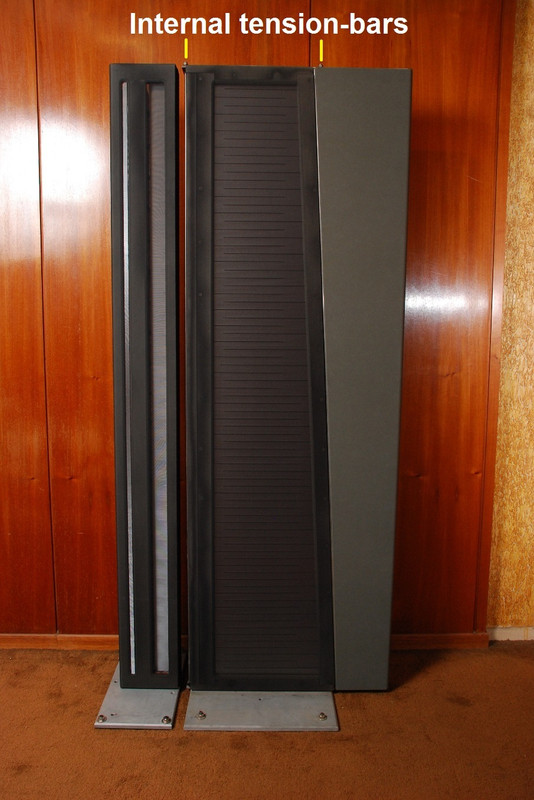
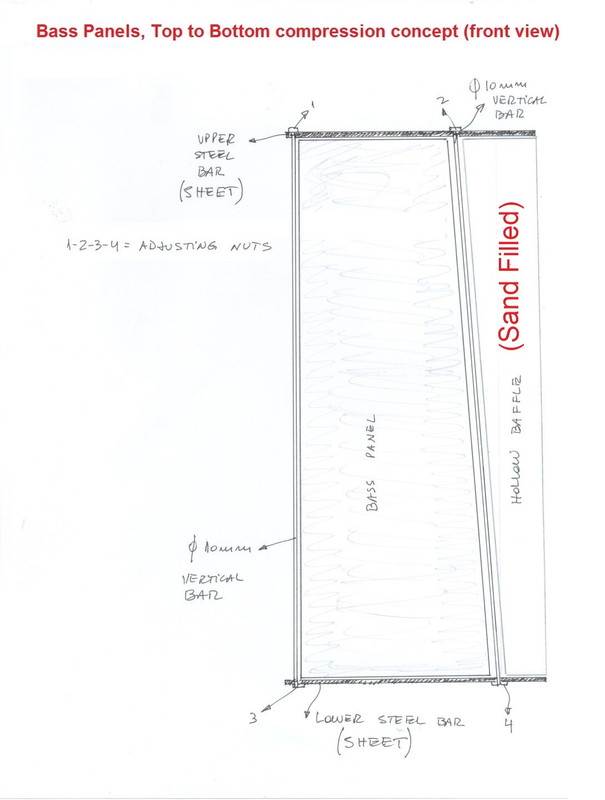
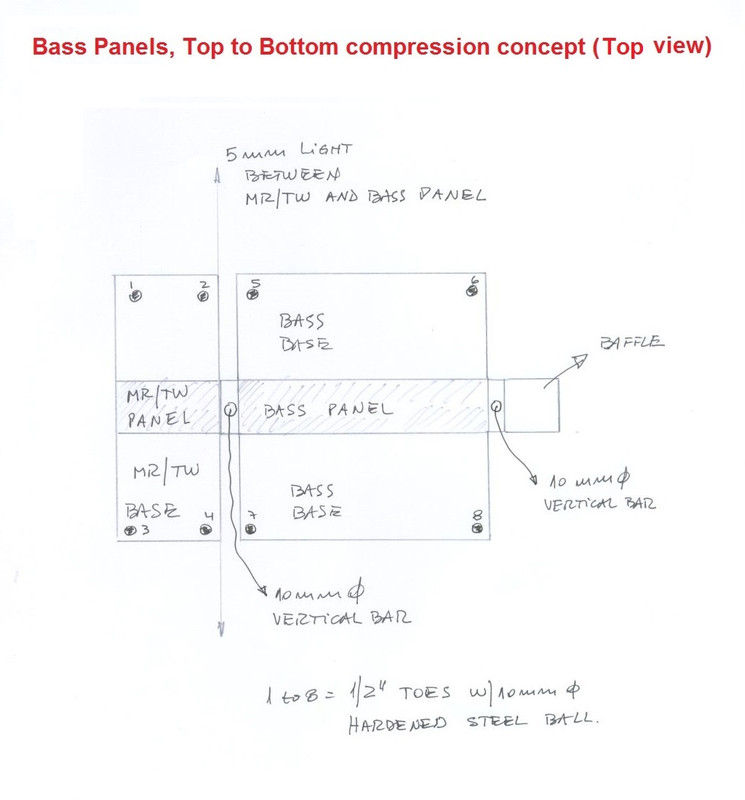
Update!
I have now discovered that there is a North American company that specializes in Apogee Upgrades. Here is the Link:
A veteran reader sent me a letter that I felt should be shared. There's no editing, but my bold:
"I have been listening to a pair of Dunlavy SC-IV speakers for the last year, and have come to the conclusion that, at their current typical price of around $ 2,000 per pair, these may be one of the best values available in used/discontinued speakers. My original VTL Tiny Triodes (25 wpc) are more than up to the task of driving the Dunlavys (94db/1w/1m).
I had most recently owned and enjoyed a pair of Acoustat Spectra 22’s, purchased after reading your opinion of these excellent speakers. I eventually decided that highly directional panels are not my cup of tea, as I enjoy listening to music with friends, which of course requires speakers with some degree of horizontal dispersion. The Dunlavys offer electrostat-like speed and detail, with greater dynamics, lower and tighter bass reproduction, and wide enough dispersion characteristics to be enjoyed by multiple listeners simultaneously. Please consider including the Dunlavys in your 'Other Interesting Speakers' list." (08/15)
Out of the Box Upgrade...
This past summer, a reader informed me of his project to improve the Avantgarde Duo Omega horn speaker system, which has always had (easily noticeable) bass frequency problems when using the standard woofers. The reader's project is obviously an extreme solution, but it appears to have been successfully accomplished and I felt the information he has generously provided me should be shared. The details below encompass his entire system, because the reader also shares my "system approach" to audio. Here are the most informative parts of the various letters he has sent me over the past 5 months, plus a picture and a diagram as well. There's only minor editing and my bold:
Reader Letter One:
As you found, the original Duo woofer is incapable of keeping up with the horns. It can produce a lot of bass, just not good bass, I tried 2 and even 3 sets of them at the same time, and even though it was better it was not even close to good enough. I am speaking about the original design, as I have not heard the current one. I found the upgrade to the Omega drivers was a significant and worthwhile investment.
I consulted with Jeffrey Jackson at Experience Music http://www.jeffreywjackson.com (see Link below). He recommended a bass horn as the only logical option to use with other horns. I considered the Avantgarde bass horns, but dismissed them for 2 reasons. First of all, a speaker with two 12” drivers and a 1,000W amplifier, that is only 4 1/2 feet long, does not fit my definition of a horn. It is a subwoofer with a flared mouth. Secondly, it is ridiculously expensive for what it is. Jeffery suggested a 16 foot horn that could be driven to satisfactory levels and beyond with a 2-3 watt amplifier. It will get down to 30 Hz with no problem, given proper amplification. Since I wanted to keep the horns aligned vertically, that necessitated building a custom stand to hold the red horns.
Jeffrey calculated the expansion and provided a suggested build plan. The driver is a 12” B&C woofer, which launches into a 4” X 6” opening forming a compression driver. It then expands exponentially to a 36” X 58” mouth. The straight sides except the mouth are 3/4” birch plywood. The sides and bottom of the mouth are double layers so 1 1/2”. The curved portions are 2 layers of 3/8” bendable plywood, which when glued together becomes rigid. The top of the mouth is a gentler bend so I used 3 layers of 1/4” plywood glued together. It was built in sections then glued together with biscuits and the help of a brad nailer. I included pictures of some of the sections so you can see how it went together. The Avantgarde woofer on the top of the bass horn is just sitting there to add 100 lbs of mass to it.
I first built the mouth. Once it was completed we decided to move. Since it was too wide to get through the door I cut it in 2 horizontally and reassemble in the new house. You can see it in 2 pieces in one picture. I first tried a single SET amp with a first order choke filter for the bass. The mid horn rolls off naturally and the tweeter has it’s own crossover. This was very good, but with a 3 way system it was too tempting not to try to tri-amp it, so I built a 6 channel SET amp, which was also constructed under the guidance of Jeffrey. Details on the amp later.
The problem with a 16 foot horn is that the bass is 15 mSec behind the mid and tweeter. That can be solved by physically aligning them. However, the mid/tweet would have to sit 16 feet behind the mouth putting the mouth about 18 feet into the room instead of 6 feet when it is up against the back wall. I have a 30 foot room so I could have done it, but it just took up too much space as it is a multifunction room. The solution is to time delay the mid/tweet so they launch at the same time as the sound is coming out of the mouth. So how do you get a 15 mSec delay? Pure Vinyl software (PV): (http://www.channld.com/purevinyl/)
Using PV opens up a lot of possibilities. Not only did I get time delay, it also has a many other features. For my front end I currently have a Wilson Benesch Act 2 turntable, Act 2 arm, and Analog cartridge, pre-amplified with a Lino from the same folks who produce PV. That is digitized by an Apogee Symphony under the control of PV, RIAA applied by PV, crossed over 3 ways digitally with PV, volume controlled digitally by PV, sent back to the Apogee for D to A, then to the power amp. Digital files are on a hard drive connected to the Mac Mini which is running PV. It works with iTunes as the file manager and PV does all of the processing such as upsampling if you choose to use it. It will go up to 192K as will the Apogee. My hard core analog friends told me it could not possibly sound very good with all of that processing along with digitizing the vinyl. One told me I would be listening to high frequency square waves. They were wrong.
One of the advantages of this set up is the precise control of crossover points. It allows you to digitally set them, choose slopes for each driver, trim the volumes individually if needed, and set the time delay. PV also works with plug ins if you choose to apply EQ or other processing. Another huge advantage is the ability to hook the output of the power amp directly to each driver with no passive crossovers, which eliminates the associated phase shifts and frequency anomalies.
Using PV to set the delay is very easy. First calculate the approximate amount of delay which is 16 feet divided by the speed of sound. Set the delay initially to that point. Play a tone at the crossover frequency and use PV to invert the mid. Then using a microphone and a pro audio interface to display the spectrum you will see a spike at that frequency. Slowly adjust the delay back and forth until you get a null. You can also adjust the gain of one or the other until you get the deepest null which will be where the outputs of the 2 are equal as they should be at that frequency. Put it back to non-inverted and you are done.
So now onto the amps. I have several. One is the aforementioned 6 channel SET. The bass channel is a 5995 direct coupled to a 2A3 in a stacked configuration. The mid and tweeter channels are the same except they use a 46 on the output. That means from the output of the DAC to the driver there are only 2 stages of SET amplification. The power supply is choke input. I am now experimenting with a Naim 6-50 which is a 6 channel 30 WPC amp built in 2001. The bass is undoubtedly superior. It appears the 2A3 isn’t capable of controlling it the way SS can. The mid/tweet is what I would call a little more hifi. However, it is very good and having never heard the SET would be very happy with it. I may end sticking with all SS, but now trying out a Naim Nap 250DR for bass and tubes elsewhere. It is a bear to get it grounded where it won’t hum and buzz, but finally got it. I’m going to try tri-amp with 2 more Naim 250DR, but this may be it.
Reader Letter Two:
I believe I have settled into a final as final can be configuration. Of course things may change down the line. By that I mean I can sit down and listen to music. I am not sitting down to think about what could be better or different. I feel I am at a 95% plus level and further changes may result in slight improvements, but more likely tradeoffs from one area of excellence to another. I am in a good place.
The last piece of the puzzle was volume control, as I have too much gain from source through amps to my 110 dB speakers.. probably about 20-30 dB too much. I worked with Placette on a 6 channel RVC, which they built for me. I had a buzz/hum issue with it initially, but I sent it back and they added some switches to lift grounds. It is silent to the point you have to put your ear to the speaker to hear a tiny amount of hiss.
The Naim Nap 250DR amps are a revelation in the SS world. Like you I was firmly in the tube SET camp, but these things are amazing. At 80 WPC they are overkill for my horns, but I believe the headroom does really affect the overall sound versus a 2-3 watt SET… effortless. I encourage you to audition them. I initially had 3 Naim in a tri-amp configuration. I then went with biamp using the crossover in the Avantgarde tweeter (the mid runs full range rolling off naturally on both ends). I don’t think there is any difference other than selling the extra amp for $ 4K.
So now...
Wilson Benesch Act 2 table and arm with carbon fiber analog cartridge with Pure Music Seta Lino phono preamp
Apple Mac Mini running Pure Vinyl software all Digital files on external drive
Apogee Symphony MKII , ADC for Vinyl under control of Pure Music with RIAA, crossover, time delay, in the digital domain
biamp DAC output of Apogee crossed over at 180 Hz through the Placette volume control to a pair of Naim Nap 250DR running speakers
Reader Letter Three:
The Lino can be configured with or without RIAA, mine is without, just a cartridge preamp, a head amp. Typically in a setup like this you use the microphone input of the interface for the MC cartridge, but the Apogee mic input is a separate card, which I do not have, so I am using the Lino instead. The advantage is that a mic input does not usually provide the proper load for the cartridge, the Lino does as well as being a very high quality head amp. The Apogee takes that signal and digitizes it, then Pure Vinyl in the Mac Mini does ……..
RIAA
...wide variety of curves selectable such as for 78s if you play them
...low pass rumble filter cutoff selectable
plays digital files using iTunes to manage the library
Crossover
...currently 2 way at 180 Hz, 24 dB slope
...time delay for mid/tweet for time alignment
...configurable up to 4 way, 6 to 48 dB slope
Digital volume control set to 0dB since using passive
Many more options
...accepts plug ins for EQ or any other processing you want
...configurable upsample up to 192K
...memory play
...you will need to go online to their website to see what all it can do
and sends it back to the Apogee for D to A.
Final Reader Side Note:
The remote volume control is a non-negotiable option so the Placette presented a very enticing solution. I find most recordings have a very narrow volume range where they are optimal and getting up and down to re-adjust is not going to happen here. I think this is one area that many audiophiles don’t understand, that the recording was mixed at a specific volume level which greatly affects the tonal balance due to the equal loudness contours of the human ear. If you find that sweet spot it is optimal.
This reader has used a number of the "Structures" that I recommend in my article: "Building a Great Audio System" (see above), but not all of them. The reader diverges from my structures mainly by entering the digital domain, but he "goes all the way" by staying there, thus taking advantage of digital's strengths and minimizing the weaknesses, which are usually the conversions; analogue to digital and back to analogue. This is the reason why I admire and appreciate his approach, and I made the decision to feature it on this website. In short, to pay my highest compliment to the reader: I would love to hear his system!
Finally, this reader has generously offered to assist any audiophile who would like to implement and integrate his hardware and software choices. If interested, simply contact me and I will then forward the letter to the helpful reader. For those readers interested in duplicating the actual custom speaker cabinets and/or the amplification, see the direct link below for professional guidance. (11/2017)
Relevant Link:
Experience Music - Jeffrey Jackson Audio Designs
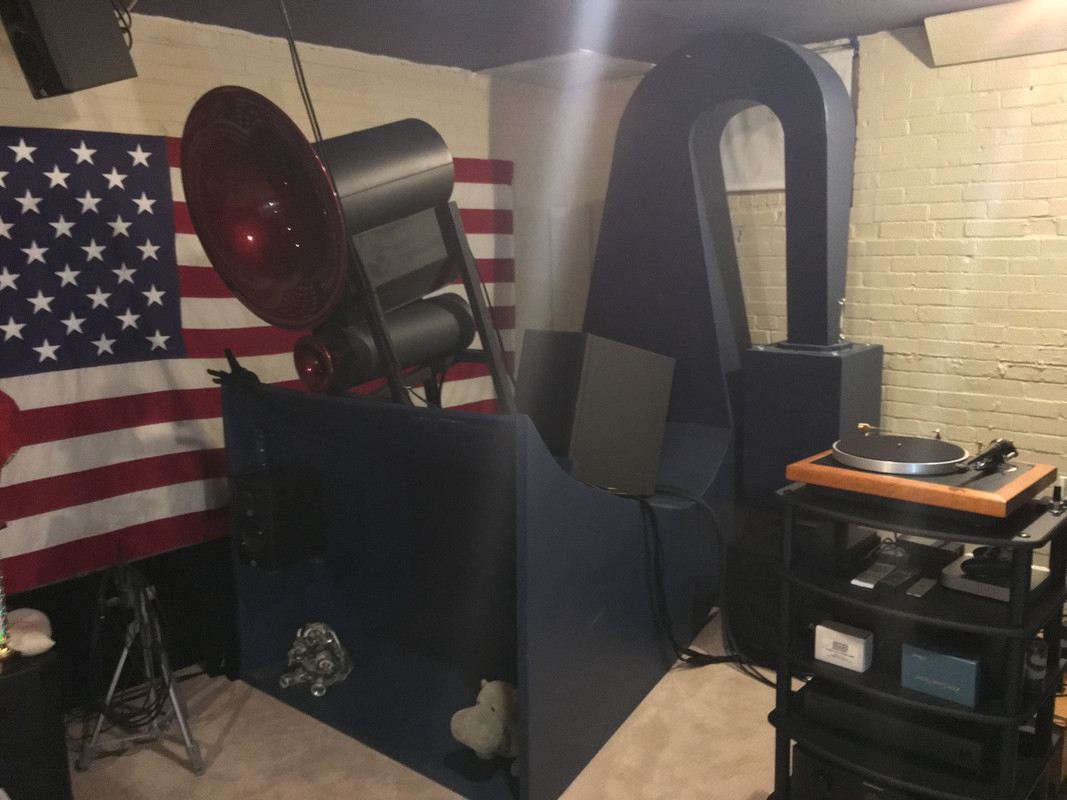
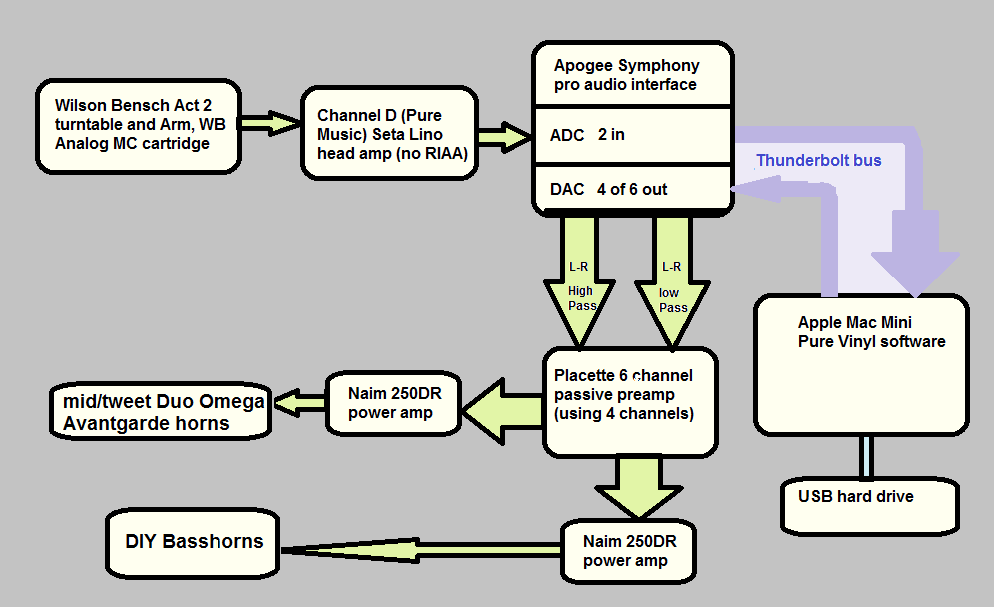
From a generous reader...
INTRODUCTION:
This is a simple two step procedure done with ears only that will result in a near perfect stereo music image from a large listening area. Best results are obtained when speakers are set along the long wall in a room and equidistant from the acoustic center of the room. A reference recording, Ballad of a Runaway Horse by Jennifer Warnes/Rob Wasserman is used, and makes the procedure much easier. However, any recording with an easy to hear bass line can be used for the first step. And any recording with a centered voice image can be used for the second step. A mono recording is also a very good recording to use for the second step.
INITIAL START POINTS:
1. Room Assessment:
Mentally assess the room for symmetry and note as best as possible the acoustic center of the room. Divide the room in half along the acoustic center of the room. Assess the similarities and differences of each side as to acoustic size, reflecting surfaces and furnishings. The more equal that each half is, in all aspects, the easier the setup procedure is likely to be and have a satisfying end result.
2. For initial speaker positioning, position the speakers equidistant from the acoustic center of the room. This doesn't have to be exact, just close.
3. Place speakers against the wall. Turn the right speaker 45 degrees out towards the side wall. Move the left speaker about a foot out in to the room.
4. Speakers need to move easily on the floor surface. Spikes need to be removed or set on to furniture sliders.
5. Sit in preferred listening spot that is centered between the speakers. And stay in this seat throughout the procedure.
BEGIN:
1. Setting the Left Speaker as Reference and for best bass position.
Play the reference recording with speakers set as in number 3 above. Move the left speaker out into the room until all sound comes from this one speaker with both speakers playing. Voice will come first to this speaker but continue moving out until the bass is also from just this one speaker. Speaker is now decoupled from the wall behind. Place a piece of masking tape at the rear of the speaker. This decoupled area extends about another foot out into the room. Any place within this decoupled area is suitable for this left speaker position.
This marks a kind of starting point. Listen to the song and focus on the steady bass line. This of course will depend a lot on the capabilities of the speaker-amp system. Move the speaker out into the room in small perpendicular increments and try to find points of smoothest bass/best bass/preferred bass, etc. I have often found that the 12th bass note of the first verse of the BRH song can vary a bit, and I use this as a listening cue. Try to get the smoothest bass possible. If in doubt, just go with what seems best and don't worry.
When you find your preferred best bass spot, mark the speaker in place with masking tape at the rear and one side of the speaker. For reference, measure distance out from wall to front baffle of speaker and note this measurement.
This will set the left speaker as a reference for the right speaker to complete the procedure.
2. Now to set the Right Speaker to get perfect stereo image
Bring the right speaker out into the room in two or three increments, noting how much the voice moves to the center with each move, until the voice centers in the middle. Mark this place with masking tape as a starting point.
Slowly move the speaker out in small increments, say ¼ inch, paying attention to the voice in the setup song. Keep moving the speaker until the centered voice gets very strong and focused. I have found that the voice can get very strong at around 2:30 into the song. Note places where you think the voice is very strong with some kind of mark. You may have several marks.
Keep moving the speaker out until the voice begins to fade a small amount. This will be the outer limit for moving the speaker. Now you need to move the speaker back toward the wall in very small increments, 1/8th or 1/16ths inch until you find the spot with the best and strongest voice.
Keep fiddling with this until you get what you think is the best, strongest, most human like voice.
3. Now to check things
Just listen to the whole song once or twice and note how it sounds to you. If the sound is really really good, then proceed. Otherwise make a small adjustment trying to get it better. Only move the speaker 1/16th inch when you do this. Once you are satisfied, proceed on.
Next is to move your listening position temporarily a bit side to side and note if the sound moves with you or not. A good check is to move 1 ½ seat positions to the right. Note if the sound moves with you or not.
If the sound moves completely with you and your move, you've missed the magic spot and need to do Step 2 all over again after a break. Note your starting position marks and start there.
If the sound moves just a tiny little bit to the right, just move the speaker in a small amount towards the wall, like 1/16th inch. Move it again the same amount if the first move was not enough. That should be good. Go back to center position and note the sound. You are trying to have the centered stereo image not move when you move seating positions. Little nudges may be necessary until you find this spot for the speaker. Mark the speaker in place with masking tape, same as for the left speaker.
4. DONE
5. Final Notes
Set the speakers in final position by replacing spikes, removing sliders, etc. Make sure that the final position matches both the tape markings and the measurements to the front baffles. Check and make sure the speakers are level. Adjust as necessary.
Do the procedure seated in the normal listening position. Move only as directed in the instructions.
I do the procedure myself. However, it can be helpful to do this with another person. One to listen, and one to move the speaker.
Toe-in has not been mentioned thus far. Toe in is variable. None is okay. A little is okay, but not too much. Go with the minimum and have each speaker the same.
It is okay to raise the front of the speaker, sometimes referred to as "rake angle". But fully level is likely easiest.
Take breaks as necessary to keep the ears and mind fresh. Don't get in any hurry.
Further Thoughts...
Here is some more info that is worth a few minutes. You may or may not have heard about WASP, the Wilson speaker setup protocol that they have used for years. Here is a link to a you tube video about it, by the late David A. Wilson himself, https://www.youtube.com/watch?v=UOI8py0DAC8
The only part worth paying attention to is where he describes the Zone of Neutrality, with regards to room boundaries, walls. Then the video shows a guy walking out into the room and placing masking tape on the floor. Just try this yourself. Stand with your back to the wall behind your speakers and count aloud one, two, three, four, five, as you slowly move away from the wall. Once you get about 2 feet out from the wall, notice how the sound of your voice changes. I was a bit skeptical about this until I did this myself. And I did it 3 times just to be sure. It correlates very well to when the left speaker gets moved out from the wall and then all sound appears to come from it with both speakers playing.
Anyway, I think it's worth a few minutes just to do this as I found it interesting.
Just a little bit more on the speaker setup procedure...............All I am doing is setting one speaker as a reference in a place of the least interaction with the walls, i.e. decoupled from the wall behind, and then adjusting the position of the other speaker to get a perfect stereo image. Once you get this perfect stereo image, a lot of things just naturally fall into place. Also, one reason I have stated that a mono recording works well for finding the perfect stereo image is that by definition a mono recording should be perfectly centered between the speakers at all times. However, this can only occur if both speakers are energizing the room equally. And that is what you are trying to do with the positioning of the second speaker. And if properly done, then the mono image will always stay centered between the speakers no matter where in the room you may be. Or, pretty close to that.
Perhaps some background information could be helpful here.
In the 1990's, Sumiko Importers of Berkeley started a training program for their dealers called M.A.S.T.E.R.S., which is an acronym for Modal All Simplified Training Electronic Retail Salespeople. It was never for public consumption, and graduates were sworn to keep it a secret. And that has pretty much happened as Google searches still give no hits for the term.
The term Master Set was coined by Rod Tomson of Soundings HiFi in Denver Colorado. I have no idea how closely this follows the actual MASTERS training. However an insight to the actual MASTERS methods can be found in a post on diyaudio:
https://www.diyaudio.com/forums/the-lounge/318975-john-curls-blowtorch-preamplifier-iii-1665.htm, go to post #16648.
Stirling Trayle is the former owner of Sumiko and started the MASTERS program along with John Hunter. Stirling now sets up speakers and audio systems as a business. He gave a talk at the San Francisco Audio Society the past March 2019, which is where the notes originated.
Rod T. started Master Set and has incorporated that into his audio business. I first heard speakers set up in this manner in 2007 at RMAF. Over time I learned the basics of the methodology and eventually have been able to get the desired results.
What I do bears some resemblance to Rod's Master Set, but I simplify things a whole lot. What I do is completely DIY, doesn't cost anything other than procurement of the set up song. It is easy to do but hard to get perfect. What I do can be done with any box speaker in any room.
There are a couple of useful links to share:
1. www.myspeakersetup.com, a website for Bob Robbins, a MASTERS certified former employee of Soundings HiFi, who does speaker setup with his version or Rod's Master Set.
2. www.audiosystemsoptimized.com, a website for Stirling Trayle, who now does speaker setup and a lot more. (09/2019)
A reader recently sent me some news concerning an interesting new speaker model from Apogee Acoustics, which is located in Australia. There is also a second letter from Graz (Graeme Keet), the owner/designer of Apogee, plus a picture of the new speaker, and the relevant links. My bold:
"...my main reason for this correspondence is to alert you to a new Apogee speaker made by Graz. He redesigned the Apogee Diva as what he calls his Advanced 9 speaker. He made the initial prototype for me, a mission that has taken over three years, but what he has achieved can only be described as sensational. I have included a photo with this email...
I know that you are an Apogee fan, so some specifications which I hope Graz will officially confirm in his release material. Nominal impedance 4 ohms. Weight approximately 250 kgs each. The MRTW array comes separate from the bass panel and are then fitted and bolted on to it. The crossover components are potted to eliminate as far as possible any vibration induced distortions. They can be bi-amped.
I have no commercial interest in this, other than these being my final (for life) pair of speakers and a hope that I can help Graz by alerting the audio world to these amazing speakers."
2nd letter...this time from Graz of Apogee..., after I asked the reader about the efficiency of the Advanced 9...
"Efficiency - now that is an interesting one as it changed literally with every crossover change. The final crossover was by far the most efficient. It is important to know line source measurements are different, dipoles even more so, and the room plays a considerable part in the equation. It is literally more relevant to compare volume position on a given monopole speaker of known values for subjective loudness imho, especially as an Apogee has different tuning to different heights of the bass panel. Final efficiency was equivalent to 88-89dB of a conventional speaker, around 1.6-2dB more than the original Diva. A high current 250w/8 amp can drive it to it's potential." (4/20)
Personal Notes - I really wish this speaker line, which are custom made by order only, was generally available to be auditioned and purchased in North America. The earlier top-of-the-line model from Apogee, the Definitive, is still available. Unlike the Advanced 9, the Definitive is also highly efficient, and is actually able to be driven by low power SET amplifiers! It may be the best overall speaker in the world, and it is certainly, at the very least, the most unique.
Relevant Links:
Advance 9 Announcement and Discussion
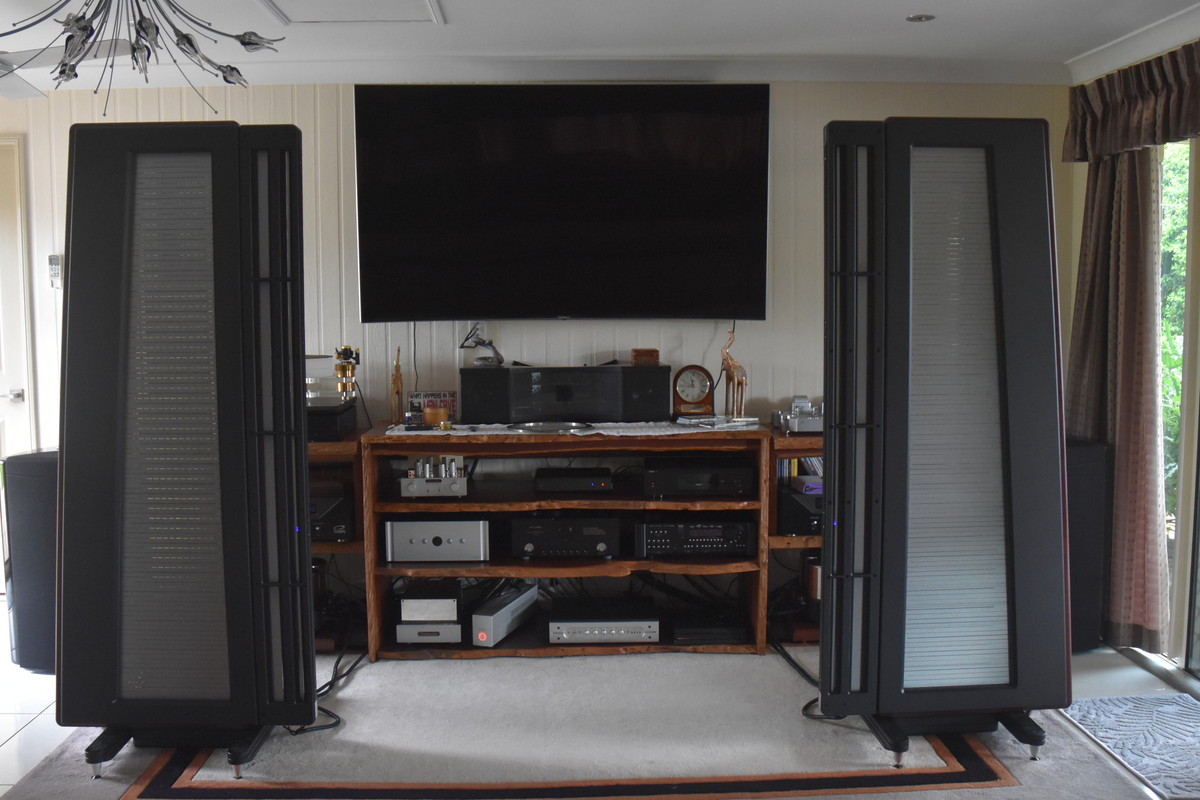
A veteran reader sent me this letter with the latest updates to the critically important issue/skill of speaker positioning. Here is his letter with minor editing and related links (my bold):
"I have additional information on the speaker positioning procedure I have championed for the past few years...
...Post #2 in the linked thread below contains a write up of the procedure that is exactly as it was first explained to me back in 2007-2008, when I first heard the results and asked questions about how to do it. The write ups that I sent to you are slightly different, though they do reflect my own trials and errors. After finding the linked post, I re-did the procedure following the steps exactly as written. While I am quite familiar with the general procedure, I did have to listen for slightly different audio cues.
In the end, I had very good success with following the steps exactly as written. I would have to say that it is a better way to do the procedure than my own previous write ups. Everything just seems to be a little bit better. I used only the song on the set up disc that I sent you. I have yet to play a mono recording, which I still tend to think is a good double check on proper balance of the speakers. I think you will find this linked write up to be helpful.
There is also a newish You Tube video that is good to watch. It is a good introduction before attempting to do the procedure the first time."
Relevant Links:
Speaker Positioning Update Thread
Video Introduction to Speaker Positioning Update
In 2020, a long-time associate purchased a pair of speakers from this Canadian company. His choice was an earlier version of their current Coherent Model 15, thereby replacing his (modified) Martin-Logan CLS, which had been his main speaker for over 25 years. My associate is very satisfied with his Model 15, so I felt I should share this important news with my readership (01/21). The link to Coherent is below:
Coherent Speakers (High-Efficiency Speakers)
TopTop
If you have a question, or want audio advice and/or consultation:
Important Notice- As of October 1, 2012, there is a minimum fee of $ 10 for me to answer a simple enquiry, which means any question that I can answer quickly without research. Anything else will cost more and I will accordingly provide quotes for approval. PayPal is being used for its convenience, universality and security. If interested, click on "Ask Arthur".
There are two exemptions to the payment fees. 1. Those readers who have provided an important service (usually information that was posted) to this website over the years. 2. Those situations where I feel that I overlooked something important and/or was obscure in my post, and thus some necessary clarification is required on my part. That will always be gratis. I don't believe in being unfair or petty, especially to my own readers.
Telephone Conversations- If a reader feels it is necessary to actually talk to me directly, this can be arranged if I also feel it is appropriate. There will be a minimum fee of $ 50. Ask for the details before paying the fee.
Finally, a veteran reader wrote that I "should also have a link for (generic) donations to keep the website going". I replied that the Donation button can also be used by appreciative readers for that purpose. Needless to say, any unsolicited donation from a generous reader receives my sincerest thanks and gratitude.

To contact me for any other reason:
COPYRIGHT 1999-2024 ARTHUR SALVATORE