My Audio System
UPDATED MAY 2025
INTRODUCTION
Like most other audiophiles, my system is in a never-ending evolving mode. This is an ideal situation where the journey itself is the experience, because if the destination is "perfection", no matter how it is defined, it will never be reached.
I feel particularly fortunate that at least I now know exactly what I want, and what is actually possible, from my system. This is sadly rare for most audiophiles, mainly because of the multitude of initial choices and alternative directions we have to choose from. I can still make mistakes and deviate temporarily from my chosen path, but I always get back and move further ahead, usually sooner rather than later and with, I hope, some greater knowledge and wisdom that I can share with others.
Ultimately, the search for a better audio system is, in many ways, a personal discovery of your deepest needs: "what really turns you on". You must experience many different components and systems, while keeping an open mind and heart, if you want to reach your unique destination.
My system is analog oriented, based around a phono front-end. I also have an excellent tuner, and an outstanding CD player, but neither of them is my primary source.
My system has a number of purposes. The first is definitely for my personal listening pleasure, but it also serves as a "reference" for comparing components, records and entire systems, within audio shows and in my friends and (now former) customers homes.
Almost all of the components you will see here are in my Reference Components List, and most of them are in Class A. This is not a coincidence. Why I chose these particular components can be further understood by reading "My Audio Philosophy", which will also explain my audio priorities and general direction.
STRENGTHS AND WEAKNESS
The primary strengths of this system are its sheer naturalness and its ability to retrieve low-level musical information, which is my highest sonic priority. This includes; musical harmonics, decays, ambience, dynamic shadings, the sense of space, complexity and tension, intelligibility, and an unpredictability of the sound. There is also a continuous, "absolute presence" that exists on good recordings even when the musicians are not active.
Further, the system is very cohesive, neutral, highly detailed and transparent, and has a "big sound". Finally, the system is truly "dynamic" and "full-range", with the frequency response being flat from 20 Hz all the way up to 50K+ Hz.
The system is capable of this performance only because of its extreme minimalist design and execution. The end result of my many years of effort:
By stark contrast, most preamplifiers, with phono stages, have 5 to 8 tubes all by themselves. The sonic result of all this "simplicity" is the lowest system "sound-floor", by far, that I have ever experienced.
The only real weaknesses of my system are that it can not play "real loud" (a very rare desire), meaning above 103 dB, and its focusing ability, while excellent, is not up to the highest standards. In actual practice, the loudness levels, which can still cause actual physical pain, are more than adequate for me, and I've never had a single guest who wanted a higher volume capability. The system's focusing ability is a step down from the omni-directional Morrison speakers (which truly excel in this area).
SOURCES
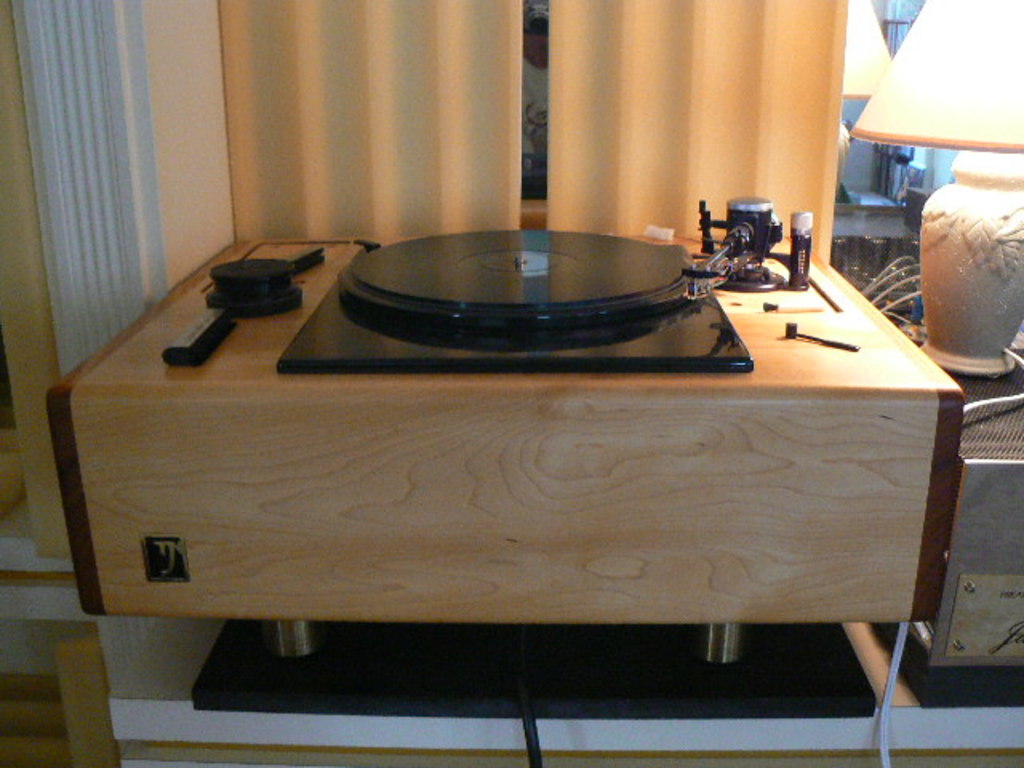
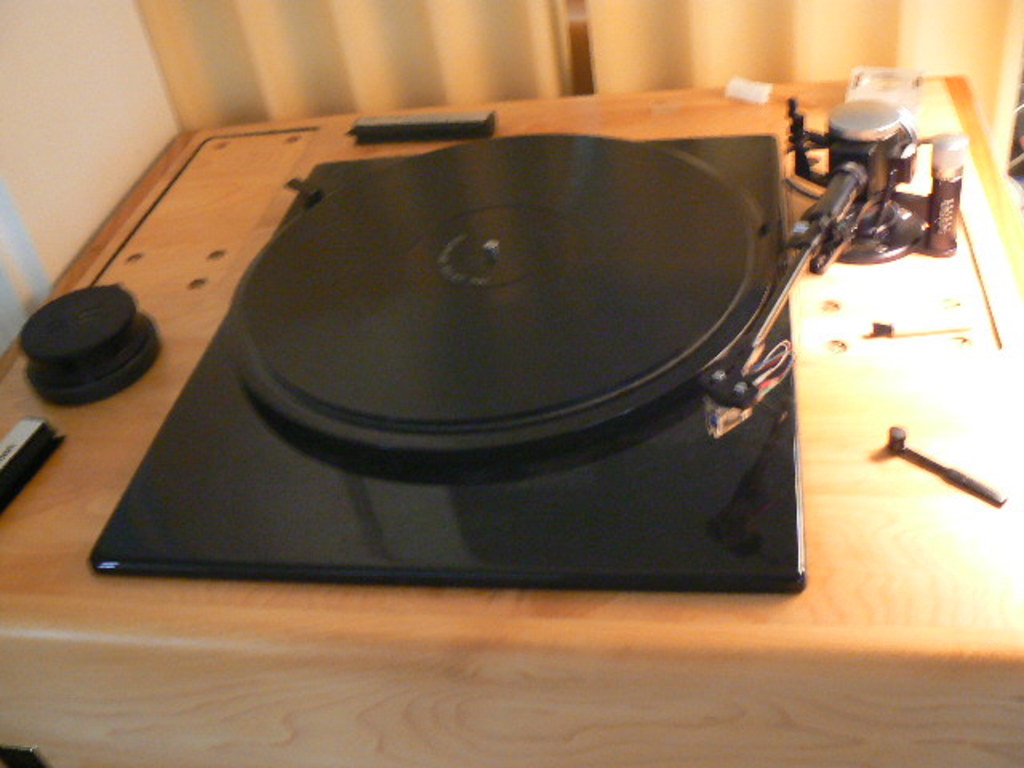
ULTIMATE LENCO IDLER-DRIVE TURNTABLE (BY JEAN NANTAIS)*
KUZMA 4POINT 14" TONEARM
ZYX UNIVERSE III CARTRIDGE
BENT SILVER MC STEP-UP TRANSFORMER
APL NWO-MASTER (Rebuilt Esoteric UX-1 Ltd.) CD/SACD Player
MARANTZ 10B TUNER
The Ultimate Lenco and Kuzma were first installed in my system in 2021, after a year delay due to the pandemic.. They are, by far, the finest front-end combination I've yet heard.
The ZYX UNIverse III is the finest cartridge I have ever heard. It is slightly superior to the UNIverse Premium. It is on loan until I audition the Optimum model. The Bent Silver is the finest transformer I've heard in my system. I use the high gain setting (26 dB).
The Marantz tuner has been partially modified, with better (Teflon) coupling capacitors. The APL is, by far, the finest digital source I've heard, in my own system or elsewhere. The APL review can be currently found in The Reference Digital Source File, link below.
*For more information about this family of components, plus my turntable history, you can read my extensive review/essay of THE L75 REFERENCE LENCO.
PREAMPLIFICATION
JADIS JP-80 PHONO STAGE (HIGHLY MODIFIED)**
I have had the JP-80 since the Spring of 1989. I have modified it countless times, in each instance making the signal path simpler and shorter, while also upgrading the passive components that are impossible to remove from the remaining signal path. It’s a shame that the JP-80 couldn’t have been built this way to begin with, because it would have cost much less to purchase and there would be no need for any modifications.
As of now, this is a low-gain but highly accurate and musically natural design; definitely the best that I have heard. The difference between a stock JP-80, of any vintage, and this modified version, is literally "night and day".
The Details: The entire line-stage and the phono cathode-follower have been removed from the signal path. That leaves only two tubes and two capacitors in the signal path. The two signal path capacitors are V-Cap CuTF Teflons, the finest I've heard. The RIAA curve is accurate to +/- .01 dB. Even the volume control has been removed from the direct signal path. The power supply is comprised of only film capacitors; since all the electrolytics have also been removed.
** For more information about this component, plus my most recent observations, thoughts and comparisons with the finest phono stages I've heard, you can read the 2011/12 phono stage essay/review, which began in Spring 2010 and completed in February 2012.
"THE TRUTH" (T3) LINE STAGE
I believe "The Truth" line stage is the most important and accurate audio component in existence. I now have the latest iteration, which I have designed as the T3. It is discussed in depth in The Reference Line Stage File.
AURAL THRILLS INTERCONNECTS
These are the finest interconnects I have heard for both phono and line-level applications. They are particularly special with digital sources.
COINCIDENT STATEMENT INTERCONNECTS
These cables are the best I've heard in the bass frequencies, so I use them for my subwoofers. They are also outstanding full-range.
COINCIDENT 300B FRANKENSTEIN MK. II-MAIN AMPLIFIER
The finest sounding commerical amplifier I've ever heard in the midrange and high frequencies. However, high quality tubes, tube dampers and cables are still required for optimization. I replaced the "Original" model with the Mk. II (shiny stainless steel) version in 2010. I have since made a simple modification which improves its performance in the midrange and high frequencies, at the expense of rolling-off the bass frequencies. This modification is only suitable for systems, such as mine, that already have separate amplifiers dedicated to the bass frequencies. Details in the link below. There are later versions of the Frankenstein, the Mk. III and the Mk. IV, which I have NOT heard.
POLK SPEAKER CABLES- I currently use two Polk cables, one for the lower midrange horns, and the other for the upper midrange and tweeter horns. The Polk for the lower midrange is only 3' long and has 6 individual cables wired in parallel. The other Polk is only 2' long and has 2 individual cables wired in parallel. No speaker cables are required for the subwoofers, which have dedicated and internal amplifiers.
SADURNI ACOUSTICS HORN SYSTEM MAX
These speakers are in a special Class of their own, literally, and my new "References". The review of the Sadurni is currently being posted in THE RECENT FILE, in sections, as this is written.
LISTENING ROOM
My listening room has proved to be superb. I chose it most carefully when I purchased my house in 2002, but it has even exceeded my own expectations. It is basically "L" shaped. It is 18' 4" wide, and 40% of the room is around 18.5' deep, while the remaining 60% of the room is 27' deep. The ceiling is 10' high. The entire structure is built out of reinforced concrete. It's extremely solid, with plenty of heavy objects and openings to break-up any potential standing waves. To enhance it even further, I have installed "Room Tunes", "foam panels" and "Tube Traps", at various strategic points, which I brought with me from Toronto.
I have also installed 3 dedicated, shielded, heavy amperage lines, one for each amplification channel, plus the other for the front-end sources. The local high-power AC transformer, for my side of the street, which has recently been replaced and even upgraded, is actually located on my property (by sheer luck!), and just a few feet away from my electrical box. There are no heavy industry or commercial users in my vicinity, which was a serious problem for me in Toronto. The biggest problem, I once had, was from the local power company, Florida Power and Light. In the Summer, up until around 2012 or so, hardly a day passed without a short-term brown-out or even a power outage. Fortunately, the brown-outs are now very rare. Overall, my system's AC can only be considered excellent at this time.
The original owner of my house had an "entertainment center" built in as an expensive upgrade. I initially planned to remove it, until I discovered how well built it was, enough to support a hippo. I kept it, but I had to get a cabinetmaker to drill (4" thick) holes through it for the (AC and signal) cables. While there are large mirrors on the back wall, they are acoustically tempered by a large amount of shaped foam. This acoustical foam is critical: it breaks-up the potentially annoying resonances from the glass, but still allows ultra-soft sounds to be heard in my ultra-quiet room.
The end result is a room that is even more satisfying, overall, than my former room in Toronto. The Toronto room was wider, by almost two feet, but that was still enough to give it a slightly greater sense of "scale". This new room has both better bass and a more intimate and immediate sound in its favor.
ACCESSORIES
My accessories, in the past, focused on acoustical isolation of the components and the purity of the incoming AC. This is still the case. I am using custom made "sand boxes" underneath both the monitor and subwoofer amplifiers. I use the Coincident Statement Power Cords (the best I have experienced) on the preamplifier, digital source and the four (mono) power amplifiers. The Lenco is isolated using a dead metapolymer shelf. There are also fluid bags underneath the preamplifier.
THE NEAR FUTURE
I have several projects planned, but nothing is confirmed yet.
The pictures below were taken in Spring 2010, I believe by Jean Nantais. Readers should note that there was no line stage in my system at that time. You can compare this system to my current system, three years later, now seen below.
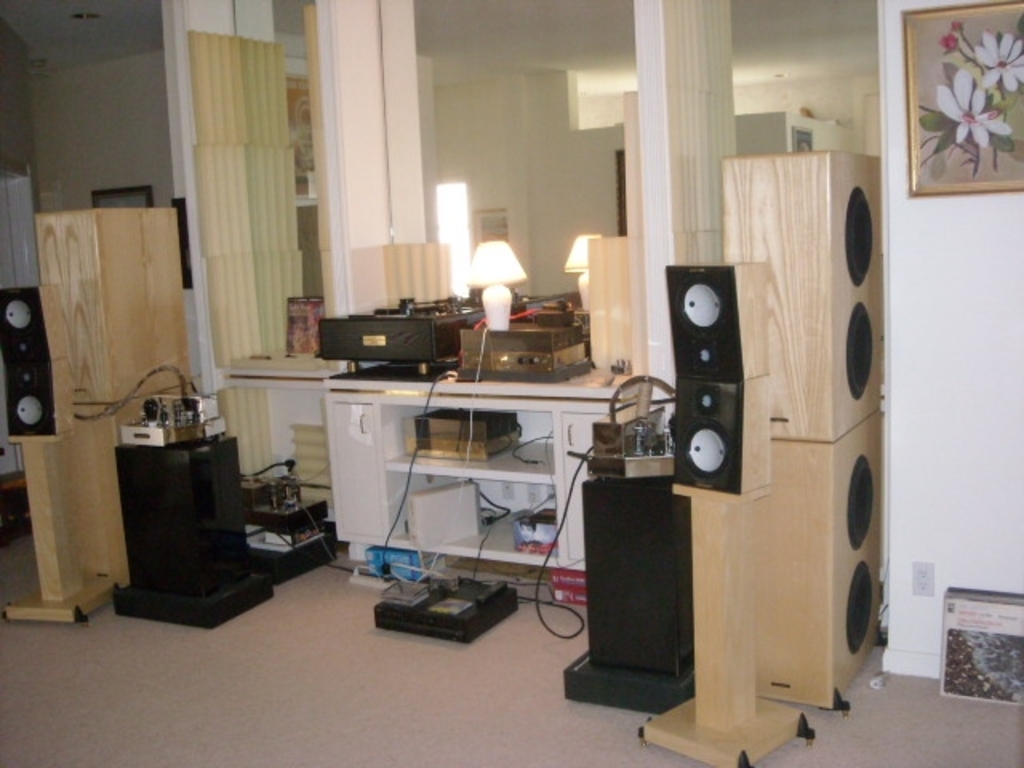
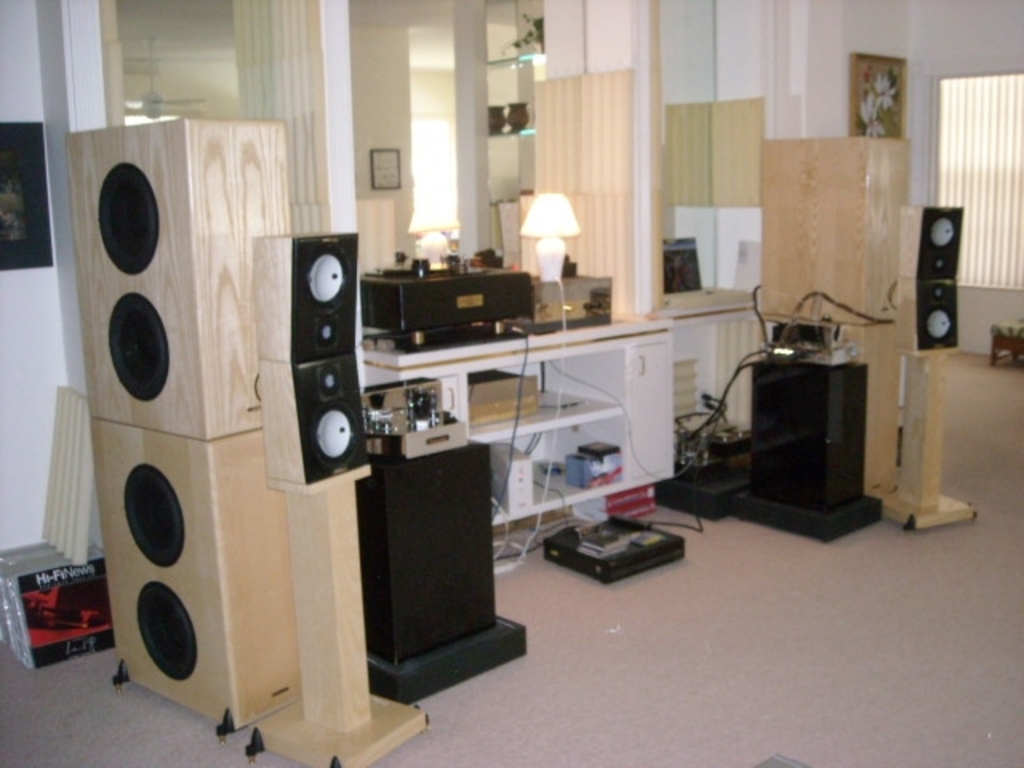
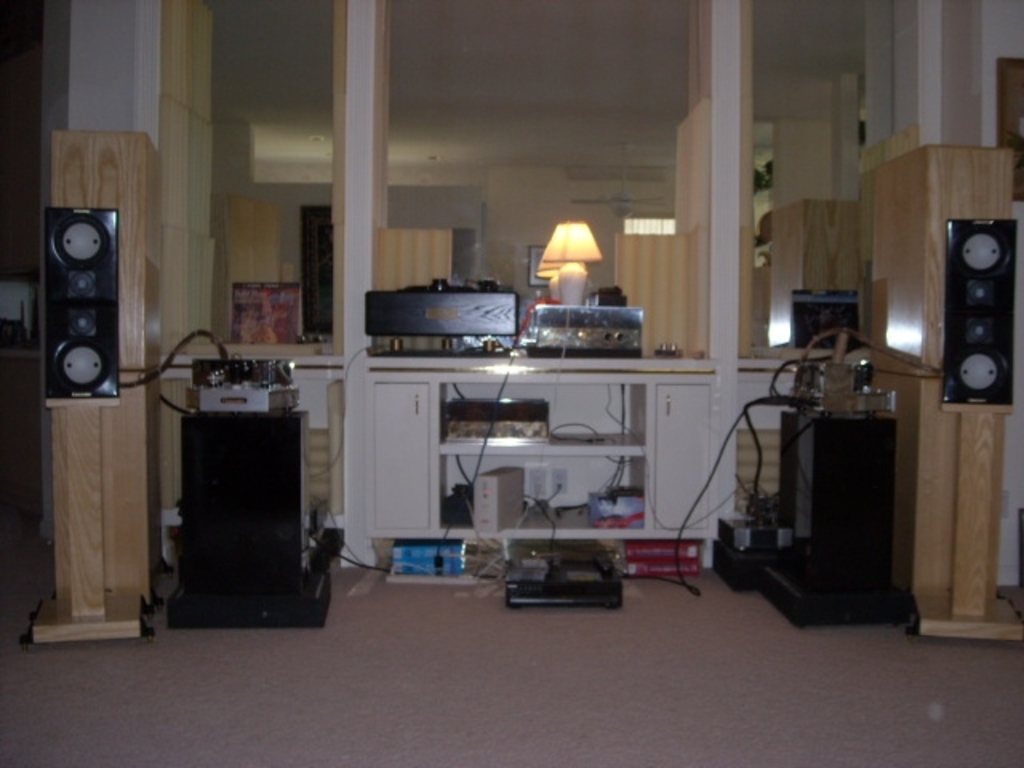
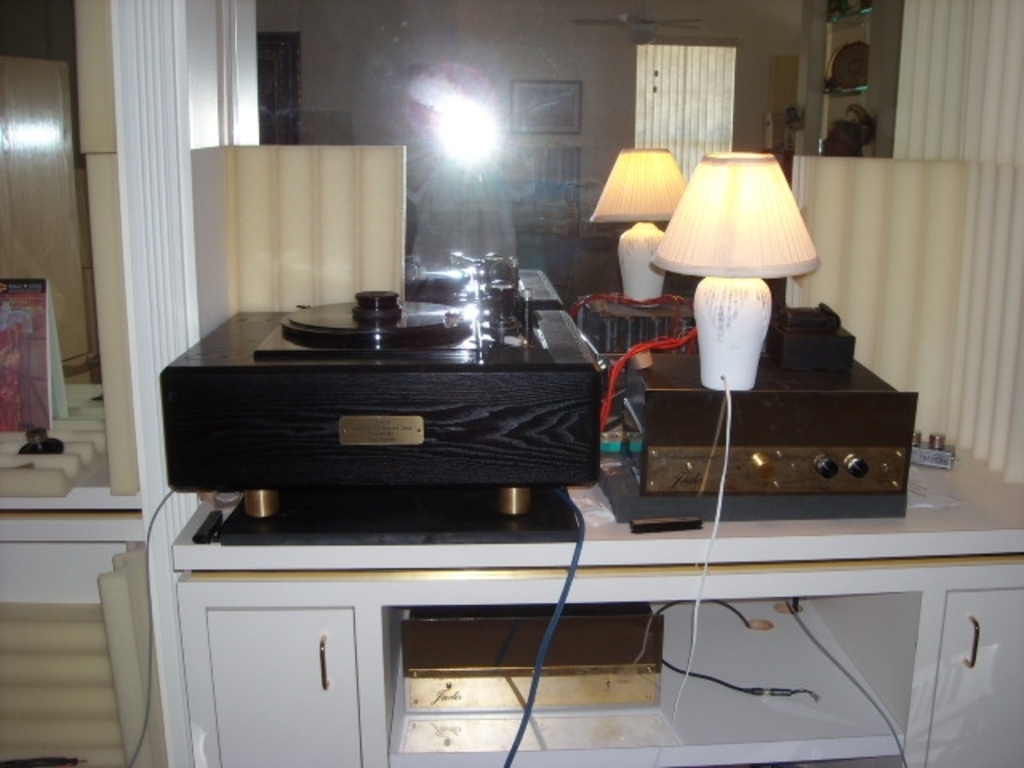
The pictures below were taken by me in Spring 2013. Since Spring 2010, I have changed the speaker positioning of the monitors (now pointed straight ahead), as well as my listening couch position (moved forward). As can be seen, I now use the Coincident Statement Line Stage, plus the speakers are now bi-amped. The Reference Lenco is now the Mk. II, plus there is the Esoteric DV-50S SACD player. There were several other changes (all for the better), but they are not visible with these pictures.
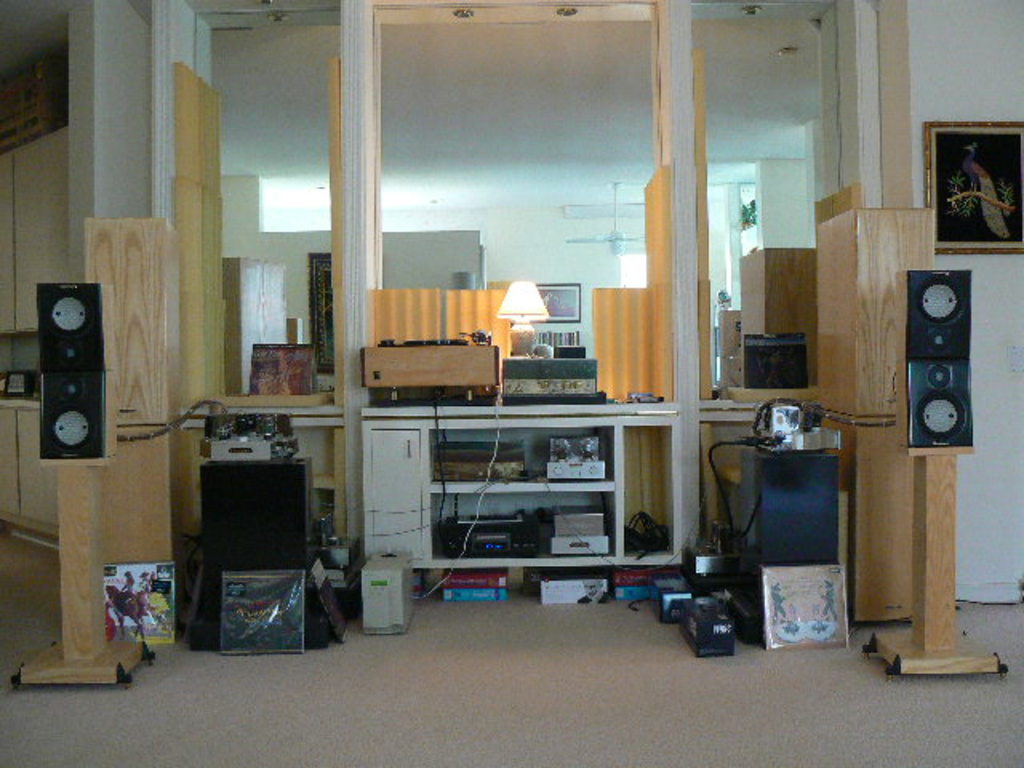
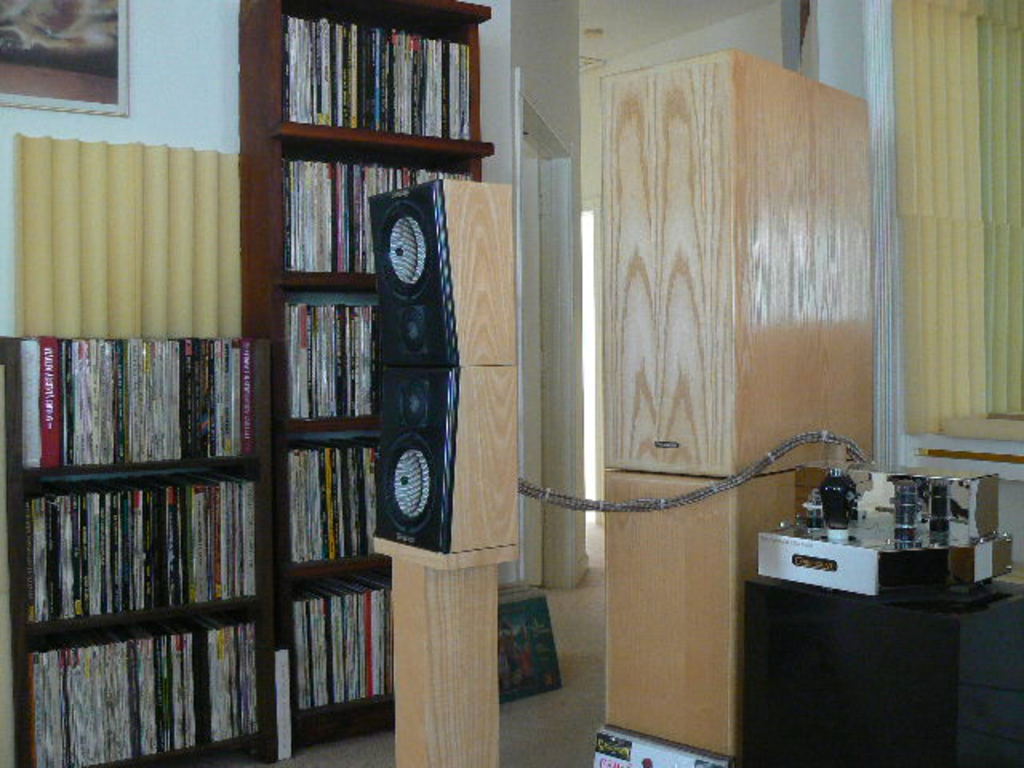
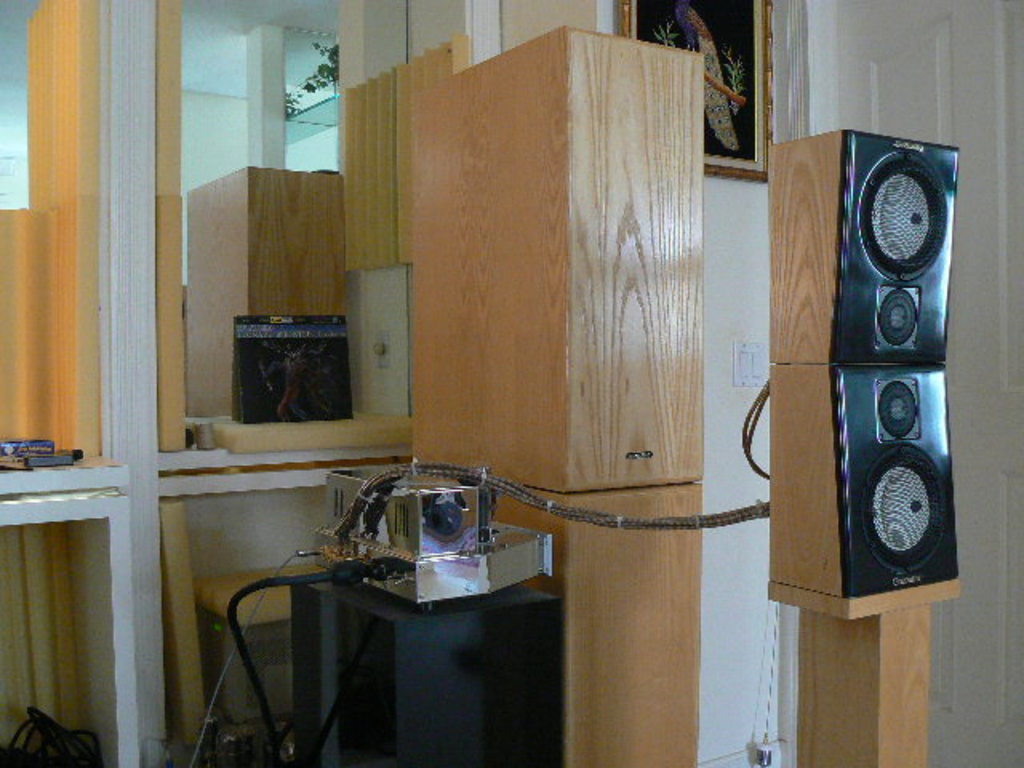
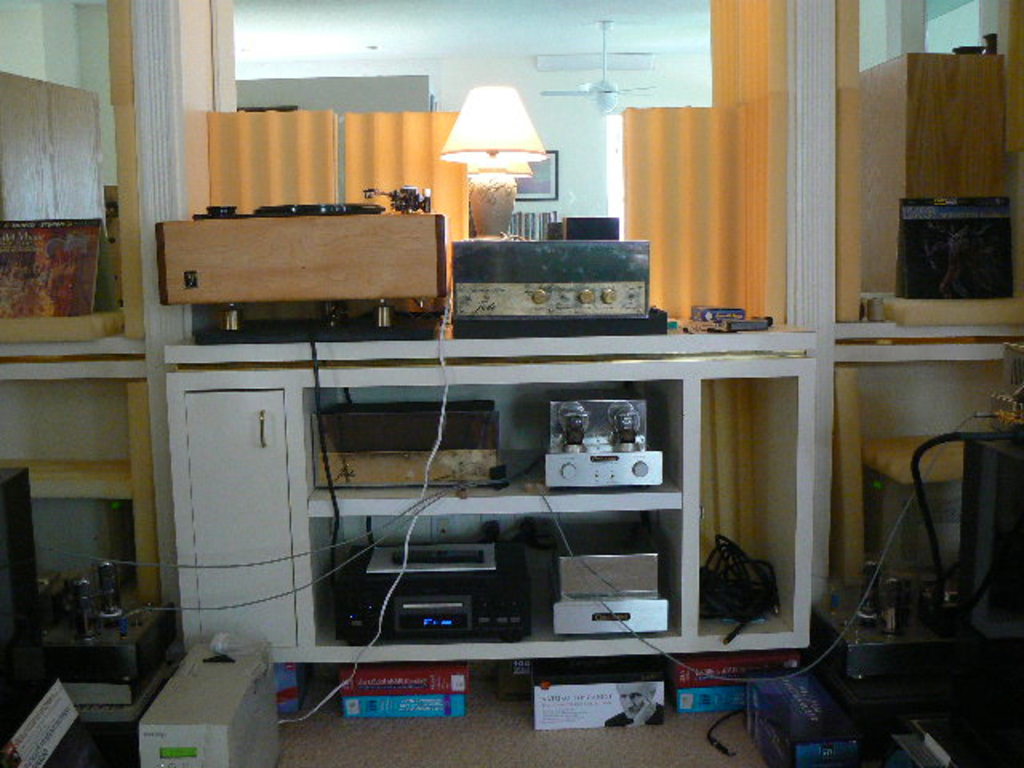
The Acapella Ion Tweeters are now utilized in the system.
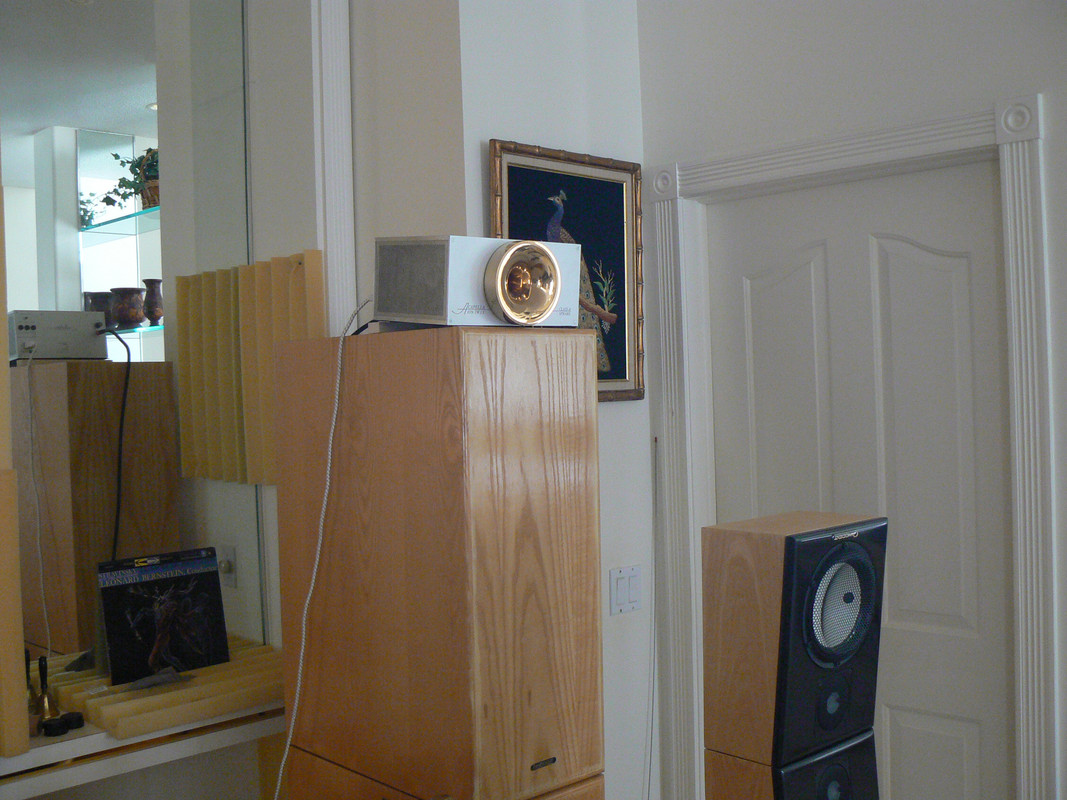
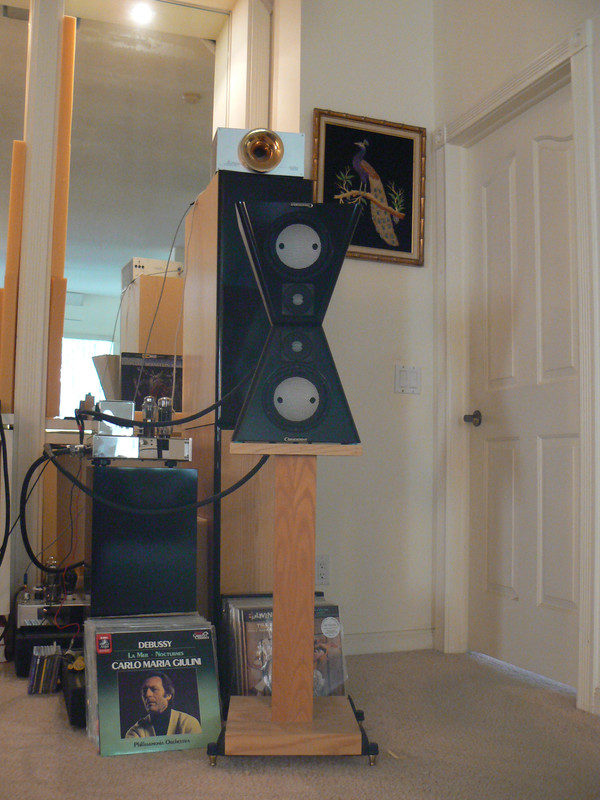
The Coincident Pure Reference Extreme Mk. II "Doubles" are now installed in the system. They replaced the Original Pure Reference Extreme "Doubles" (seen above). Attentive readers, when looking closely, will notice two thin wires (red and black) attached to the amplifier's speaker outputs, extending to the stand below, and then attached to three film capacitors. These 3 capacitors (in parallel) form a 1st order filter, which rolls-off the PRE Monitors above 5k. Without this low-pass filter, the PRE II Monitors, and the Acapella Ion Super Tweeters, would both operate, at full volume, above 5K, thus resulting in confused sound (see Acapella review, link above).

1. The size of the Staccato Max, and especially its huge Upper Bass Horn, can be scaled by using the LPs and the Coincident Frankenstein SET amplifiers.
2. The Staccato Max is placed on the same energy absorbing "sand box" I previously used with the Coincident Dragon amplifier (no longer required).
3. Despite my best efforts, the above picture does not do justice to the absolutely stunning finish of the Staccato Max.
4. The Ultimate Lenco/Kuzma 4-Point and the (highly modified) Jadis JP-80, plus the heavy-duty structural shelving, can all be clearly seen, plus much of the sound absorbent material now in use.
5. The right channel "tapped horn" subwoofer can also be clearly seen, with the drivers facing to the "outside" of the system. Polk speaker cables (6 in parallel) can also be seen.

1. The Polk speaker cables, bi-wired and as short as possible, can be clearly seen connected at the rear of the Frankenstein SET amplifier, including the Upper Bass Horn's small crossover box's direct connection.
2. The "tuning" and power controls of the Staccato Max's left channel "tapped horn" subwoofer can be seen in its rear, though it is "off" in the picture. The subwoofer is turned "on" automatically when it senses a signal.
3. The Frankenstein's line stage signal cable can be seen crudely separated from the Coincident power cable.
If you have a question, or want audio advice and/or consultation:
Important Notice- As of October 1, 2012, there is a minimum fee of $ 10 for me to answer a simple enquiry, which means any question that I can answer quickly without research. Anything else will cost more and I will accordingly provide quotes for approval. PayPal is being used for its convenience, universality and security. If interested, click on "Ask Arthur".
There are two exemptions to the payment fees. 1. Those readers who have provided an important service (usually information that was posted) to this website over the years. 2. Those situations where I feel that I overlooked something important and/or was obscure in my post, and thus some necessary clarification is required on my part. That will always be gratis. I don't believe in being unfair or petty, especially to my own readers.
Telephone Conversations- If a reader feels it is necessary to actually talk to me directly, this can be arranged if I also feel it is appropriate. There will be a minimum fee of $ 50. Ask for the details before paying the fee.
Finally, a veteran reader wrote that I "should also have a link for (generic) donations to keep the website going". I replied that the Donation button can also be used by appreciative readers for that purpose. Needless to say, any unsolicited donation from a generous reader receives my sincerest thanks and gratitude.

To contact me for any other reason:
COPYRIGHT 1999-2024 ARTHUR SALVATORE