FIRST EDITION-AUGUST 1998
UPDATED MAY 2024
Introduction
Beware of Used Record Dealers and "Collectors"
Original Pressings and Reissues
Identical Pressings-The Dirty and Unspoken Secret
Decca/London
Decca Vs. London- A Tale of Fantasy, Ego and Greed
The Definitive Documents! Proving Decca & London Have the Same Masters NEW!
RCA
RCA's "Decline" (The History and the Consequences)
MY FAVORITE CLASSICAL RECORDINGS
INTRODUCTION
This is the one essay within this website dedicated to musical software - LPs only. I don't enjoy CDs as much, and I lack the required experience with them to make a worthwhile contribution to what has already been written.
This essay is concerned with purchasing LPs, new and used, of Classical Music and will focus on record labels, pressings etc. The information, experiences and advice you will read here are generalizations only. Specific LP recommendations are detailed in an extensive list discussed below.
This website also includes another huge section with the title: The Supreme Recordings.
This is an extensive listing of the finest sounding records I've ever heard, primarily (though not exclusively) of classical music. Most of them are not expensive, if you can find them! I also mention and discuss a number of overrated and expensive records to avoid. Each LP on the list has a short description of its sonic qualities (with the exception of "The Honorable Mentions").
While I will rarely comment on matters of musical taste, the performance etc., I do have a great deal of experience concerning the sonics of many well known labels and their different pressings. For those of you who know little about the sonics of Classical Music LPs and/or still have an "open mind", I will give you the results of countless hours of listening to, and making comparisons of, all types of LPs on various "state of the art" phono reproduction systems.
Much of what you are about to read will be very controversial in some circles, though it shouldn't be. I will tread on the biases, egos, reputations, credibility of a good number of record collectors, dealers and audiophiles, some of them "famous". And, most importantly to them, their personal and business financial investments.
BEWARE OF USED RECORD DEALERS AND "COLLECTORS"
The very first Rule you should always remember is:
Some of the very best LPs I own only cost me $5 to $10 dollars, not $50, $100 or more. Those expensive "biggies" have usually proved to be huge disappointments in my experience, and not just because my expectations were high. In most cases, they weren't even as good as the better $10 LPs that had no hype. (See TAS #103 p.132) (Ironically, one well known dealer uses an old Dual changer to make judgments on used LPs that he sells for $ 1,000 or more!)
Serious music lovers are fortunate that serious "record collectors" have a "habit" which will inevitably disclose their true priorities and deepest desires*. It is their unique language and manner of describing records. In contast, when a music lover, or any ordinary person, wants to describe a particular recording, they will name the composer, performer(s) etc.
That is not true of serious "record collectors". They will almost always name only the record number. This is particularly true if they are only with their fellow "collectors".
Here is just one "Example" of how these two groups describe one famous record:
"Music Lover"- Rimsky-Korsakoff, Scheherazade, Fritz Reiner, Chicago Symphony Orchestra etc
"Hard-Core Collector"- 2446, 10S (Please do not ask me to interpret these numbers.)
Could there be more of a contrast?
This means, in effect, that all the effort and unique talent that was required to compose and perform this music has been reduced by (the mentality of) the "collectors" to a couple of numbers.
*Can a "record collector" also be a "music lover"? Yes, but their descriptive language is still the undeniable sign of their first love; And that is "The Record".
In other words...
Music lovers collect music that happens to be in the form of records. The records are irrelevant unto themselves, being just a necessary means to an end. Their ultimate objective is to possess and enjoy the music. Meanwhile...
Record collectors collect records that just happen to have music on them. The music itself is basically irrelevant to them. Their ultimate objective is to possess the record which, from their perspective, is some form of a "trophy".
TopORIGINAL PRESSINGS AND REISSUES
It is inevitable that there will be disagreements and controversies concerning which records, pressings, labels etc sound the best. It is unavoidable considering tastes, LP conditions, audio systems, recording philosophies, emotional attachments etc. etc.
The real surprise is the astonishing claim of many reviewers and collectors that none of the "original pressings", many of them manufactured 30 to 45 years ago, have ever been equaled, let alone surpassed, by any of the subsequent "reissues". These reissues include those either from the distant past (by the original labels) or the recent reissues using the most advanced mastering and pressing equipment, from small, independent companies (Classic Records, Cisco etc).
These people, in effect, do not recognize any technological advancements in mastering or pressing records. They don't even acknowledge any enhanced technical skills (the normal "learning curve") by the mastering engineers, due to their increased knowledge and experience.
With very few exceptions (like RCA-see below), the proponents of original pressings have provided absolutely no supporting scientific or technological explanations for their strict, dogmatic beliefs. They have only referred to casual, subjective and haphazard anecdotal comparisons. Further, virtually all of these "comparisons" were made only with their fellow collectors, who just happened to share their exact same beliefs. In other words, they will studiously avoid any situation that may cast the slightest doubt on their strict doctrine.
For instance, they will never, under any circumstances, agree to a "blind" comparison of LP pressings (when they don't know which of the LPs is the "original"). Why not?
Because when (not if) they eventually admit that even one reissue sounds better, their entire myth of the superiority of all original pressings is forever disproven. That would mean they would then have to actually take the time and effort to listen to all the reissues and make hard judgments, instead of their current, fundamentalist, non-thinking and robotic search for the earliest possible pressing.
To a (true believing) used record dealer, or collector; all rare, old LPs, on all labels, will always sound better than any more common, easier to find, and cheaper reissues. What an incredible coincidence! How fortuitous! How simple life is!
CAVEAT- The above discussion is strictly concerned with Classical Music recordings and pressings. Because of very different markets, standards, engineering procedures, economics, history and buyers' expectations, the reissues of NON-Classical recordings are almost always inferior to the original pressings.
Now I must bring up some "bad news" that is rarely shared with the LP buying public...
Top
IDENTICAL PRESSINGS-THE DIRTY AND UNSPOKEN SECRET
Anyone with extensive experience dealing with (and comparing) particular pressings of a particular recording will eventually come to a very distressing realization: Not only do the different pressings sound different (as can be expected), so may IDENTICAL PRESSINGS!
Identical pressings (the same mother, stamper etc.) may sound different depending on a variety of (unknowable) factors:
1. The manner in which it was played and stored (if it was used),
2. How (and when) it was pressed (at the beginning, middle or end of "the run")
3. The length of time it was in the stamping machine, and
4. The quality of the vinyl
How can you tell which pressing sounds the best? That's easy.
The Inevitable Moral- If sonics are the priority, never purchase a truly expensive record without recourse, no matter what the stamper number is claimed to be, or the "reputation" of the seller.
One (well known) LP 'collector/reviewer/dealer' visited a friend of mine a few years ago to make LP comparisons. He was a real, hard-line Original Pressing-Fundamentalist; He firmly believed it is essentially "impossible" for any reissue to ever sound as good as any original. Upon arriving, he immediately announced that he would never participate in any blind comparisons of LPs.
The actual listening comparisons were both funny and sad. My friend put on a large variety of pressings, including some excellent reissues, but no matter what the famous collector heard, he always preferred the original. If the original was cleaner and more transparent, he would say "See, I told you so", but if the reissue, instead, was similarly cleaner and more transparent, he would then say "The reissue must have been 'goosed up'!".
In other words, under absolutely no circumstances would this collector ever knowingly admit that any reissue was superior, in any manner, to an original pressing. (A "blind test", of course, would be unknowingly.)
In this instance, he even refused to recognize and believe what he was actually hearing with his own ears. That is the classic description of a "true believer", and also of psychotics.
The more complex reality is as follows:
Top
As for the sonic generalities on labels; below will be the actual truth, which readers will very rarely, if ever, hear from used record dealers and, especially, "collectors", because they have too much $$$, or "prestige", at stake in keeping up the status quo.
Most of the very best orchestral and (especially) opera recordings I have ever heard are from the Decca label, but their overall sonics are very variable. This is in contrast with their rival EMI, which are more uniformly excellent (though not reaching the highest standards of Decca).
Even worse, their pressings are also very variable, so what I have written below are true generalizations. The best pressings, in descending order, are:
1. Late British - Middle 1970s to 1979 - These pressings are almost always your best and safest choice. They have the important advantage of rarely having a serious sonic problem.
These records are difficult to distinguish from the other Decca/London's. However, they do have a shinier, darker vinyl compared to the earlier pressings. The record labels also look a little more "modern" and the printing appears in better "focus". They almost always combine an "immediate" and "clean" sound, with excellent dynamics and bass.
Unfortunately, these pressings are somewhat rare, not because of the demand, but rather there were never many of them pressed in the first place. Sadly, only a small part of the London/Decca catalogue was mastered and pressed during this period but, fortunately, the Dutch pressings (at least partially) came to the rescue.
Yes:
1. They used superior cutting heads and mastering amplifiers during this period (see TAS #102 p.133).
2. The engineers also had more accumulated experience by this time (I do recognize "the learning curve").
3. They used purer and quieter vinyl.
4. The inner sleeves used rice paper instead of the earlier (sticky and noisy) plastic which could bond to the vinyl.
(Important Note- "Collectors" have NEVER acknowledged any technological advancements in the production of records after around 1965.)
2. Dutch- Most Dutch pressings will rival the finest Late British and, in a few rare instances, are "The Best". The Dutch pressings, which were actually mastered in England, almost always equal, or prove superior to, the Late British in immediacy, purity and transparency. Their sonic advantages over the even earlier pressings are that much more pronounced.
However, some Dutch pressings are "dry" and/or have weak and rolled-off bass. In some instances, considering the music, audio system and listening tastes, these problem(s) are serious enough to be disqualifying.
Dutch pressings replaced the Late British during 1979. Since they were still available when the "great record panic" started in the early 1980s, the used record dealers dumped on these cheap competitors for obvious financial reasons. I must admit to also falling for this propaganda at the time, and I only bought a few Dutch pressings out of sheer desperation. Eventually, I found some "good original pressings" to replace the so-called "Dutch junk".
It is an understatement to say I was shocked when I discovered that the Dutch were better in most instances. It was these specific experiences that forced me, and my audiophile friends, to make our own comparisons. (It is also the reason that I no longer trust "collectors" and "dealers".) Today, I actually look for Dutch (or Late English) pressings, mainly to compare with my earlier British equivalents.
3. Middle British - Pressings between 1968 until the Middle 1970s. These are the easiest to find. They were mastered using cutting heads that were a noticeable improvement* over the cutting heads used in the earliest pressings, but they are still not as clean sounding as the late British or Dutch (which used further improved mastering equipment and probably superior vinyl).
However, they are still better than the earliest Londons (the Bluebacks) or the equivalent Deccas. Because they are the most common, they sell for a lot less than the earliest pressings.
Some of the problems with these pressings, and also the earliest British, seem to be caused by the sticky, plastic inner sleeves, that sometimes even bind directly to the record. The late British and Dutch pressings used a different, non-sticky sleeve. (I advise changing these sleeves immediately after purchase.)
The vinyl also looks inferior on these earlier pressings, it's not quite as black, as though the vinyl wasn't as pure. In any event, the later pressings, both the British and Dutch, are generally much quieter and allow more low-level musical information to be heard.
*As stated in "The Audiophiles Guide to London Bluebacks" written by Robert Moon & Michael Gray (on page 20):
"...there is a harsh brightness to the Decca-London early stereo records because the disc cutters were weak in reproducing frequencies above 10khz. The pressings made after 1968--to my knowledge all FFRR--were made with the Neumann SX-68 helium-cooled disc cutter which could reveal the sweet high frequenices on the original tape. It's for that reason that the later FFRR pressings are often superior to the early FFSS pressings."
4. Early British (1958 to 1968) - These are the oldest, rarest and most expensive pressings. In addition, they are also the poorest sounding and usually in the worst condition. This was not caused by any lack of effort or incompetence, but the engineers back then simply had relatively poor quality mastering equipment to work with (see above), at least compared to the equipment that was available in the later years.
I always think of the classic children's fairy tale "The Emperor's New Clothes" when contemplating people collecting these records, at sometimes ridiculously high prices. Many people hear what they want to hear. They remind me of the (OJ) Simpson jurors in their denial of the obvious reality. In this instance, an inferior product in virtually every way, except some of the fascinating original covers.
Now that the recent 180 gram reissues have come out, most of the "originals" have even less going for them. The recent reissues almost always sound much better, plus they are new and they even have the desirable original covers. Now there are no reasons, except nostalgia and "prestige", to buy virtually any of the originals that have been reissued. The only early pressings that are true "must buys" are those very few that have never been reissued (even be Decca itself). Those records are real "collector's items".
The one thing to remember is: don't automatically associate sonic excellence with rarity or "collectibility". Sometimes they're synonymous, but mostly they are not.
London "Stereo Treasury Series"- These (budget) records from this label, which were made in England, and not the United States, have the same amount of variability as all the other pressings from England. This means that the LPs from this series are usually as desirable as any others from this company, and the prices are usually much cheaper. This is also true of the (rarer) English Decca reissues ("Jubilee" etc.).
The one problem I have noticed, over time, is that there is generally more "background noise" with these pressings. It sounds like either inferior vinyl was used, or they are the final pressings of a particular stamper. This problem is not always obvious on any particular record, but it is noticeable when listening to an assortment of them and making the comparisons to the earlier equivalents. The U.S. pressings are to be avoided.
U.S. Pressings- Some U.S. pressings sound quite decent, but they are always worse than the British and Dutch. Avoid them if you can. However...
Canadian Pressings- From Montreal, are better than the U.S. pressings, but they are still not the equal of the Late British or Dutch. Some of them are very impressive. Only a few titles were pressed and they are cheap.
A Very, Very Special Decca Label...
This Decca label specialized in recording classical music composed after World War II, so many of the titles are considered "Avantgarde". There were only 24 titles released in the entire series, and I have heard (and own) almost all of them. Why is this tiny label also so special to audiophiles in particular? Very simple...
The Bottom Line- The recording quality of every single LP in the series is the among the finest I have ever heard. Accordingly, I can state, with a greater confidence than with any other label I've yet heard, that a Decca Headline LP is guaranteed to have outstanding sonics. (Whether the actual music they recorded is also enjoyable, is a completely different issue, and totally irrelevant to the main point I've made.)
For a variety of reasons, my favorite classical record label has always been (UK) Decca (and "London" of course). Here is a fascinating and informative article that anyone interested in Decca recordings should read:
Top
This essay would be incomplete if I didn't address this Issue: Are Deccas better than Londons?
The short answer is;
It all depends on when and where they were mastered and pressed, as described above. When the respective LPs are both mastered and pressed at exactly the same time and place, then they will usually sound the same. In other words, identical pressings, with different labels, almost always sound exactly the same.
However, there is one "Caveat" to the above statement, and also one "Exception".
The CAVEAT- Even "Identical Pressings" may sound different, as previously discussed above.
The monetary premium you pay for DECCA is for the relative rarity of the Decca "brand name" on the jacket and on the inner label, and the subsequent extra demand for them. This "extra demand" is due to the hype and nonsense (discussed below) of the used record dealers and "collectors", who are usually the same people. It is not based, in any manner, on the superior technical quality of the Decca record.
The only practical advantage Decca has is in their (early) box sets, where the records can be played in chronological order, without constantly changing LPs. This is in contrast to their (early) London equivalents, which were meant to be used with "automatic" turntables, which had records "stacked" above the platter. Later box sets, for both Decca and London, are the same, and can be played in chronological order.
Of course, the "collectors" and the dealers will tell you that Deccas, all of them, are consistently superior to Londons and, further, that the earliest pressed Deccas are "the best of them all". The fact that both the Deccas, and the earliest pressings, are also the rarest and most difficult to find, is just another "unfortunate (and innocent) coincidence", of course.
This "conventional wisdom" that first;
"All the Deccas are better", and second:
"The earliest pressings are always the best of the bunch",
is absurd, irrational and just plain ignorant, and it's extremely dishonest as well, as I will demonstrate just below.
We are now going to closely examine the many implications of this First "Rule": that Deccas are always better than Londons, and later their Second "Rule": that the earliest pressings, of either label, are always superior to the later pressings.
Caution- The reader is now going to enter a bizarre world of fantasy, paranoia, ego, greed and wishful thinking.
Let us start with some historical facts, first- All of the Decca and London records we are discussing were pressed in England for around 25 years, and then for around 5 years after that in Holland. Further...
The Deccas and Londons both used:
1. The exact same master tapes and
2. Were pressed at the exact same time;
3. Within the exact same plants
4. Used the exact same vinyl and
5. Were mastered by the exact same engineers (around 10 of them), during the entire 30 year period we are focusing on.
What does this all mean?
Well, if Deccas were actually better than Londons, All of the below events would have had to have happened.
1. There would have had to have been a policy decision, at the highest corporate level, to deliberately sabotage (degrade) the sonic quality of every single London Classical LP during this entire 30 year period, from around 1955 to 1985. Why?
2. This decision would have had to have been known to the North American Importers of the London label, for the entire 30 year period. Further, they would have had to have acquiesced in this policy, if not actually requested it.
Why would they do this? (If not, they were all undeniably grossly negligent, or incompetent, during this entire 30 year period.) They have also never acknowledged this policy, at the time, or since then. Why?
3. The chief engineer, and every one of the 10 or so mastering engineers, would have had to have carried out this odious task of deliberate and consistent degradation and sabotage, for 30 years. They must have performed these duties without complaints or any type of notice (even confidential) to the classical music and/or audio press, or to the buying public. Why?
4. These same engineers would have had to:
A. Invent a method to deliberately degrade the sound on a consistent basis, and
B. Take the necessary precautions to separate the numerous masterings of the Deccas from the even more numerous sabotaged Londons, so that they wouldn't be confused with each other within the pressing and packaging plants (if not, they would be defeating all the efforts of #A).
Achieving task #B was even more difficult when you consider...
They did not have the practical benefit of any visible, engraved indication on any of the thousands of stampers they used. (Even the "collectors" have admitted that the engraved, stamper information is identical for both labels, and absolutely indistinguishable from each other.)
This means that it would be essentially impossible to identify a Decca stamper from a London stamper once they were inadvertently disordered.
Collectors, in effect, have made the miraculous claim that not even one "mix-up" ever occurred during the entire 30 year period, despite the multiple handling of many thousands of indistinguishable stampers by hundreds of employees. (Not even one of the hundreds of Decca employees has ever come forward to verify the collectors' version of the events during this 30 year period.)
5. The recording artists, conductors and orchestras, and even some (then living) composers, would have had to have been:
A. Kept totally "in the dark" about the sabotage over the entire 30 years, or have been...
B. Totally unconcerned about the degradation of their whole-hearted efforts, or
C. Have unanimously agreed to it, and then kept it secret over all these years. Why?
I would like to ask two simple questions to the readers of this essay:
1. Why would Decca ever agree to this sabotage in the first place, since there could have been no cost savings to complete the degradation process?
In fact, it would have cost Decca more money to go to all the trouble of making two completely separate mastering and pressing processes that still had to appear identical to the buying public.
2. Since Decca only used the name "London" because they couldn't legally use the name "Decca" in the North American marketplace, did they actually then take some advantage of this legal scenario to produce inferior records for this market?
Or was it their plan to sell inferior products to the North American market from the beginning? If so, how would they have then distinguished the two different products using the exact same name?
This isn't all though...
Unlike RCA and Mercury, amongst others, Decca had virtually the same engineers mastering their records over a long period of time. You can check this out by looking at the inner label where you will see their designations: "G", "W", "Y", etc. What does this mean?
If the collectors and dealers are correct about their "rule" of: The earlier the pressing, the better the sound, this would mean all of the following events would also have had to have occurred during a 30 year period:
1. The engineers, every one of them, would have had to have made their one and only "best effort" to master a particular recording the first time they attempted to master it, and even then, only when they knew, for certain, that it would be a Decca LP. After that, to a man, they would have all agreed to never again attempt to improve on that first effort. This would be the case even when superior technology became available at a later date.
2. During each subsequent re-mastering, they would have had to deliberately degrade the sound a little more than the most recent mastering of that same recording.
3. To ensure that the degradation became consistently worse with each re-mastering, they would have had to have kept detailed notes, specifications and instructions, so that they, or their replacement engineers, wouldn't "screw-up" and actually improve the sound by "mistake".
4. To make these degradations, in measurable increments and on a consistent basis, they would have had to invent, and build, some type of "degradation device", or a foolproof "degradation procedure", which they could then rely on to make their degradations; without any unusual difficulty or any possibility of "failure".
5. Meanwhile, don't forget that the engineers would also have had to made sure that this deliberate degradation of the Deccas was not as great as the deliberate degradation of the Londons, or else the Londons would actually sound better than the Deccas. This would contradict the "official corporate policy" that Deccas must always sound better than Londons, and waste all their efforts previously discussed above. This extra consideration would have required even more extensive notes and instructions.
6. All of the above degradation would have been accomplished despite the many technical improvements* in mastering equipment (both cutting heads and amplifiers), mastering techniques**, pressing equipment, pressing techniques and vinyl formulations discovered and acquired over the entire 30 year period.
*See discussion of both "Late" and "Middle British" Decca/London pressings above.
**Collectors don't even admit that these engineers had a "learning curve".
If this is all true, what does it say about these engineers...
7. During this entire 30 year period, not even one of the engineers had the courage and integrity to inform the public and the press as to the deliberate sonic sabotage of the records being sold to the public. That's not all...
During this same period, not even one engineer had the curiosity and spirit to use the improved mastering tools and produce a superior mastering. This means that...
In effect, the "collectors" (and dealers) are claiming that these engineers, all of them, lived a fraudulent professional life.
They allege that these engineers promoted and discussed technological improvements in the mastering process, while either knowing these "improvements" weren't real, or went to great lengths to make sure that the public would never hear these potential improvements.
I truly pity any reader who actually believes that these "events" could have actually occurred in real life. Such "true believers" do exist; just subscribe to "Phonogram" and you will find out who some of them are. They include well-known "record reviewers", who haven't made the effort (or lack the intellectual ability) to think out the full implications of their crackpot "theories".
Some of them are "believers" strictly out of greed; others need to believe this nonsense to justify their financial (and emotional) investments, and some of them, the most pathetic of the lot, must believe in these fantasies because they feel their record collections, and their esoteric knowledge concerning these early pressings, actually make them "special" and reflect their worth as human beings. Some fit into more than one of these categories.
To actually believe that all these above imaginary, degenerate, malicious actions and conspiracies are real historical events and truths (and which form the underlying foundation that the Decca/Early pressings have real sonic advantages) is beyond my comprehension.
If this isn't a demented belief process, I don't know how else to describe it.
Always remember...
The collectors and the dealers have provided NONE.
The most accurate and straightforward term I can think of when describing these particular "collectors" is: "Labelists". This reflects their combined prejudice, insecurity, ignorance and snobbery.
I have finally (and reluctantly) decided to "spill the beans". Anyone who has read this far will now know what took me years to learn: the real, secret method to find the best pressings of the Decca/London/Argo LPs. It's very simple: Look for a "G" pressing in the "dead wax". "G" stands for Ted Burkett, a Decca mastering engineer.
Burkett's masterings are virtually ALWAYS superior to the others, though "W" (Harry Fisher) is (sometimes) almost as good. I don't know why, though I assume he had superior mastering equipment, because skill alone, even if he was a "genius", can not account for all the sonic improvements I have consistently experienced with his masterings. (Greater purity, transparency and detail, plus a more extended high-end, a lower sound-floor etc.).
Bottom Line- If there is a choice, always get the G pressing, and if a "G" is not available, then get the W pressing. After that, you are on your own.
Further-
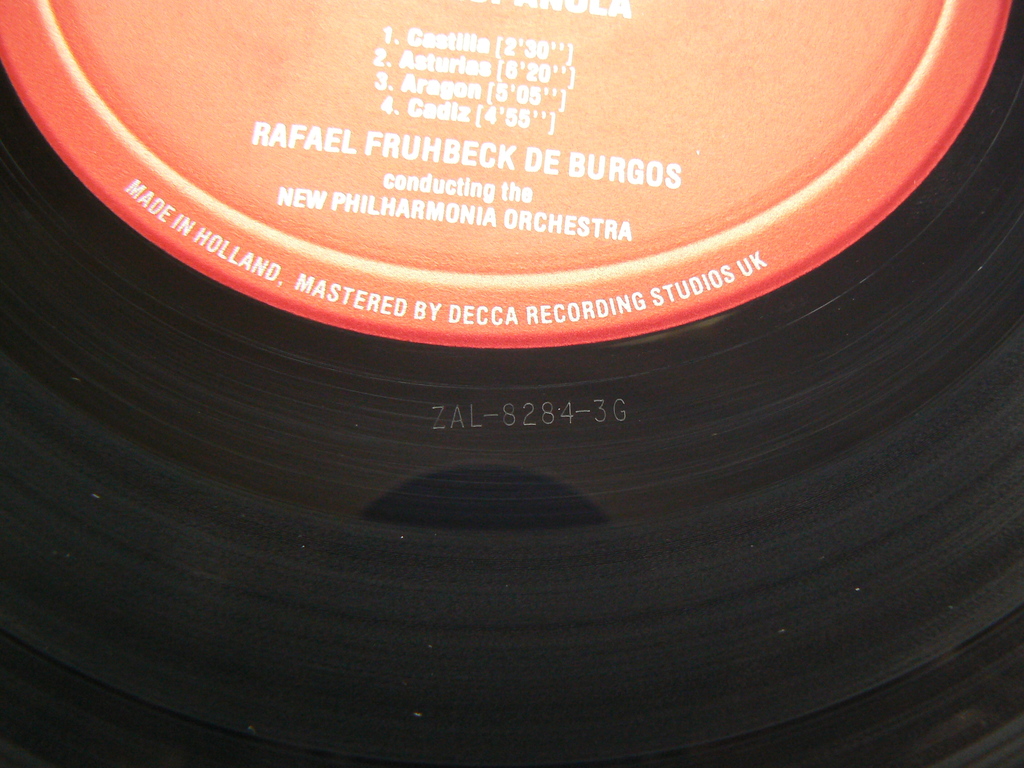
"ZAL"- Means it's a "stereo" recording
"8284"- Is the number of the recording
"3" of "3G"- Means it's the third lacquer made for that recording.
A reader sent me a letter with more useful advice for finding the best pressings of Decca/London classical records, when an actual direct listening comparison is not possible (which is the case 99% of the time). Below is the relevant part of his letter, with some minor editing and my bold:
"I'd say that after the crucial disc cutter change in the industry around 1968, it's best to get the earliest pressings for maximum dynamics and liveliness. And perhaps most important is to look at the stamper codes. Not so much which engineer was involved, although I agree that Ted Burkett (G) seemed to have an edge over most of his colleagues. He was almost entirely responsible for the Argo catalogue, surely one of the reasons these discs sound so good.
I've learned that the Buckingham stamper code is most important of all the details that one should look for with discs manufactured by Decca: 1 and B at respectably 9 o'clock and 3 o'clock (first mother, first stamper) are the best indicators for best sonics. For instance, a 1G at 6 o'clock (first lacquer mastered by Burkett) with e.g. a '4' mother and 'UC' (23rd) stamper will probably not sound as good as a 5G (5th lacquer mastered by Burkett) with 1B stampers. With literally hundreds of Decca's, London's, Argo's, etc. going through my hands over the years, that is probably THE one consistent aspect to explain sonic differences between various pressings. Not the mastering engineer and certainly not the label, as Decca and London are indeed created equal. Like you, I had already arrived to that conclusion simply by listening, years before the 'proof' was finally presented by the leaflet of the Borodin record turning up."
Personal Notes- I've seen this code before, many times in fact, but I regret now that I did not take it as seriously as I should have. However, I still believe that a "G" is the single most important detail to look for when searching for Decca's best sonics, then comes the Buckingham code mentioned by the reader. So a "G" still trumps everything else, though, to be fair, only a minority of records had a choice of mastering engineers, so the Buckingham code is more practical in the majority of cases. A little warning though, the Buckingham codes are sometimes difficult to read.
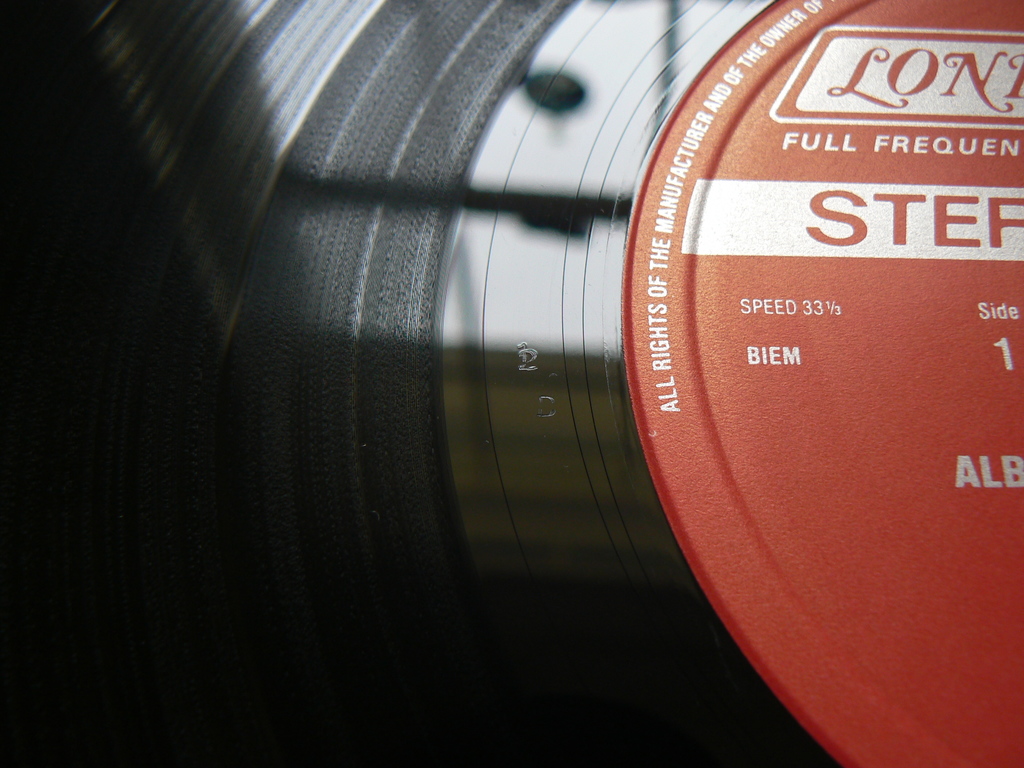
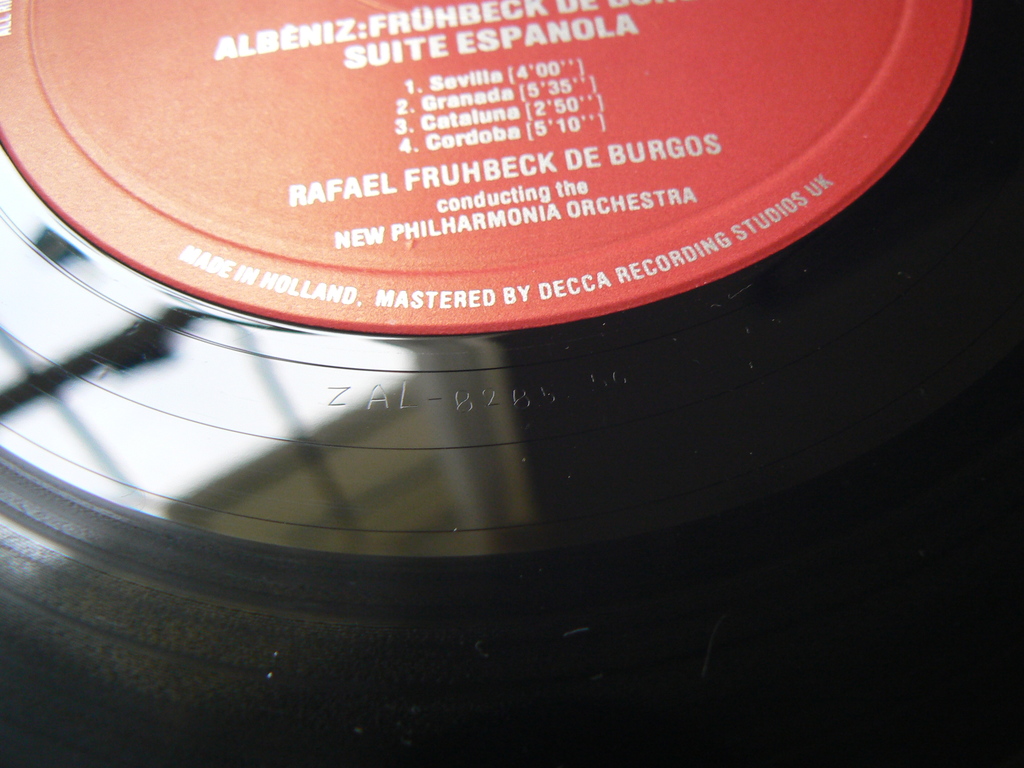
Also, the (Dutch) London "Suite Espanola", which came in first place in the shootout above, happens to be a 3/5G, and it was noticeably superior to the (1G) UK Decca. However, the Buckingham code was no longer being used when this particular LP was pressed. Below are the deadwax pictures of the "champion" LP:
I just received this letter from a reader concerning British Decca Pressings. Here it is, slightly edited:
"On your website you write about late British Deccas:
These records are difficult to distinguish from the other Decca/London's. However, they do have a shinier, darker vinyl compared to the earlier pressings. The record labels also look a little more 'modern' and the printing appears in better 'focus'.
I was just checking two of these (box sets 85d and 156d), and noticed that the date is printed on the lower corner of the inner sleeve. The 85 is of 1977 and the sleve states 1-78 and the 156d, 9-79. This seems credible to me, since on the later is even handwriten the date 25/3/1980." (8/05)
Personal Note- I have now checked a few of my own Deccas, and found that the relevant dating information is indeed on the BACK of their familiar inner sleeve, in the bottom left hand corner, though ONLY on the later pressings. This is also true for the Argo, London etc. pressings that I checked out. Many thanks to this helpful reader.
Top
The Definitive Proof!!
For around 20 years now, I have made the "controversial" claim that Decca and London Classical Records were manufactured to the exact same high standards. Meanwhile, almost all classical record collectors and used record establishments have claimed, in stark contrast, that the Londons, all of them, were deliberately sabotaged to sound worse than the Deccas, despite the firm denials by all of the actual Decca engineers and marketing executives. Since most people still believe in this "London sabotage conspiracy", the Deccas are much more valued by "serious collectors" and, of course, sell for a much higher price.
Some time ago now, I received an e-mail from a reader in Europe. Here it is, with some minor editing:
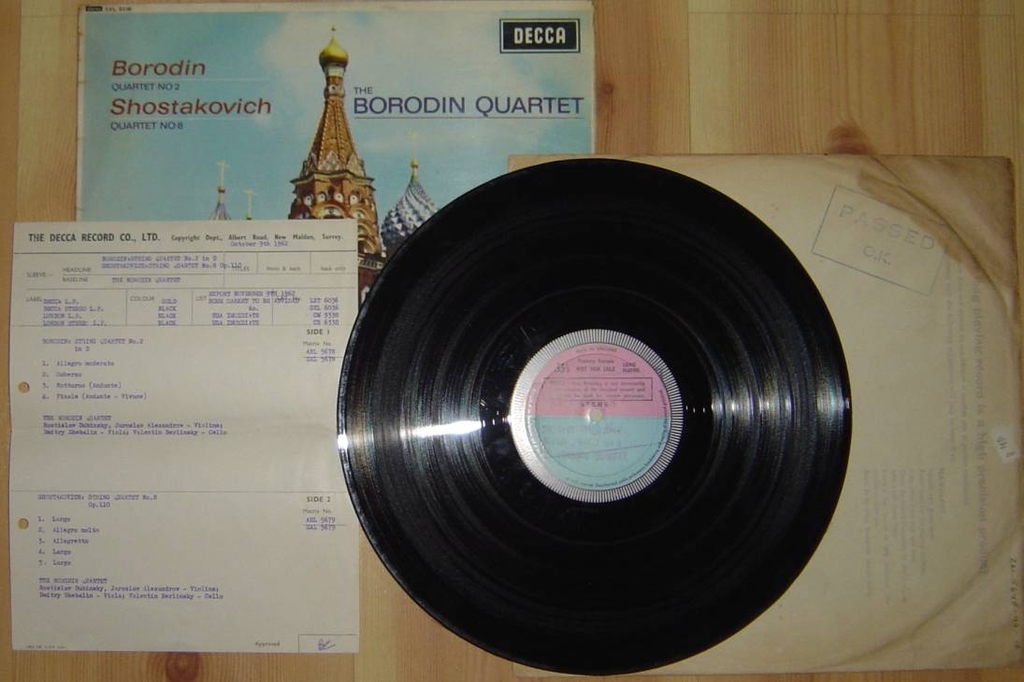
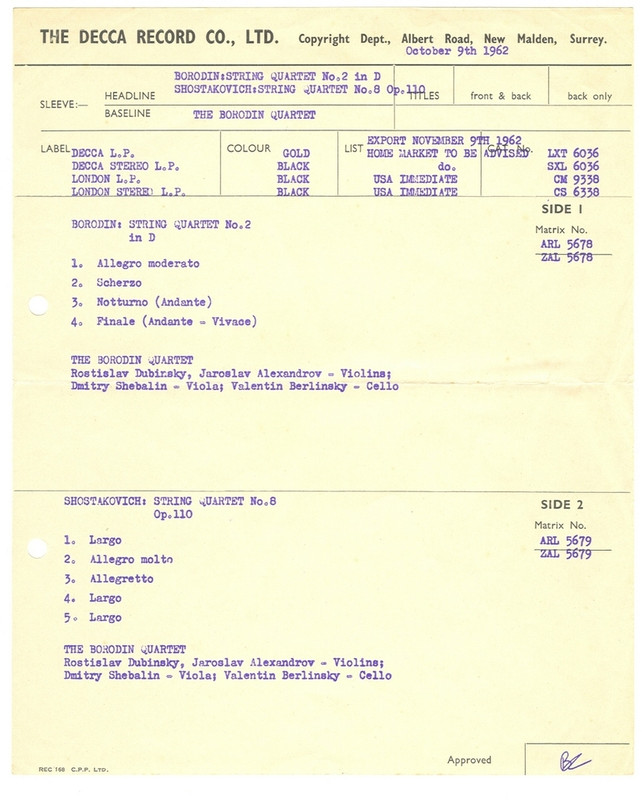
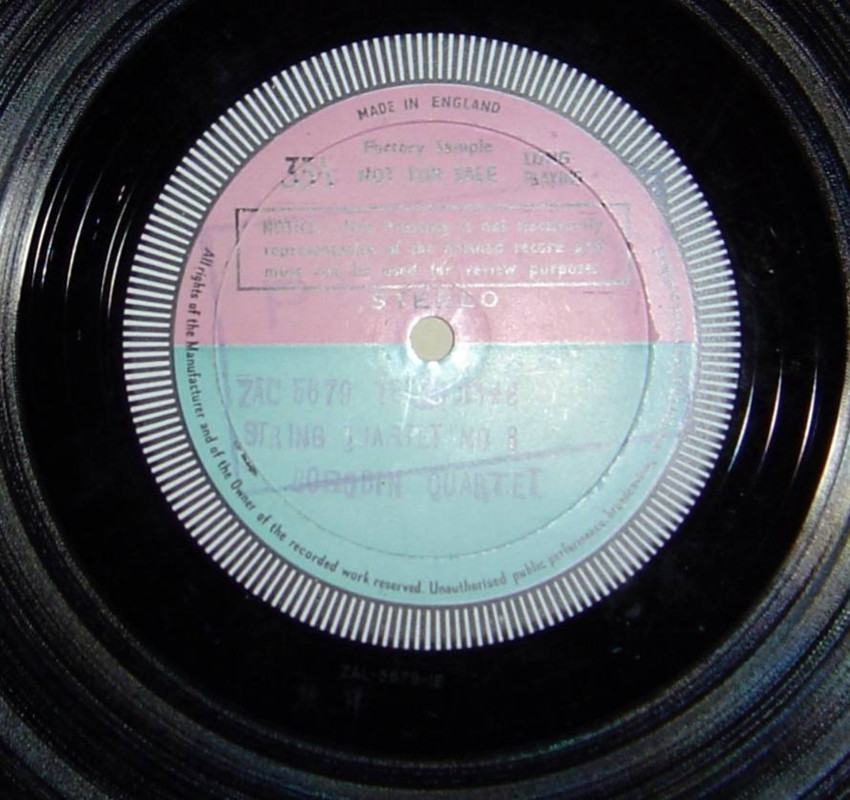
"I have an original Decca factory sample LP of SXL 6036, dated October 9th 1962, which includes the actual approval sheet from Decca, stating which labels are to be printed from this master; those being Londons and Deccas, both in stereo and mono. This is the ultimate proof on your thoughts that Londons and Deccas are the same.
I have closed many disputes over this issue, even to very hardcore Decca collectors, some of which also have offered me substantial amounts of money to buy this proof (some of them were dealers of classical records, so I think they had destruction in mind)."
Personal Note- I can now provide a Link to the above mentioned document, which proves, beyond any doubt, that Decca and London records were made from the exact same master. Here it is:
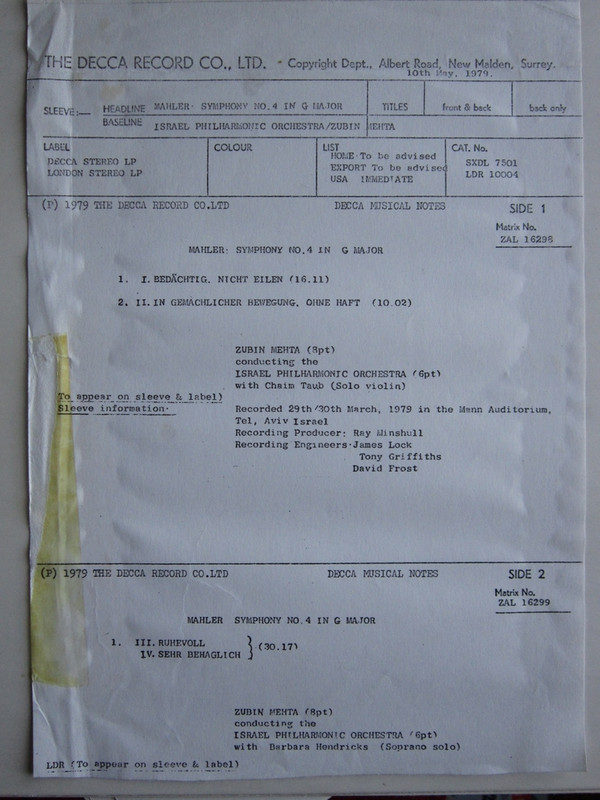
Further- Better yet, I also have my own pictures as well, of not only the above discussed document, but now even another separate document, which confirms the first:
Top
1. Middle to Late Pressings- Pressings from around 1970 to the end. There is less variability with EMIs than Londons. Sometimes the 1970s pressings (postage stamps) are a little warmer and more full-bodied than the late pressings (large Nippers), particularly if they have thicker vinyl, but the late EMIs usually sound more immediate, cleaner etc.
The "collectors" always prefer the earliest pressings, but that's just their predictable bias. Remember, like the Dutch London's, the large Nippers were still available in the 1980s and you know the rest by now. Don't fall for it.
2. Early pressings- from the late 50s to the late 60s. These records are very rare and expensive, and don't sound very good. They are (like the early London's) veiled, distorted and lack bloom, inner detail and dynamic shading. Any middle to late pressing will sound much better.
However, unlike London/Decca, only some were reissued so the originals may be all you can find (if you can!) in many instances. They are fun to hold and look at, even to play, at least until you hear a superior later pressing your friend bought for 20% of the price you paid.
Note- Many of the original EMIs were marketed under the Columbia label, using a "SAX" prefix. They are actually EMI recordings, regardless of the name used then.
3. Non-English Pressings- The first and most important rule is to avoid all North American Pressings (Angels), with the one important exception of those LPs that are from digital recordings. The Angels used inferior (regenerated) mastering tapes and mastering equipment, and inferior, noisy vinyl. The North American budget label (Seraphim) was even worse than the Angels.
German pressings can be as good as the English if the original recording was made in Germany. They can be almost as good when recorded elsewhere, with a further advantage that they may have quieter pressings. Unfortunately, their notes and librettos are rarely in English.
French pressings can also be quite good, but are usually somewhat veiled and colored compared to either the English or German. They are still far preferable to those from North America.
Top1. Early Pressings- This time the dealers and collectors are right! The earliest pressings are the best, and the earlier the better most of the time. That is if you can find them in good condition.
The differences between the early pressings are normally small, and are greatly exaggerated by the collectors and dealers. Sometimes though, the differences are large, even with identical pressings. The later pressings became progressively worse. The recent reissues (from Classic), discussed below, are the real competition.
2. Later Pressings- Late 1960s until the 1980s. Big disappointments. Very few sound excellent. The recent reissues from Classic Records make these pressings obsolete, unless you're really on a tight budget, or don't care about sonics. But then, if that were the case, you wouldn't be reading essay this in the first place.
3. Victrola Budget Reissues- These were the budget reissues made by RCA themselves that came out shortly after the "Shaded Dog" originals. A rare few of them are also "originals". They have a good reputation with the "collector crowd", who are easily impressed by anything that is "old". I've owned a large number of them, and I found them to be noisy and distorted compared to the full priced Shaded Dogs. If I had to guess the technical reasons for this, I would say the use of inferior and noisy vinyl plus the use of worn and/or inferior stampers. I would avoid them if possible.
It is a historical fact that RCA, through a publicized corporate policy, both cheapened and altered their records (all for the worse) from the Late 1960s and on.
First it was Dynagroove, which was a process that added an unnatural equalization to the sound, that was supposed to compensate for listening at "average volumes".
Then came Dynaflex, which were records pressed with the least amount of vinyl in history. The resulting number of warped and noisy LPs was unprecedented, at least for Classical Music records.
At the time, RCA actually stated that these two alterations were "improvements". No one believed them, especially after hearing the miserable, audible results of these two changes; which were obvious to any objective listener. Since then, even RCA has acknowledged that both of these "innovations" were mistakes.
Taking an unscrupulous advantage of this undeniable reality, concerning just one label, used record dealers and collectors proclaimed that all classical record reissues, on all labels, were inferior to the early and original pressings, despite absolutely no technical evidence to support their all-inclusive "theory". (There is evidence that some other labels, Everest, Mercury etc. also decided to compromise their sonics for various reasons, but there is a huge difference between "some" and "all".)
Audiophiles and novice record collectors bought into these "observations", because, at the time they were published (20 years ago), the audiophile community believed everything it read, to the degree of ignoring what they actually heard with their own ears.
In this case, the originals were so rare, that extremely few people, with an objective perspective, had the opportunity to make actual comparisons, which would have verified (or disproved) the supposed superiority of all the originals. When no challenges were made, or at least printed, the observations became "conventional wisdom", and finally, "undisputed laws".
As far as I am aware, this essay and website are the first, and only, challenge to these "laws". It will remain so because I have made the comparisons and I now know that these "laws" have absolutely no foundation in reality. In other words, they are a "big lie". As the Nazi propaganda master, Joseph Goebbels, once said, and I paraphrase;
The people who proclaim and propagate these "laws" are the true enemies of both the many, maligned recording and mastering engineers, who made real, unrecognized, sonic improvements over a two decade period, and also the numerous audiophiles and music lovers, who are not enjoying the results of these engineers' superior equipment and efforts, based on only self-serving lies, greed and prejudice.
Top1. "Golden Import/Series" from Holland and Canada- There is no greater misinformation concerning pressings than that about the Mercurys. After around 25 comparisons with early originals, reissues and then the final Dutch pressings, I've come to the conclusion that, in about 75% of the time, the Dutch sound best overall.
However, there are two potential problems with the Dutch pressings; in some instances they put too much music on one side, which severely compresses dynamics and also increases distortion. The other problem is that many have rolled off bass. Finally, some original Mercurys were never reissued.
In general though, just like the Decca/London's described above, the Dutch Mercurys are cleaner, more transparent, less noisy and have considerably more low-level information; air, ambiance, decay etc. This only makes sense, since they used superior cutting amplifiers than those available 20 years earlier, plus much purer and cleaner vinyl. The newer pressings are also much quieter and don't have that "old record" sound.
The rare English Mercurys are even better in some ways, but only a few were ever issued, and some with Philips covers. The Canadian pressings (Golden Series) were presumably mastered with tube amplifiers and are also excellent, and even cheaper (and rarer).
How people can truly believe there can be progress in only the playback of records and not in their mastering and pressing remains a total mystery to me. This manner of thinking is completely irrational, if not degenerative.
2. Earliest pressings- These are probably the most overrated records of all time. In fact they're the "Linn Sondek" of software, but the dealers and collectors are correct when they state that the earliest U.S. pressings are superior to the later ones. It's very similar to the RCA situation, if you ignore the Dutch and Canadian (and the very rare English) Mercurys in the mix.
The originals do have some excellent things going for them; they have outstanding bass and dynamics, mainly due to their laudable efforts and the short times on the sides. They also have a large and focused soundstage. If there was a method to combine the strengths of the Dutch and the early "originals", you would have some of the finest LPs ever made.
However, the earliest pressings will usually be in questionable condition, and remember that they used inferior vinyl and were noisy to begin with. What a dilemma! It was all supposed to be solved with the new reissues from Classic Records, but only 6 ever came out.
3. Later U.S. pressings- The dealers and collectors are correct in this instance; the later the pressings the worse they sound. I don't know why (to reduce tracking problems?) or how (there must be a technical reason), but it's true and there is anecdotal evidence that supports this account. Our best hope is that the Mercury reissues start up again sometime soon.
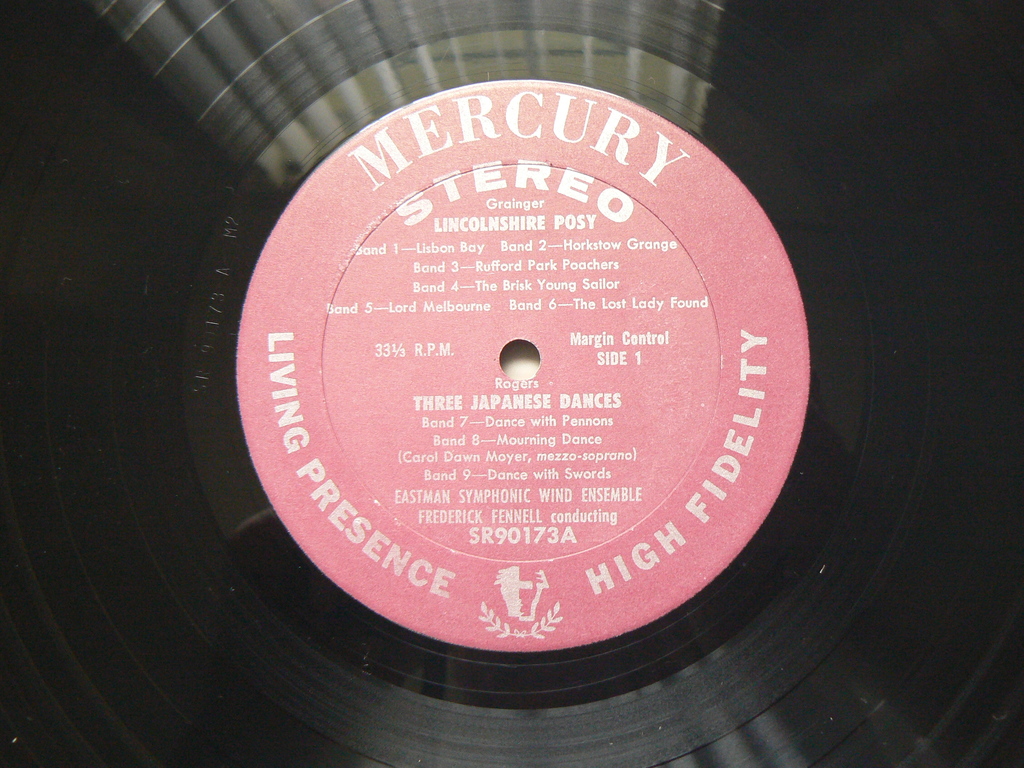
There was a thread in Audiogon on this controversial subject in December 2006. As usual, one of the posters wrote that it was "laughable" that I (or anyone) could ever claim than any reissue, such as the Golden Imports, even approached the incredible, and near flawless, sonic standards of the original "Living Presence" Mercurys. So I decided to make another comparison of two Mercurys, with the exact same musical compositions; The very famous "Winds in Hi-Fi":
1. SR90173 (the original, which is also on the TAS/HP "Super Disc" List*) and
2. SRI 75093 (the Golden Imports) Dutch reissue.
The results actually surprised me. I thought it would be closer, but the Golden Imports was so far superior to the Living Presence that I was concerned about how I would concisely describe the full scope of the differences** between them. Well, it's like the differences between the finest moving coil you've ever heard, and a decent $ 50 moving magnet, and that's being kind about the MM. To be frank, and to skip the diplomacy...
When I played the Living Presence, it actually sounded like I had exchanged a component in my system with one that was defective (but still working), and that's not an exaggeration. The differences were not "audiophile" in nature; Your half-deaf neighbor or brother-in-law can easily hear what I'm describing. In my almost 40 years as an audiophile, plus in my two decades of owning an audio store, where I participated in thousands of component comparisons, with every type of audiophile imaginable, I can never remember any time when someone preferred the degree of sonic degradation clearly audible with the Mercury Living Presence.
I've read about the concept of "cognitive dissonance". There's one famous historical example of it, which I don't know for certain actually occured: The island natives, in 1492, apparently weren't able to "see" Christopher Columbus' ships floating in the ocean, because they were so alien to their imagination of what was possible. Anyone who compares these two records***, and actually prefers the Living Presence to the Golden Imports, suffers from the same condition, or worse.
*I'm amazed that Harry Pearson was impressed enough with this record's mediocre sound to actually distinguish it. I couldn't disagree more with his assessment, since I've heard literally thousands of better soundings LPs. This one record, on its own, reveals the stark contrast between the respective sonic standards of Pearson and myself.
**The Golden Imports was much more immediate, transparent, natural, cleaner, quieter and had considerably more inner and outer details, greater separation of instruments, plus superior micro and macro dynamics. The sound-floor was also much lower. The bass and soundstage were about the same on both. The Living Presence had a touch more "body".
***I'm not making a "Rule" about all Mercury pressings because of this one particular comparison. Many of the other Golden Imports reissues have their own problems, mainly because there was too much music mastered on them, so neither of the pressings is always better than the other. The main point I'm making here is simple: Ignoring the technical limitations and the engineering problems of the late 1950s/early 1960s, plus the cheap vinyl used by Mercury back then, is a fool's choice with real-life consequences; wasted money and inferior sonics.
I recently made a 3-way comparison of a famous (TAS listed) Mercury recording; "Winds in Hi-Fi". The recording was made around 50 years ago (1958). I am fortunate to have a mint copy of the earliest original pressing (SR90173), plus the Mercury Golden Imports Reissue (SRI 75093) and now a new copy of the recent Speakers Corner (180 gram) Reissue.
In the past couple of years, I've received a number of letters from readers asking me for my opinion of these latest reissues, but I never heard one of them until now. (I attempted to purchase almost all of the Speakers Corner Mercurys from Acoustic Sounds, along with many other LPs, but they refused to give me my former modest discount, so I cancelled the order. I purchased this particular reissue on eBay. I have never received "free review" LPs from anyone.)
I already made this comparison back in 2007, but I duplicated it because I wanted to be thorough. The results were the same: The Golden Imports (GI) "wipes the floor" with the "Original Pressing". To repeat my previous post: It's like the differences between the finest moving coil you've ever heard, and a decent $ 50 moving magnet, and that's being kind about the MM. To be frank, and to skip the diplomacy...The GI was much more immediate, transparent, natural, cleaner, quieter and had considerably more inner and outer details, greater separation of instruments, plus superior micro and macro dynamics. The sound-floor was also much lower. The bass and soundstage were about the same on both. The Living Presence had one advantage: a touch more "body".
The Speakers Corner (SC) reissue was well made, which isn't surprising for this company. The LP was both flat and quiet, and the outer jacket was clear and glossy. The sonic comparison was also a lot closer. In fact, I even went back and forth a few times (A/B/A/B) to confirm what I heard. The SC had more body, more noticeable tape hiss and the bass also went a little lower. The GI, in turn, was more detailed (inner and outer), immediate, transparent and cleaner. Overall, I preferred the Golden Import, though the Speakers Corner was still quite respectable. Neither of them are "outstanding". To be honest, I was somewhat disappointed with these results, since I was hoping that the SC would be far better than the GI (like the finest Classic Records Mercury Reissues).
So, what is my opinion and advice at this point? (which can still change depending on other Speakers Corner Mercury Reissues I hear)...
There are now four different pressings of the Mercury catalog, though only the original pressings are complete. Based on my auditions, this is how they rank in desirability (and I would read the fine details, because this is necessarily somewhat complicated):
1. Classic Records Reissues (both 33 and 45 RPM)- These are, by far, the best sounding Mercury pressings. Unfortunately, only six records were ever released by Classic. Three of them (Ravel, Prokofiev and Stravinsky) are among the very finest sounding records ever made by anyone. Every audiophile (with a turntable) should have these "big three".
2. Golden Imports (including the Canadian "Golden Series")- These are not in the same league as the Classic Records reissues, but a few of them are excellent. In fact, 6 of them are in The Supreme Recordings, and another 3 are in The Honorable Mentions. There are others that are pretty good, but they also have some problems, mainly from putting too much music on a side (and totally avoid all their "electronically enhanced stereo" LPs, they're awful). Further, and in consequence, the deep bass is rolled-off on many of them. If you find some pressings that match the original's musical selections, without any additions, then they are a safe choice. If not, then...
3. Speakers Corner Reissues- With the exception of the 9 total records mentioned above, which are already in The Supreme Recordings, these are now the best choice for the remainder of the Mercury catalog. They are new, and have sonics that are comparable to the best of the Golden Imports. They should be noticeably superior to those many Golden Imports with extra music. They also have the original covers etc. Hopefully, they will come out with all of the most in-demand Mercury recordings, including the rarities. I'm still hoping that this particular reissue is atypical, and their other Mercury reissues have superior results.
4. Original "Living Presence"- These are desirable only for serious "collectors of original pressings", who will want them regardless of their actual sound (which they almost always overestimate), and, of course, for all those music lovers looking for the Mercury recordings that were never reissued by anyone.
Top (Left to Right)- Original Pressing, Golden Import Reissue
Bottom- Speakers Corner Reissue

I was fortunate enough to win an eBay auction of three Mercury classical reissues from Speakers Corner (I have never received any "review copies" from this label) in late August 2013. The three records are:
1. Wagner for Band - SR90276
2. Rachmaninoff - Piano Concerto No. 3 - SR90283
3. Respighi - The Birds/Brazilian Impressions - SR90153
I have now auditioned these records, and I have great news to report: ALL THREE of these LPs are outstanding, and superior to BOTH the original (US Mercury) pressings and the Golden Imports reissues. This unexpected good news now changes my previous recommendations concerning Mercury Classical record pressings (seen above). As of NOW, this is what I advise...
With the exception of the "Big 3" Classic Records reissues (mentioned above), I now prefer the new Speakers Corner reissues over any alternatives I know at this time. Caveats- There could be future ORG releases (45 RPM) to take into consideration (I have one of them at present, to be auditioned). Also, "Winds in Hi-Fi" (SR90173), the first Speakers Corner reissue I heard, wasn't as successful as the others.
Top1. Early pressings- Once again the earlier pressings do sound better. The differences are noticeable; they are warmer, with more natural body, and have a larger soundstage etc. (Similar to the typical differences between tube and transistor amplifiers from that period.) So it's worth it to search them out, but only if the music and performance are important to you. However, none of the Columbia pressings sound good enough to make it a really big deal. Why?
Not even the finest Columbia records approach the sonics of any high quality RCA or Mercury, let alone the best from Decca and EMI. They're noticeably dirty, noisy and unnatural sounding, especially in the high frequencies, compared to the better recordings, let alone the best.
2. Later Pressings- As mentioned above, they're not quite as good, but, in most instances, it's nothing to worry about. I suspect the reason is simple; the master tapes weren't good enough in the first place to either make a great sounding record or to screw one of them up.
Further- The jazz records by Columbia, Miles Davis etc., are a totally different story. The early pressings are noticeably superior and are worth hunting down and paying the price premium. The recent reissues, by Classic Records, are still preferable (overall) to any pressings I've heard from the past, but my experience in this area is very limited. Many people, who are both objective and with more experience than I have, still prefer the originals.
The best pressings I've heard from the DGG label are Canadian*, believe it or not! Why? I was told, by someone that I trust, that they were mastered with high-quality tube* amplifiers. They're also cheap. Unfortunately, not too many titles were pressed, but I would not pass them by if you see them.
Early German pressings are sometimes slightly better (they used thicker vinyl) than the reissues, but the differences are even smaller than with Columbia. In fact, too small for anyone but the fanatics to care about, mainly because the recordings themselves are almost always mediocre, especially when compared to the best from Decca, RCA etc.
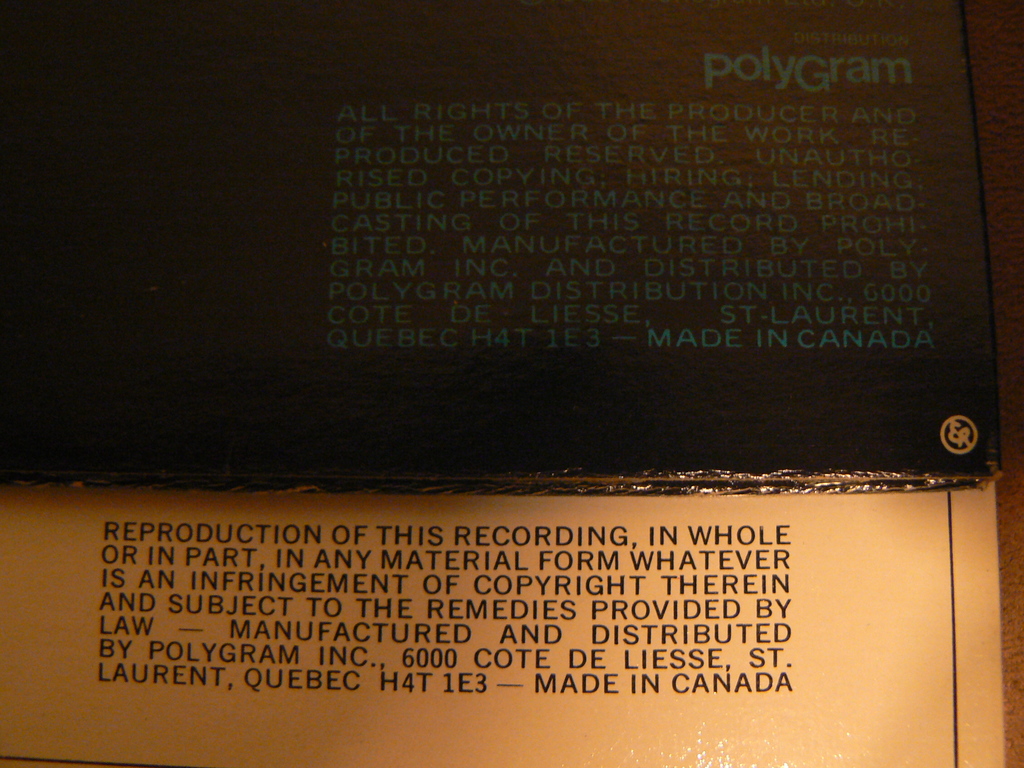
*The tube masterings must have this name and address on the back cover: "POLYGRAM INC. 6000 COTE DE LIESSE. ST. LAURENT, QUEBEC H4T 1E3 - MADE IN CANADA" (see picture below). Any other addresses should be avoided.
Many of Philips and Telefunken classical music box sets have thin pieces of foam to take up empty space and keep the records in place. I've recently found that this foam is now disintigrating into dust. This dust may get into the grooves of the records, so I would, very carefully, remove all the foam. It can be replaced with similar sized cardboard.
Top
RCA (CLASSIC RECORDINGS) - These reissues, on the whole, were a mixed success. While most of them could have been better, we should be grateful for what we did end up getting. I overrated the quality of these reissues when I first wrote and posted this essay 18 years ago. I have now listened to virtually every Classic reissue, and I am not as impressed as I was originally.
The collectors, and the dealers, were closer to the truth than I realized back then. However, their ignorant contention that all of these records were essentially "worthless", was just more self-serving and egotistical nonsense.
The naked hatred these collectors have for Classis Records all stems from the loss in monetary value of many of their (once expensive) originals, along with the further loss of their once exclusivity of ownership of some of the more ultra-rare titles. These collectors paid big money for some of the originals and assumed they would keep rising in value. That fantasy is over. In fact, some of the Classic reissues are now "collectibles" themselves, and worth considerable money.
The presentations, of course, are far superior; the glossy covers are as good as it gets, the vinyl is virgin and 180 grams. The sound, obviously the most important consideration, is far superior to the originals in many, if not most areas, but not all!
Many of the early reissues have a somewhat "cold, analytic" quality. They weren't "sterile", but there is a noticeable lack of natural warmth and bloom. At their worst, some of them sound unnaturally "bright" and even "metallic" at times.
While this is a real problem, the used record dealers have blown it all out of proportion, because in virtually every other way; cleanness, immediacy, precision, dynamics and frequency range etc., the reissues are far superior to the originals. Plus, the reissues are NEW, with all the advantages that entails.
The problems they do have were probably caused by a combination of solid-state mastering, instead of tubes that were used in the original pressings; the (now exposed) weaknesses within the original master tapes; and an inferior vinyl. The later RCA reissues used both a new vinyl formulation plus tube amplifiers (finally!) in the mastering process. They definitely sound better and should end the controversy for all but the most biased, who will never accept any reissues, no matter how good they sound.
I have to admit that I have never been as impressed with the original RCA recordings as much as the best I've heard from the other Classical record labels. I still feel that Decca, EMI and Mercury, produced superior recordings (and eventually records).
That being said, I believe that the finest records, meaning the most "real" and "natural", were made by RCA until the middle to late 1960s. I find their early pressings usually superior to their rivals' equivalents, but they still could not match their rivals' later (and better) pressings mentioned above.
In conclusion: RCA's famous, "Golden Age" recordings, while still excellent or even better, and the finest available at their time of debut, are overrated in the final analysis.
TopCHESKY- These reissues, around for more than 20 years now, are more variable sonically than the Classic RCAs. Their covers are unimaginative and some of their early titles had noisy surfaces. Their last releases, all using 180 gram vinyl, didn't have that problem. They also used superior mastering amplifiers.
The entire Chesky LP catalogue is now deleted. This is a true tragedy, because some of these later Chesky reissues were sonic masterpieces. In fact, one of them (Petroushka-Danon) may be the finest LP of an orchestra ever made!
DECCA (SPEAKERS CORNER)- These are almost all excellent. The biggest improvements are heard with the earliest recordings, which were mainly the "2000 series", or London "Bluebacks" (1956-1968). They actually sound "modern" for the first time, in the most positive sense of that word. However, I have found that the more recent the recording, the smaller the improvement in sound, but then this only makes sense since Decca itself had access to improved mastering equipment as the years went on.
In fact, a good number of these reissues, while still excellent, do not equal the sonics of the finest of the original pressings from Decca if it was a later recording (from around 1969 to 1982, the end of the analogue era). This is especially true if the original was a "G" pressing, which trumps everything else. Unlike the Classic RCAs, these reissues have no obvious downsides, and the selection is excellent.
DECCA/EMI (ALTO)- They are basically the same in quality as the Speakers Corner. However, two EMI Alto reissues I've heard are on 3 sides, in contrast to the original's two, and they are both stupendous. Both of these albums are in The Supreme Recordings.
EMI TESTAMENT- These reissues are mainly focused on early, EMI violin recordings. They sound decent and have quiet surfaces, but they are a disappointment in the final analysis. They are clean and transparent, but they are also quite dry and analytical. The originals are grossly overrated recordings, and they are usually incredibly over priced, but I still prefer them in sonics.
ANALOGUE PRODUCTIONS - There are only a few classical reissues by this label (most are jazz etc.), but these few are superb, and some are outstanding. It's a shame that these, like the Cheskys, didn't sell better. If they did, we would have more titles by now. Instead, audiophiles have been spending their money on overpriced and inferior originals.
KING SUPER ANALOGUE - These are also Decca/London reissues. The now deleted, original Japanese pressings are pricey. They're usually cut at a low level, so you have to turn up the volume a little bit. One other problem; the liner notes are in Japanese only.
The Japanese pressings were uniformly excellent, and competitive with their English and Dutch equivalents. They had advantages with their quiet surfaces, heavy vinyl and large mastering amplifiers. I found some of them to be superior to their English equivalents (Three Cornered Hat-Ansermet and Mahler's 3rd-Mehta), but some of them were veiled in comparison (Russian Music-Ansermet). All of them were at least excellent.
The later (Cisco) pressings, still being made in the U.S., are not as successful as the older Japanese. I don't know why, but with a different pressing plant and vinyl formulation, a good educated guess can be made. On direct comparison, the Speakers Corner reissues are also superior. So these recent pressings are only recommended when there are no alternatives.
MERCURY (CLASSIC RECORDINGS)- Only six of them came out, and it's now doubtful whether any more will ever be made. They were mastered with tubes, just like the originals. The Mercury catalogue is the only one left that has great material that was never realized to its full sonic potential. At least 50 titles are "musts". Speakers Corner has recently began reissuing some titles with generally excellent results.
I have since heard 5 out of the 6 titles. Three of them are stupendous, and two of them are disappointments. The lengthy details of these auditions are in The Supreme Recordings.
MOBILE FIDELITY - They only made a small number of classical reissues, mainly during the first time around, in the early 1980s. They were usually excellent and very underrated, though a few of them were real "clunkers".
You can still get them for (mainly) reasonable prices. There were two UHQRs, and both of them are very desirable, and a few others that were also dynamite. The "details" are also in The Supreme Recordings.
Meanwhile, the pop, rock and jazz Mobiles were much more variable. A good number of them were major disappointments.
I listened to 8 of the Everest reissues, 7 of which I purchased new (from Acoustics Sound, which had a sale on them for $ 25 each) and one was purchased used, when I won an auction on eBay. Their sonics are very similar, so I won't have to make a serious distinction between them. Here is what I have observed.
In general, they are excellent records, but not outstanding (with one exception). Their strengths are a full-bodied "musical" quality, that many audiophiles value, plus they have a large soundstage, and excellent bass. Their dynamic qualities are outstanding, and it's also important to note that the sonics don't degrade when the music becomes loud and complex, which is a rare quality. They also have some downsides...
They are somewhat "euphonic" and "forgiving" in character, like a vintage tube amplifier. They lack fine inner detail, and are also a little homogenized, even at low volume levels. They are somewhat veiled compared to the finest records, and their sound-floor is barely above average. They have an easily noticeable problem with speed stability, which may drive some sensitive listeners crazy. Finally, they lack that "alive" and "immediate" quality that the finest records possess. Still, quite a good score overall though, so all (but one) of them will be placed in The Honorable Mentions*.
Addendum 1: I've heard the original pressings of many Everest records, and none of them even approached the sound of these reissues. Worse, they used cheap vinyl, which was unacceptably noisy, even for its own day.
Addendum 2: I've compared these reissues to an older (Classic Records) Everest reissue from the late 1990s, which I now realize I underrated in the past; Antill's Corroboree (SDBR-3003). To be blunt: The Corroboree "wipes the floor" with all of them. It is a stunning recording, even shocking at times, with very interesting music. Make the comparison to hear for yourself the differences between "excellent" and "great".
Further, the Corroboree has no mention of a "35mm magnetic film recording", while these recent reissues make this highly prominent. Finally, the Corroboree has no "speed issues", while the recent reissues definitely do. So, "the big question": What Happened?
*One of them, DEFALLA-THE THREE-CORNERED HAT-JORDA-EVEREST SDBR 3057, is better than the others, and goes into The Basic List.
Top
I wrote in generalities in this section. I was forced to, because within the subject of record pressings and labels, there are no "absolutes". There are exceptions to virtually everything I wrote within each label and pressing description; some early pressings actually sound excellent, and some of the reissues that I touted above may be inferior.
The only important point is simple:
Top
Below is a short list of my favorite recordings of the music of the great Classical composers which I also consider to be among their most essential to hear and own. This list will be for those audiophiles and/or music lovers who want to "get into Classical Music", but have found no other place to start. I'm not a musicologist, nor a formerly trained musician or record reviewer, but I've been listening and studying this music for more than 50 years, and the recordings I will choose have brought me great joy and satisfaction for many years and, in some instances, decades.
The music and the performances are the only two criteria on this list, and not the sonics, like The Supreme Recordings. I'm not even going to ignore the worst pressings. Finally, these compositions are almost all great masterpieces, meaning no one performance can ever be "definitive", so other choices may be equally (or even more) satisfying to many music lovers.
BACH-ORGAN FAVORITES VOL. 1-BIGGS-COLUMBIA MS 6261
BACH-ORGAN MUSIC-WALCHA-DGG 139 114
BACH-BRANDENBURG CONCERTOS-MUNCHINGER-DECCA 5 BB 130/1/LONDON CSA 2301
BACH-MASS IN B MINOR-RICHTER-DGG ARCHIVE 2710 001
BARTOK-CONCERTO FOR ORCHESTRA-SOLTI-DECCA SXL 6212/LONDON CS 6784
BEETHOVEN-PIANO SONATAS (8-14-23)-ARRAU-PHILIPS 6599 308
BEETHOVEN-PIANO SONATAS (17-21)-ARRAU-PHILIPS 6570 190
BEETHOVEN-LATE QUARTETS (12-16)-VEGH QUARTET-TELEFUNKEN SKA 25113-T/1-4 (6.35040)
BEETHOVEN-THE FIVE PIANO CONCERTOS-ASHKENAZY-DECCA SXL 6594/7/LONDON CSA-2404
BEETHOVEN-VIOLIN CONCERTO-GRUMIAUX-PHILIPS 6500 775
BEETHOVEN-THE NINE SYMPHONIES (1960s)-KARAJAN-DEUTSCHE GRAMMOPHON 2721 055
BEETHOVEN-SYMPHONY NO. 6 ("PASTORALE")-WALTER-COLUMBIA MS 6012
BEETHOVEN-MISSA SOLEMNIS-KARAJAN-EMI SLS 5198/ANGEL S 3595
BERLIOZ-SYMPHONY FANTASTIQUE-FRECCIA-CHESKY CR1
BIZET-CARMEN-DE LOS ANGELES/BEECHAM-EMI SLS 5021/ANGEL S 3613
BRAHMS-VIOLIN CONCERTO-GRUMIAUX-PHILIPS 6500 299
BRAHMS-THE FOUR SYMPHONIES-SZELL-COLUMBIA 77356
BRAHMS-A GERMAN REQUIEM-KARAJAN-EMI SLS 996/ANGEL S 3838
BRUCKNER-SYMPHONY NO. 4-JOCHUM-DGG 2535 111
BRUCKNER-SYMPHONY NO. 9-KARAJAN-DGG 139011
COPLAND-RODEO/BILLY THE KID (COMPLETE BALLETS)-SLATKIN-ANGEL DS-37357
DEBUSSY-IMAGES I/II-MICHELANGELI-DEUTSCHE GRAMMOPHON 2530 196
DEBUSSY-LA MER/NOCTURNES-GIULINI-EMI SXLP 30146/ANGEL S 35977
DVORAK-SYMPHONY NO. 9-KERTESZ-DECCA SXL 6291/JB 118/LONDON CS 6527
DE FALLA-EL AMOR BRUJO-STOKOWSKI-COLUMBIA MS 6147
DE FALLA-THE THREE CORNERED HAT-ANSERMET-DECCA SXL 2296/SDD 321/LONDON CS 6224
GERSHWIN-RHAPSODY IN BLUE/AN AMERICAN IN PARIS-BERNSTEIN-COLUMBIA MS 6091
GERSHWIN-PORGY AND BESS-MAAZEL-LONDON OSA 13116/DECCA SET 609-11
GRIEG-PEER GYNT-BARBIROLLI-EMI (COLUMBIA) TWO 269/ANGEL S 36531
HANDEL-FIREWORKS MUSIC/WATER MUSIC-MARRINER-ARGO ZRG 697
HANDEL-MESSIAH-MACKERRAS-EMI SLS 774 (OR ANGEL)
HOLST-THE PLANETS-PREVIN-EMI ASD 3002/ANGEL S 36991
JANACEK-TARAS BULBA/SINFONIETTA-ZINMAN-PHILIPS 9500 874
MAHLER-SYMPHONY NO. 2-BERNSTEIN-DEUTSCHE GRAMMOPHON 423 395-1
MAHLER-DAS LIED VON DER ERDE-KLEMPERER-EMI SAN 179/ANGEL S 3704
MENDELSSOHN/BRUCH-VIOLIN CONCERTOS-PERLMAN-EMI ASD 2926/ANGEL S 36963
MENDELSSOHN-A MIDSUMMER NIGHT'S DREAM-PREVIN-EMI ASD 3377/ANGEL S 37268
MENDELSSOHN/SCHUBERT-SYMPHONIES 4/8-SINOPOLI-DEUTSCHE GRAMMOPHON 410 862-1
MOZART-CLARINET QUINTET K. 581-PAY/ASMIF-PHILIPS 9500 772
MOZART-CLARINET CONCERTO-BRYMER-PHILIPS 6500 378
MOZART-PIANO CONCERTOS NOS. 20/27-CURZON-DECCA SXL 7007
MOZART-PIANO CONCERTOS NOS. 21/25-BISHOP-PHILIPS 6500 431
MOZART-SYMPHONIES NO. 40 & NO. 41-BOHM-DEUTSCHE GRAMMOPHON 2530 780
MOZART-THE MARRIAGE OF FIGARO-GIULINI-EMI SLS 5152/ANGEL S 3608
MOZART-REQUIEM K. 626-SCHREIER-PHILIPS 6514 320
MUSSORGSKY/RAVEL-PICTURES AT AN EXHIBITION-MUTI-EMI ASD 3645/ANGEL S 37539*
MUSSORGSKY-BORIS GODUNOV (HIGHLIGHTS)-CHRISTOFF/CLUYTENS-EMI SXLP 30547/ANGEL S 36169
PROKOFIEFF-SYMPHONIE NR.5-KARAJAN-DEUTSCHE GRAMMOPHON 139 040
RACHMANINOV/RAVEL-PIANO CONCERTOS-MICHELANGELI-EMI ASD 255/SXLP 30169/ANGEL S 35567
RAVEL-DAPHNIS ET CHLOE-MONTEUX-DECCA SXL 2164/SDD 170/JB 69/LONDON CS 6147/STS 15090
RESPIGHI-FOUNTAINS OF ROME/PINES OF ROME-KARAJAN-DEUTSCHE GRAMMOPHON 2531 055
RIMSKY-KORSAKOFF-SCHEHERAZADE-BEECHAM-ANGEL S 35505/EMI SXLP 30253
RODRIGO-CONCIERTO DE ARANJUEZ-BEHREND-DGG 135117 (2535 170)
SAINT-SAENS-SYMPHONY NO. 3 (ORGAN)-MEHTA-DECCA SXL 6482/LONDON CS 6680
SCHUBERT-PIANO QUINTET (TROUT)-CURZON/VIENNA OCTET-DECCA SXL 2110/SDD 185/LONDON CS 6090
SCHUBERT-STRING QUINTET IN C-ALBAN BERG QUARTET/SCHIFF-EMI ASD 1435291
SCHUBERT-STRING QUARTET "DEATH AND THE MAIDEN"-QUARTETTO ITALIANO-PHILIPS 9500 751
SCHUBERT/MENDELSSOHN-SYMPHONIES 8/4-SINOPOLI-DEUTSCHE GRAMMOPHON 410 862-1
SCHUBERT-SYMPHONY NO. 9-KRIPS-DECCA SXL 2045/LONDON CS 6061/STS 15140
SCRIABIN-POEM OF ECSTASY-MEHTA-DECCA SXL 6325/LONDON CS 6552
SHOSTAKOVITCH-SYMPHONY NO. 5-BERNSTEIN-COLUMBIA MS 6115
SHOSTAKOVITCH-SYMPHONIES 6 & 11-HAITINK-LONDON 411 939-1 (OR BERGLUND/EMI/ANGEL)
SIBELIUS/TCHAIKOVSKY-VIOLIN CONCERTOS-CHUNG-DECCA SXL 6493/LONDON CS 6710
STRAUSS, R.-FOUR LAST SONGS-SCHWARZKOPF/SZELL-EMI ASD 2888/ANGEL S 36347
STRAVINSKY-FIREBIRD SUITE-MUTI-EMI ASD 3645/ANGEL S 37539*
STRAVINSKY-THE RITE OF SPRING-BERNSTEIN-COLUMBIA MS 6010 (OR MUTI/EMI/ANGEL)
TCHAIKOVSKY-THE NUTCRACKER-DORATI-PHILIPS 6747 364/6747 257
TCHAIKOVSKY-SYMPHONIES 4, 5, & 6-MRAVINSKY-DGG (OR MEHTA/DECCA/LONDON)
VAUGHAN WILLIAMS-FANTASIA ON A THEME BY THOMAS TALLIS-BARBIROLLI-EMI ASD 521/ANGEL S 36101
VILLA-LOBOS-FOREST OF THE AMAZON-VILLA-LOBOS/SAYAO-UNITED ARTISTS UAS 8007/UAS 5506
VIVALDI-THE FOUR SEASONS-FASANO-EMI SXLP 30419/ANGEL S 35877
WAGNER-DER RINGS DES NIBELUNGEN (HIGHLIGHTS)-SOLTI-LONDON OSA-1440
Top
Here is a letter from a reader based in the U.K. There is a lot of useful information about UK pressings and recordings that I felt should be shared. There's only very minor editing and my bold as usual:
"... You're obviously based in the United States, so I thought you might be interested to have a view from the UK. I've been buying records since I was a teenager in the late 1960s, almost entirely classical, including a lot of 20th century repertoire. I've never owned top-end playing equipment, not least because, in the crowded south-east of England, one has to consider one's neighbours. (If I could find a way of inducing 'bass roll-off' into the system of the guy in the next apartment...) In fact I'll listen to good music on almost anything - radio, CD, LP, even cassette. Each to his own!
I first became aware of the 'collectors' market' in older classical LPs six or seven years ago. There's a book here called Rare Classical Record Price Guide 2004 which values the Decca and EMI (including Columbia) series originally sold as full-price discs. It's a pretty shoddy effort: omissions, record data very inaccurate, and no effort to limit its pricing to what actually exists in terms of label types for a particular catalogue number. I got a copy, just to see if I had anything 'valuable'. I also got hold of a few dealers' lists, and have since been checking on-line sales listings from time to time. I was intrigued, let's say.
Many years ago, I used to go occasionally with a friend to book fairs. In the book world, the First Edition is king. A phrase we overheard one day became a standing joke between us: '...well, it's all right if you only want to read it...'. (How naive we had been, imagining that reading was what books were for.) For reading purposes, a paperback for a dollar or two at your local used bookshop is just as good as a hardback 'first' costing a hundred or two.
What seems to have happened is that record collectors have caught First Edition disease from the book world, and are trying to justify it by claiming that their 'firsts' do actually read/sound better. (Book collectors tend not to have such delusions.)
Collectors go by labels. You give some interesting opinions on the quality of Decca pressings based on dates. A while back, I compared the issue/review dates of the Decca SXLs with the first labels existing for each. This is what I came up with:
Wide band, grooved- Issues up to about late 1968
Wide band, no groove- Issues from late 1968 to mid 1970
Narrow band- Issues from mid 1970 onwards
What I noticed at once on reading your notes was that the superior Neumann SX-68 cutter was introduced in 1968, more or less coinciding with the abolition of the groove for which collectors will pay so dearly!
The majority of 1970s Decca LPs have dates on the inner sleeves, in the form '6-75', meaning June 1975. This is, of course, the date on which the inner sleeve was manufactured, and is likely to be earlier than the date the record inside was pressed. Dating of inner sleeves seems to have begun in about 1969 and tailed off in the early 1980s.
Since both matrix and record numbers were assigned more or less in sequence in most cases, it's usually possible to tell from the numbers approximately when a particular disc was mastered. In 1975, Decca was up to the high 6600s with its SXL numbers and the high 13000s for its ZAL matrix numbers. By 1979, matrix numbers were in the low 16000s. The copyright date (P in a circle) is often a good guide, too.
There are certainly differences in the exact colours of the narrow band labels. Both the black and the silvery colour vary, as does the degree of surface shine. I'd need to study them carefully to come up with any meaningful conclusions. The most obvious thing is that the lettering gradually changed from a bright, silvery-white to a duller greyish silver. (The same thing happened on the red Headline labels: compare early and late numbers of those and you'll see the basic difference.)
Concerning the Decca v London question, I'll attach a photo of a slip glued to the plain outer sleeve of a test pressing I remember buying soon after it was made. You'll see that it puts the two on an equal footing, as one would expect. In fact it looks as if they were planning to issue the London record first. The inner sleeve is dated 7-78, nine months earlier than the date on the slip itself.
One comment on your various lists, if I may. I note a dearth of recordings of 'standard' 18th/19th Century orchestral repertoire. On a label like Argo that's expected - it was used for the more esoteric music. But the mainstream Decca and EMI labels offered far more discs of Beethoven, Brahms, Mozart, Tchaikovsky et al than they ever did of the mainly 20th Century (with some pre-Baroque) repertoire that features so preponderantly in your lists.
I realize that you base the lists on sonics. Would this imbalance be caused by the fact that the scoring of this "standard" repertoire puts less strain on recording technology, thus giving less need (or opportunity) for excellence? Or is it rather that you never got round to listening to all the hundreds of versions of the symphonies of Beethoven et al? Equally, you have half a dozen string quartet recordings in your lower two categories but no other chamber music that I could see anywhere at all (e.g. duet sonatas, string or wind quintets). What's behind the absence of recordings in this category?"
Personal Notes: 1. The reason why I don't have many "classical period" composers is because they were rarely well recorded. Many of these recordings are good, but only a rare few are "outstanding" or "stunning", which is my standard for inclusion. By contrast, modern composers, like Bartok, Britten, Stravinsky and Prokofiev, received the finest recordings, for reasons unknown to me, but I guess they required top notch sonics more than Mozart and Beethoven, whose recordings may sell well even with mediocre sound.
2. I have the photo of the mentioned internal "slip", which proves, once again, that Decca and London LPs were "equal". It is shown below. (This is the second definitive documented proof of London's equality with Decca, from Decca itself no less, which the "Decca superiority protagonists" have completely ignored. This is no surprise, since they've ignored reality for decades.)
For good measure, here is the first documented and definitive proof I received about Decca and London:
A reader sent me a letter describing his experiences with the original Everest Classical records, which I feel should be shared, even though I have no personal interest in these pressings. In fact, I've heard numerous Everest LPs over the years, and not even one of them impressed me, and not even one of them is in my collection. I found them veiled, distorted and noisy (because of the cheap vinyl). Maybe I was just unlucky, but in any event, here is his letter, with minor editing and my bold:
"I thought I'd share some observations regarding Everest records. The company had a very checkered history as you may know, and sound/pressing quality is all over the map. The first pressings (blue/silver label) are the ones most prized by collectors and sound uniformly terrible! Why anybody would pay big money for these discs is beyond me - they almost all sound shrill and harsh with unbearable noisy surfaces.
HOWEVER - the second label (maroon/gold) is a whole other story. While vinyl quality is still sometimes less than optimal, sound quality is largely extraordinary and surpasses any LP or CD reissues I have heard. It's incredible how much dynamic range they were able to get on these old discs, the only trade-off being a slight loss of low bass impact (probably the cutting heads couldn't handle any more!).
On the maroon/gold 'Pines of Rome', the thrilling fortissimo chord about two minutes into the piece comes across with absolutely no distortion or harshness (which is evident even on the best reissues.) Another thriller is the Stravinsky 'Ebony Concerto' with Woody Herman (historically important as he was the dedicatee.) The physical presence of the band in the listening room is uncanny, but please be aware that later pressings of the same record sound terrible.
That brings us to the real problem: both early and late pressings can sound bad making it something of a crap shoot to find the right one. Often the later gold/black pressings are a good compromise. The common blue/red label can be either excellent or execrable!
Anyway, I've never gone wrong with the second label and have almost the whole run of original Everest recordings with it. Do try to track some of them down - the 'Corroboree' will knock your socks off! It's worth mentioning that most of their records are of surpassing artistic value - evidently they let their amazing roster of talent (Goossens, Stokowski and Sargent in particular) call the shots with results that surpassed many of their projects with more mainstream labels. You'll never hear an Everest performance that sounds studio-bound or "canned."
Overall I find Everest maroon/gold stereo and SOME of the Mercury 50000-series monos (in the MF pressings) to come closest of any Classical LPs to recreating the dynamic and emotional impact of live orchestral music." (11/12)
A reader sent me a letter about this documentary, which can be seen on YouTube. The documentary concerns the 1967 recording of Britten's short opera: "The Burning Fiery Furnace". The LP is part of "The Demi-Gods" of The Supreme Recordings, which means it is one of the finest engineered recordings I've ever heard. Here is the link:
I was totally mesmerized by this documentary, seeing many legendary performers, producers and engineers, as well as Benjamin Britten himself (almost all of them now dead). The sound is quite good as well. This documentary answers the question as to why Britten, record for record, received the best engineering of any composer (at least for Decca). It includes this important quote from the famous record producer, and narrator, John Culshaw, as to why they went to so much trouble when making a recording:
Further, at 48:35, Culshaw discusses the importance of using high quality audio equipment with his recordings. All in all, this is a documentary that should not be missed by anyone interested in many of the individuals who took the recording of music as seriously as anyone ever has. (03/13)
A reader sent me a letter bringing up the issue of "Polarity" and different record labels. Here is the reader's letter, with my reply below:
"Have you noticed that many of the records listed sound even better if the absolute polarity is reversed? This applies to Sheffield, Harmonia Mundi, RCA, Chesky, London/Decca. I noted that earlier Belafonte At Carnegie Records were less dynamic-compressed than later versions. I live in Germany and BMG has "remastered" the Belafonte, shrinking the soundstage depth, removing the beauty and the softness of Harry's voice. A terrible "improvement"
Simply reversing the leads of both speakers can improve many of the so-called high-end records ;-) (this trick may not work if the speakers have reversed midrange driver polarity, often seen with 12dB crossovers, as bass and midrange present opposite information below 1kHz) Played with correct polarity the soloist and all instruments are better focussed, there is more impact and clarity, less diffusion. There are technical reasons for that based on the behaviour of human hearing cells converting to only positive nerve pulses."
My Reply to this letter:
I have experimented in this area for many decades. Polarity issues are mentioned in a number of the record reviews, plus in some of the readers letters. Some listeners are more bothered by the wrong polarity than others.
However, your letter assumes that a system is already in correct polarity when the problems are observed. Many systems are not, which means those records which are not in correct polarity will sound best "as is". I agree that you must experiment, though for some audiophiles, such as myself (who are biamping), changing system polarity is too much of a hassle most of the time. A "polarity switch" is the ideal solution of course, but it also presents problems (and costs) of its own, which is why most designers avoid using it.
My advice to readers is to switch the polarity if the LP doesn't sound as good as you thought/remember it should. For those listeners really serious about polarity, every record should be played twice and then designated either a "+" or a "-" (in the inner sleeve), depending on which sounds best. This designation must be consistent (or "absolute"), so it is not altered when a new component changes the system polarity. Examples- If you know your system's polarity, choose the LP which sounds the most improved when it is played "+", and then designate that LP the "reference" for finding, or verifying, "+". If you don't know your system's polarity, then simply choose the LP where polarity changes are the most easily noticeable, and then arbitrarily use "+" for the polarity that sounds the best, making that LP the "reference" for "+". (07/14)
As any veteran (or observant) reader of this website knows, I have never claimed to be any type of "expert" when it comes to either digital sources or digital software. The only exception to this admission would be (if it even qualifies as such) my search, discovery and listing of some high quality records that were digitally recorded (in The Supreme Recordings of course). This long-time, digital-avoidance, status quo has only very recently began to change (with the Esoteric DV-50S review in March 2014). However, for obvious reasons, my entry into the "digital world" will be in "baby steps", at least for a while.
Below is my first digital software report, which must be brief because of my lack of a broad perspective. Still, I will attempt to provide some real and relevant substance to this broad topic (or why bother).
Earlier this year, I received three musical discs from Katzenberger Music Production, located in Germany, two of which are SACD, while the other is a Blu-Ray (which is a first for me). The first SACD is piano and voice (Mezzo-Soprano), while the music is Classical (Schubert, Faure, Schumann, Mendelssohn etc). The second SACD is solo harp, and the music is again Classical (Bach, Albeniz, Faure etc). The third disc, a Blu-Ray, is modern jazz (Von Kalnein).
All three have outstanding sonics; pure, fast, natural and immediate, as should be expected considering they are using minimalist recording techniques, plus high quality microphones and electronics. The two SACDs also include "Special" bonus tracks, miked differently than the standard tracks, which allow observational testing of the audio system in use. However, of the three discs, considering just the sonics alone, it is the third disc, the Blu-Ray, that proved to be, by far, the most interesting for me.
I was not able to listen to this disc on my Reference System. My current digital source (APL/Esoteric NWO-Master) lacks the capability to play a Blu-Ray, so I used my home theater system instead, which is "OK", but far from being anything "special" of its type, let alone compared to a dedicated audio system. However, this large disadvantage made the results even more relevant and undeniable for me, because it demonstrated not only the ordinary and expected strengths of a good digital recording, it also provided powerful and undeniable evidence for what I believe is Digital's true sonic* trump card: Multi-channel capability.
Obviously, like virtually every audiophile, I've heard multi-channel sound in many different circumstances, and I've also heard high-quality digital recordings, so I can only theorize that this is the first time I've heard both simultaneously, because if what I heard wasn't a "revelation", it was very close to one, at least for me. How? This Blu-Ray has combined outstanding retention of natural musical information (soft and loud), with the superb organization of that same information, while also avoiding any obvious amusical artifacts. The end result is a spontaneous/involuntary (and even primal) feeling that what you are hearing is "real", and that is a very rare (and desirable) experience, especially for any serious audiophile.
Of course, this was 5-channel sound, which is most likely what made this recording truly "special", but that's the point. Yes, analog, using the same 5-channels, may arguably be even better, but that is now basically only an academic argument, because analog, in actual practice, has long been limited to 2 channels. In short, it's now possible that the best digital recordings, at least those which take full advantage of all of its capabilities (meaning 5 channels), may be superior to even the best (2 channel) analog can now offer.
The Bottom Line- The best sound I've heard, overall, is still from an analog source. However, I've now experienced a digital recording that may be as good, or even superior, if it is played on an optimized and dedicated system that, at least "theoretically", is possible to put together today. In fact, I wouldn't be surprised if someone already has such a system. Maybe I'm behind the times, but I long ago predicted that "Digital" should eventually overtake "analog", though I wasn't able to predict when this would happen. Maybe it already has, even though "extreme" efforts have to be made to accomplish this change in status, but that is almost always the case when "crossing the Rubicon". So, as an "Audio Perfectionist", I must acknowledge what I experienced, and think about when (not if), and how, to best enter this "New World". (11/2014)
*In contrast to Digital's long recognized advantages in long-term storage and now ease of transmission.
Relevant Link:
Katzenberger Music Productions
A reader sent me a letter that opened up an old issue which I previously thought was settled a long time ago:
"I used to work at the Decca studios in the 1990s and although it was all digital by then it meant working with the analogue tapes too...
...I noticed your mention of differences between the UK and US releases of the Phase 4 recordings. This has been puzzling me for a while as I've read this many times but have never been able to confirm it one way or another. I've spoken to one of the engineers who cut many of the Phase 4 masters in the 60s and also a former Phase 4 producer - many of the old engineers and producers were still there in the 90s and I'm still in touch with some of them - but they both said they knew nothing about it so I'd begun to wonder whether this was another myth..." (07/15)
Personal Notes- Well, it looks like one more Decca/London pressing fantasy has been shattered. This time it is the myth that the London Phase Four records had some sort of equalization added to them to please the "unsophisticated taste" of North American listeners. In fact, I have to admit that I believed this myth myself (and even posted it as a "fact", which I've now corrected). As it turns out, after an Internet search, I couldn't find one bit of hard evidence supporting this myth. There are only the same "expert opinions" and unsupported anecdotes that I fell for myself a couple of decades ago. Worse, these opinions came from the same dead-enders who still promote the now fully discredited theory that Decca classical records were mastered and pressed differently than London classical records.
Fortunately, I had already posted a direct comparison of the Decca and London "Ben Hur" soundtrack on Phase Four two years ago, which found the London superior, to my surprise. I accordingly advised the readers of this website to ignore the Decca and London labels and look at only the dead wax information. Still, I had to ask myself how and why I believed this myth in the first place? The answer was simple actually, and consistent with human nature. I believed it because, this time, it was specific. I didn't think anyone would put themselves in a position where they could so easily be contradicted, discredited and shamed in public, but they did. In other words, to paraphrase Goebbels; the more brazen the lie, the easier it is to believe. And now this reader has called their bluff, and once again "the Emperor has no clothes".
In a recent thread in Audio Asylum (Music Lane), the writer (vinyl phanatic) mentions a post, concerning Decca and London (classical music) pressings, that he (I assume) made at the beginning of 2013. Here is the relevant section...
>>I have one theory which seems reasonable and does not involve some sort of "conspiracy". I don't think anyone would argue that there is a limited number of discs that can be made from each stamper, and that the quality decreases as you go through that run (if it didn't, there would be no limit to the number of discs that you could make from a stamper). It seems perfectly logical to me that when they produced x number of records from a stamper, the earlier ones could have gotten the Decca labels, and the later ones the export labels. I have no evidence that this is the case, it's just the only explanation that makes sense to me.<<
I felt a serious reply to this latest "theory" was required (so I posted the below article in Music Lane)...
When I first began to surf the Internet, it wasn't long before I discovered numerous posts and articles touting the superiority of Decca over London pressings (of the same recording). According to its proponents, this "superiority" was "universal", with absolutely no exceptions, no matter when the records were pressed. However, I knew from my personal experiences that this claim was demonstrably false (I sold new and used records in my former store for many years and had heard literally thousands of Decca and London LPs).
I had long ago discovered that the real sonic differences between the two lables were almost entirely dependent on the date of, and which engineer performed, the mastering that created the actual stampers. I posted these observations on my website. This was the first time (I'm aware of) that anyone publicly challenged the "Decca Myth". I quickly received personal attacks and ridicule from "the vested interests", which I had expected (see Phonogram and Audiogon etc). However, time and truth were on my side. I soon had hard proof, from Decca itself (actual production sheets), verifying my observations, along with anecdotal evidence from listeners around the world.
Of course, the hard core Decca "true believers" will never admit they are wrong (like Bible fundamentalists and Evolution), no matter what the evidence. Why? They fear the loss of their investment along with the "prestige" of ownership, as well as common ego insecurity. Now, in 2013, we have a new "Superiority Explanation" (or "Excuse"). It is quite simple: Decca records were made with a fresh stamper, while London records were made when the stamper started wearing down (or in other words, "defective"). I'll first give the anonymous poster some kudos for pure imagination, but, once again, this is just more Decca "BS".
Here are some of the problems with this latest "theory":
1. There is absolutely no (hard or even soft) evidence that it ever happened, which the poster admits himself. (It's also insulting to Decca's executives, engineers and production employees, no matter how you attempt to spin it.)
2. It doesn't account for the "Rule" that ALL UK Deccas are better than ALL UK Londons, and with no exceptions or conditions, which is still the current dogma of the Decca Superiority Gang (see Phonogram)
3. It assumes that new stampers have absolutely no problems of their own until they start to deteriorate from overuse (which is not consistent with my experience, and many other audiophiles as well)
4. It assumes that Decca CONSISTENTLY* (and recklessly) used these substandard stampers for their largest and best customer, even when they knew, from experience, that they were sonically compromised, rather than simply disposing them prior to that point and replacing them with a new stamper. (*"Consistency" is critical, because if everything was simply haphazard, or random, neither label would have an advantage over the other, with each having the same percentage of inferior pressings. Thus there would then be no plan, strategy or "conspiracy" in play.)
5. It assumes that Decca would use an uneconomical and irrational method of separating pressings solely due to having to use two different printed labels.
An example of this is in order...
Let's say, using easy to understand numbers, that Decca will press 10,000 records on a run, with 3,000 staying in the UK (Decca) and 7,000 going to the US/Canada (London). Let's say each stamper has a "life" of 1,000 records, so 10 stampers are required to complete the entire run. According to this poster, the first 300 records pressed on each stamper would be a Decca, while the remainder (700) would be a London. STOP!
Wouldn't it be much simpler, and economical, just to use the first three stampers (3 X 1,000) to satisfy ALL of the 3,000 Decca LP requirement, rather than separate (300/700) all of the 10 different runs? If this was done, there would then be no reason for the production to be stopped and/or sorted 10 times (that's "logical"?!). Would any competent and responsible plant supervisor prefer the poster's (stop and sort) make-work method instead of the latter process (let alone knowingly produce an inferior product in the first place)?
However, let's now give vinyl phanatic a break. We will now concede that it all happened just as he theorizes in the Decca factory. Even then, what would be the end results?
It doesn't change the FACT that the largest factor determining the final sonics is still the quality of the master that created the stamper(s). It means that almost every Decca/London comparison (95%+), other than those with the EXACT same stampers, will still depend on the quality of the master. Even when there is a direct comparison between LPs with the exact same stampers (5%?), the vast majority of the records will still sound exactly the same, assuming everything else being equal, with any real differences usually depending on to what degree the LP was (ab)used, how long it was in the press, how flat it is, the spindle hole location, etc.
Yes, I admit (using this poster's scenario) that there could be some inferior pressings, made too late in the stamper's life, with everything else being equal, which would be the rare exceptions that the poster is so depending on to justify his theory. In short, even if the poster's defective stamper theory was all true (a real long shot), it would be irrelevant 99+% of the time. (And that doesn't even take into consideration the experience of early pressings having their own unique problems.)
Decca equals London, period. The sonic differences between them are entirely explained by the quality of their respective masters/stampers, and nothing else. Further, it still requires some impossible conspiracy for someone to believe that ALL Deccas are better than ALL Londons. I don't believe this, and neither does vinyl phanatic (or any person using their brains). However, he still provides an "out" (and aid) to all those people who have, for decades now, shamelessly misled many thousands of audiophiles and music lovers about the literal treasure chest of outstanding music and superb sonics available to them on London, which can still be purchased today at prices that should be considered a steal.
Further, never forget that the only reason why there is a "London" label in the first place is because (UK) Decca waited too long to trademark "Decca" in the U.S., which then allowed another company to trademark that same name. So they used the name "London" instead for their exports. According to the "Decca Conspiracy Gang", Decca then used this second label requirement as an opportunity to sell an inferior product to their U.S. customers. If this is not so, then how were they supposed to manufacture and market that same inferior product if and when ALL their records had the same "Decca" label?
Finally, vinyl phanatic writes that I have "an uncomfortable personal tone" on this subject. He's correct about this, it is "personal". I spent (wasted) more than a decade of my life mainly avoiding (just as good) London LPs, while spending more to purchase (the no better) Decca LPs. Worse, I also felt I was "missing something" when I did listen to my ("inferior") London records. My behavior during this period, and my underlying beliefs, were completely based on what I had read and heard (to my face) from the Decca "admirers". I felt betrayed by those people I had completely trusted as fellow audiophiles (and so were tens of thousands of other audiophiles and music lovers).
When I called those "admirers" out on my website, even with incontrovertible evidence, they attacked me, personally. As the most recent defender of the Decca Superiority Myth (with his new spin), vinyl phanatic appears to feel some sympathy for those same people. I don't. I take such BETRAYAL "personally", especially when it is something of great importance to me (and countless others). I will not back down from taking on those people (and their "arguments") who have used their former and current positions to discourage so many fellow beings from experiencing great joy, and all based on a myth, with no basis in fact, and still defended to this day for the most petty of reasons.
P.S. "Conspiracy Theorist"? It is the Decca Superiority gang which has claimed that ALL the London LPs were sonically sabotaged, or now compromised through deliberate negligence (the poster's new theory). These scenarios obviously require a "conspiracy" (or "plan") to accomplish. Ironically, it is I who has made the effort to deconstruct and discredit this "conspiracy theory". In short, this charge sounds like routine psychological "projecting" to me.
Still, I do very much appreciate the compliments I received from vinyl phanatic.
P.P.S. I anticipate that the Decca Gang may once again feel the need to create some new "conspiracies" to rationally explain their label's "superiority", especially since their earlier theories have now all been discredited. So, in the spirit of "holiday compassion", I will now even humbly assist them. Here are 6 more fantasy "conspiracy scenarios" (plus a "bonus") that they can use in the future to explain the imaginary and mythical advantages that all the Decca pressings inherently possess:
1. Decca pressings used more vinyl than London pressings
2. Decca vinyl was purer and quieter than London vinyl
3. Decca pressings were kept in the press for a longer period of time, capturing more subtle information and reducing micro warps
4. London labels used cheaper paper, ink and glue
5. London inner sleeves were inferior, causing problems over time
6. They used their "B" team for London pressings, saving their star "A" team only for Decca pressings
7. London records were compromised by being transported, in bulk, first over an entire ocean, and then over an entire continent
Related Link: Even Michael Fremer Is Now in Agreement
Below is by far the most important letter I've ever seen concerning the Decca/London "controversy". It's devastating news for the "Decca Superiority Gang" dead-enders, though it should not be a surprise for readers of this website. The non-sensical "strategy" of deliberately sabotaging London labeled records for decades, which is, in effect, what the Decca gang has always claimed to be a "fact", is both extremely poor business and a gross insult on the integrity of the Decca management and its engineering and production staff. It would also have been incredibly stupid and unproductive to boot. Here is the letter which will confirm the obvious historical reality for many, and hopefully finally remove the scales from the eyes of other music lovers who still have open minds. There's some minor editing and my bold:
"I thought that you might be interested in what my late uncle, Hillary Watson, who was a director of Decca, once told me about the ridiculous claims made for the superiority of Decca label pressings over London ones (his words).
Because the USA was the most important market, priority was given to pressing London records where ever possible, particularly first runs, as these would usually constitute copies for review and that was vital for good sales. All discs were pressed at the same factory, in Mordon South London, using the same vinyl and stampers from the same matrix. Where differences could occur was using the best operators and presses, if possible, and when the presses were at their optimum performance. Decca senior management (not the artistic side like John Culshaw) were highly motivated by profit at all cost. Sir Edward Lewis, the Chairman, often said, I was told, 'I don't care if we sell umbrellas or Strawberry jam'. Maurice Rosengarten, in Switzerland, influenced this quality policy more than anyone, as he knew it was the best way to maximize profit. The early 'pancake' pressings were only done for London records because the USA was the first market for stereo LPs and that was the format at that time.
Another interesting fact is that the RCA 'Dynagroove' pressings in the UK were very soon discontinued because of the amount of complaints (at least on the classical issues), and although the sleeves still carried the Dynagroove logo, the discs were mastered without using the Dynagroove equipment. Although my uncle never confirmed it, I suspect that Decca thought it wise not to mention this to RCA - a case of letting sleeping dogs lie or what the eye doesn't see the heart doesn't grieve.
What you say about the early EMI (HMV/COLUMBIA) stereo lp's is also true. They were not that well mastered, as the equipment of the time they used was not the best and in some cases, for example ASD 251 Beecham Scheherazade, it was remastered a couple of years after (1960 approx), as a small note to this effect was mentioned in The Gramophone at the time (I think the other lp mention was the Kletzki Mahler 2). For the Beecham recording, the best ever recording of that is the Stereosonic 2 track 7 1/2ips reel tape SAT 1021, an amazing transfer. I have been extremely lucky in inheriting nearly all of the HMV/COLUMBIA stereo and mono reels, the latter being quite outstanding, with two of them being the only mono Mercury recordings to be released anywhere; the Kubelik Chicago SO Mussorgsky Pictures and Hindemith/Schoenberg.
I hope you find this of interest as I found your high-endaudio posting website very refreshing and de-bunking." (10/15)
Twenty years ago, I was ridiculed by some "audiophile LP collectors" for claiming, based on my numerous experiences, that there was no inherent difference between Decca and London pressings (outside of the normal and inevitable variances in any pressing runs). It took a while, but eventually a growing number of other audiophiles confirmed my observations, and further definitive evidence, directly from the manufacturer, closed the issue permanently (outside of "dead-enders"). Below is further evidence on this (formerly controversial) issue (my bold).
"I was taking an electrical engineering degree at Imperial College in London during the early 1970s and I had the opportunity to work for Decca at their New Malden plant during one summer vacation, basically acting as a gopher in the pressing plant.
I can state categorically that the same stampers were used for both the Decca and London pressings at that time and the requests for metalwork often included both the US and UK labels in the one invoice- which explains why both issues often have the same stamper codes in the inner section.
I know of at least one copy of such an invoice which definitively proves that there is no difference."
URL: https://forum.audiogon.com/discussions/are-london-pressings-made-in-the-uk-inferior-to-the-decca-pressings
Letter One:
"I was rereading your... (Decca/London Classical) LP evaluation on your site, and noticed one thing from the “middle British” section that I would like to amend.
The vinyl also looks inferior on these earlier pressings, it's not quite as black, as though the vinyl wasn't as pure. In any event, the later pressings, both the British and Dutch, are generally much quieter and allow more low-level musical information to be heard.
The 'not being quite as black' probably has nothing to do with the quality of the vinyl, and probably has everything to do with with the pigment. The 'blacker" records may have more carbon black pigment in them, or they may be using a higher quality of black pigment that is more 'blue shade' instead of 'yellow shade'. Blue shade blacks are more expensive pigments (finer ground and more intense) that are used in automotive applications, whereas the yellow shades are used in cheaper industrial coatings.
Now, there may be a real reason that the 'blacker' ones may sound better. Carbon black is very acidic, and it can act as a catalyst for the vinyl resins, promoting a tougher surface (tougher being as how a material scientist would look at it). I have noticed that the artistic albums, especially the clear ones w/o any carbon black in them, do not sound quite as good. Off the top of my head, one album is a newer Chicago pressing comparing it to a track from a black vinyl, older pressing, comes to mind.
I love your album evaluations maybe even more than your equipment comments. Even 20 years ago, I never really understood what the big deal sonically of the early Decca/London recordings. I had recordings from the mid ’70’s from them that were sonically superior, in my mind. Yet popular belief was that the earlier ones were better."
Letter Two:
"I did a few searches on the net, and this was very interesting.
https://www.gearslutz.com/board/mastering-forum/381089-colored-amp-clear-vinyl-vs-standard-black.html
I liked this one because it was a combination of peoples’ experience and some expert comments. The evidence in these posts actually support my hypothesis that cure is extremely important in record quality, and carbon black assists cure in the formation of a record.
I looked at some comments on some small manufacturers that stated it was only the vinyl formulation that mattered. Looking at the small amount of data they released, I feel that they came to the wrong conclusions. Being a former coatings chemist, I realize that most formulators tend to ignore the influence of pigments on their final formulations. It is much, much easier to assume that the pigments have no effect on the final formulation. I have found that not to be the case, especially with red and black formulations."
And Yet Even More Direct Evidence On...
I realize this post can be viewed as "piling-on" (or even a "beating a dead horse") to any objective observer. However, it's difficult to resist embarrassing the few remaining "Decca Was Superior to London" dead-enders (whom have spread malicious and damaging misinformation to audiophiles for decades). Here is a recent post on Vinyl Asylum. There is no editing, but my bold:
Posted by Botanico92007 (A) on July 19, 2019 at 17:34:17
In Reply to: Look at the pictures in his original post.... posted by ghost of olddude55on July 19, 2019 at 03:33:37:
"I also have compared UK pressed Decca vs. London. They sound the same when pressed from the same master. I have a friend in England whose uncle was on the board of directors of Decca. My friend insists that Decca never did separate pressing runs for either country. The vinyl formulation was the same. In fact, the US was often favored with early pressing runs because the market was much larger and Decca wanted favorable US reviews to sell more copies in the UK. What is true is that the very early pancake pressings with no raised outer edge do sound better, but it's not the label, it's the vinyl profile. These are very rare because Decca quickly dropped the flat profile and went 100% to the raised outer edge to keep the stylus from slipping off the record and from being damaged with careless users."
I received this letter from a reader concerning the King Japanese pressings of classical Decca recordings. I felt it was informative and should be shared. Some minor editing and my bold:
"...I have been working with a Japanese classical collector who has helped me out a ton. According to him, there are 4 groups or variants to the London/Decca catalog in Japan.
1. Earliest - Decca UK masters and metal work shipped to Japan and pressed by King records, used Decca cover artwork, but with London Blueback coloring on rear of jackets, similar to the US released London FFSS bluebacks.
2. Early 70s to mid 70s - King Record made metal work and stampers, and pressed by King Records, not 100% though, this era was a mix of both Decca UK masters and King record masters and metalwork.
3. Late 70s (or about the time Polygram bought Decca) - Decca UK metal work and stampers, pressing shifted from King Record to another pressing plant; Polydor KK in Japan.
4. Early 90s to mid 90s, King Record - Japan mastering, metal work and stampers, pressed by King Records - resulting in the King Super analogue titles.
A few titles I have all 3 versions (Decca UK, London UK, King pressing and/or King Japan mastering and pressing, or Polydor KK pressing). On the titles where Decca UK cut the metalwork, they sound very close to UK titles, but are a bit quieter. on the King mastering, some are close and some are cut a bit hotter."
Top
The Detailed Descriptions and Awards of THE DIVINITY
The Detailed Descriptions, Awards and Essay of THE DEMI-GODS
The Detailed Descriptions and Award of THE BASIC LIST-ANCIENT MUSIC & SMALL SCALE CLASSICAL
The Detailed Descriptions of THE BASIC LIST-LARGE SCALE ORCHESTRA & OPERA
The Detailed Descriptions of THE BASIC LIST-POP/JAZZ/FOLK/ETHNIC MUSIC & SOUNDTRACKS.
The Detailed Descriptions, Award and Essays of THE BASIC LIST-ESSAYS & CONTROVERSIES
Some Detailed Descriptions and Essays of THE HONORABLE MENTIONS
Some Descriptions of INTERESTING RECORDINGS
If you have a question, or want audio advice and/or consultation:
Important Notice- As of October 1, 2012, there is a minimum fee of $ 10 for me to answer a simple enquiry, which means any question that I can answer quickly without research. Anything else will cost more and I will accordingly provide quotes for approval. PayPal is being used for its convenience, universality and security. If interested, click on "Ask Arthur".
There are two exemptions to the payment fees. 1. Those readers who have provided an important service (usually information that was posted) to this website over the years. 2. Those situations where I feel that I overlooked something important and/or was obscure in my post, and thus some necessary clarification is required on my part. That will always be gratis. I don't believe in being unfair or petty, especially to my own readers.
Telephone Conversations- If a reader feels it is necessary to actually talk to me directly, this can be arranged if I also feel it is appropriate. There will be a minimum fee of $ 50. Ask for the details before paying the fee.
Finally, a veteran reader wrote that I "should also have a link for (generic) donations to keep the website going". I replied that the Donation button can also be used by appreciative readers for that purpose. Needless to say, any unsolicited donation from a generous reader receives my sincerest thanks and gratitude.

To contact me for any other reason:
Top
COPYRIGHT 1998-2024 ARTHUR SALVATORE